
Summary
If you only need to measure AI visibility, buy a monitoring-first tool: Peec AI gives the most measurement per dollar at $95 a month, Otterly is the cheapest start at $29, and Similarweb adds AI traffic data to prompt tracking from $99. Enterprise teams that need governance should look at Profound or Brandlight. Stride monitors well but is built to act on what it finds, so it fits teams that want accuracy checks and fixes in the same place, not a pure measurement instrument.
Stride publishes this comparison and is one of the tools in it. Facts about Peec AI, Otterly, Scrunch, Similarweb, Ahrefs Brand Radar, LLMrefs, Profound, Brandlight come from their own public pricing and product pages, checked on October 10, 2026, and are linked where they appear. Where another tool is the better choice, we say so.
What is AI visibility monitoring?
AI visibility monitoring is measuring, on a schedule, how AI engines answer the questions your buyers ask and where your brand sits in those answers. A monitor runs a fixed prompt set on each engine and records four things: whether you're mentioned, whether your pages are cited, the sentiment of the answer, and which competitors appear.
It's a different job from optimization. A monitor's job is to be trustworthy: the same method every run, honest handling of noise, and numbers you'd defend in a board meeting.
Why does AI visibility need continuous monitoring?
Because answers move. Advanced Web Ranking tracked 481 sites across ChatGPT, Perplexity and Google AI Overviews and found that only 49% of brands stayed visible across three weeks. The rest dropped out or moved week to week.
A single check is a sample, not a trend. Read changes across several runs and engines before you act on them.
How did we evaluate monitoring tools?
- Cadence. How often prompts run on the plan you'd buy.
- Engines covered at that plan.
- Depth. Mentions and citations separated, sentiment tracked, raw answers visible.
- Accuracy. Can it flag answers that are wrong, not only absent?
- Price per monitored prompt, and how many people can see the data.
We checked each vendor's own pricing or product page on October 10, 2026. Stride publishes this page and is ranked by fit for buyers who want measurement.
How do the nine monitoring tools compare?
| Tool | Entry price (Oct 2026) | Engines at entry | Prompts and cadence | Users at entry | Accuracy checks |
|---|---|---|---|---|---|
| Peec AI | $95/mo | Choose 3 of 6 | 50, daily | Unlimited | Fact-checked prompts against facts you set |
| Otterly | $29/mo | 4 | 15, daily | Unlimited | Not stated on pricing page |
| Scrunch | $250/mo | 4 | 125 | 5 | Not stated on pricing page |
| Similarweb AEO Intelligence | $99/mo billed annually, $129 monthly | Not stated on pricing page | 150 | 1 | Not stated on pricing page |
| Ahrefs Brand Radar | From $199/mo | 6 in its index (Claude available) | 470M+ prompt index; custom prompts extra | Per Ahrefs plan | Not stated on pricing page |
| LLMrefs | $79/mo | All supported, no per-engine fee | 500, weekly reports | Unlimited | Not stated on pricing page |
| Stride | $99/mo | ChatGPT | 25, weekly | 2 | Brand Integrity (Grow and up) |
| Profound | Free trial; Enterprise custom | 3 on trial; up to 9 | 50 daily on trial | Unlimited | Not stated on pricing page |
| Brandlight | Not published | Not published | Not published | Not published | Not published |
Facts last verified October 10, 2026. Prices and plan limits change often; each vendor's pricing page is linked so you can check today's numbers.
Which monitoring tools are worth a trial?
1. Peec AI
Best for: teams that want the most measurement per dollar.
Peec tracks visibility, position, sentiment and share of voice daily against competitors, with unlimited users on every plan. It classifies cited sources, scores brand attributes, groups the objections AI raises about you, and checks tracked answers against facts you set.
Limits: three models per plan without add-ons; API and SSO on Enterprise. Price: Starter $95, Pro $245, Advanced $495 a month, per Peec's pricing page as of October 2026.
2. Otterly
Best for: a first monitor on a small budget.
Lite tracks 15 prompts daily on ChatGPT, Google AI Overviews, Perplexity and Microsoft Copilot, with a Brand Visibility Index, link citation analysis and unlimited team members. Standard adds API, MCP and agent analytics.
Limits: 15 prompts on Lite; Gemini, AI Mode and Claude cost extra. Price: Lite $29, Standard $189, Premium $489 a month, per Otterly's pricing page as of October 2026.
3. Scrunch
Best for: teams that need more prompts and seats on a self-serve plan.
Core tracks 125 prompts with 5,000 responses a month, citations, sentiment and AI bot traffic, for five users. Enterprise adds nine models, API access and SAML SSO.
Limits: four engines on Core. Price: Core $250 a month, 7-day trial, per Scrunch's pricing page as of October 2026.
4. Similarweb AI Search Intelligence
Best for: analysts who want AI traffic data next to prompt tracking.
AEO Intelligence includes AI brand visibility on 150 tracked prompts, sentiment and citation analysis, and AI traffic data, for one user with three months of history.
Limits: one user, and engine coverage isn't listed on the pricing page. Price: $99 a month billed annually or $129 monthly, per Similarweb's AI search pricing as of October 2026.
5. Ahrefs Brand Radar
Best for: benchmarking any brand in your market without building prompts.
Brand Radar runs more than 470 million search-backed prompts through AI Overviews, AI Mode, ChatGPT, Perplexity, Gemini and Copilot, so you can see who gets mentioned and cited in your market on day one. Your own prompts are tracked through add-on packages.
Limits: costs stack on an Ahrefs plan. Price: Brand Radar AI from $199 a month, custom prompts from $50, per Ahrefs' pricing page as of October 2026.
6. LLMrefs
Best for: broad prompt coverage when weekly data is enough.
One plan tracks 500 prompts for mentions, sources and fan-out queries on every engine it supports, with unlimited team members and projects, and weekly reports.
Limits: weekly cadence, and the price is labelled limited time. Price: $79 a month, per LLMrefs' pricing page as of October 2026.
7. Stride
Best for: teams that want accuracy checks and fixes alongside monitoring.
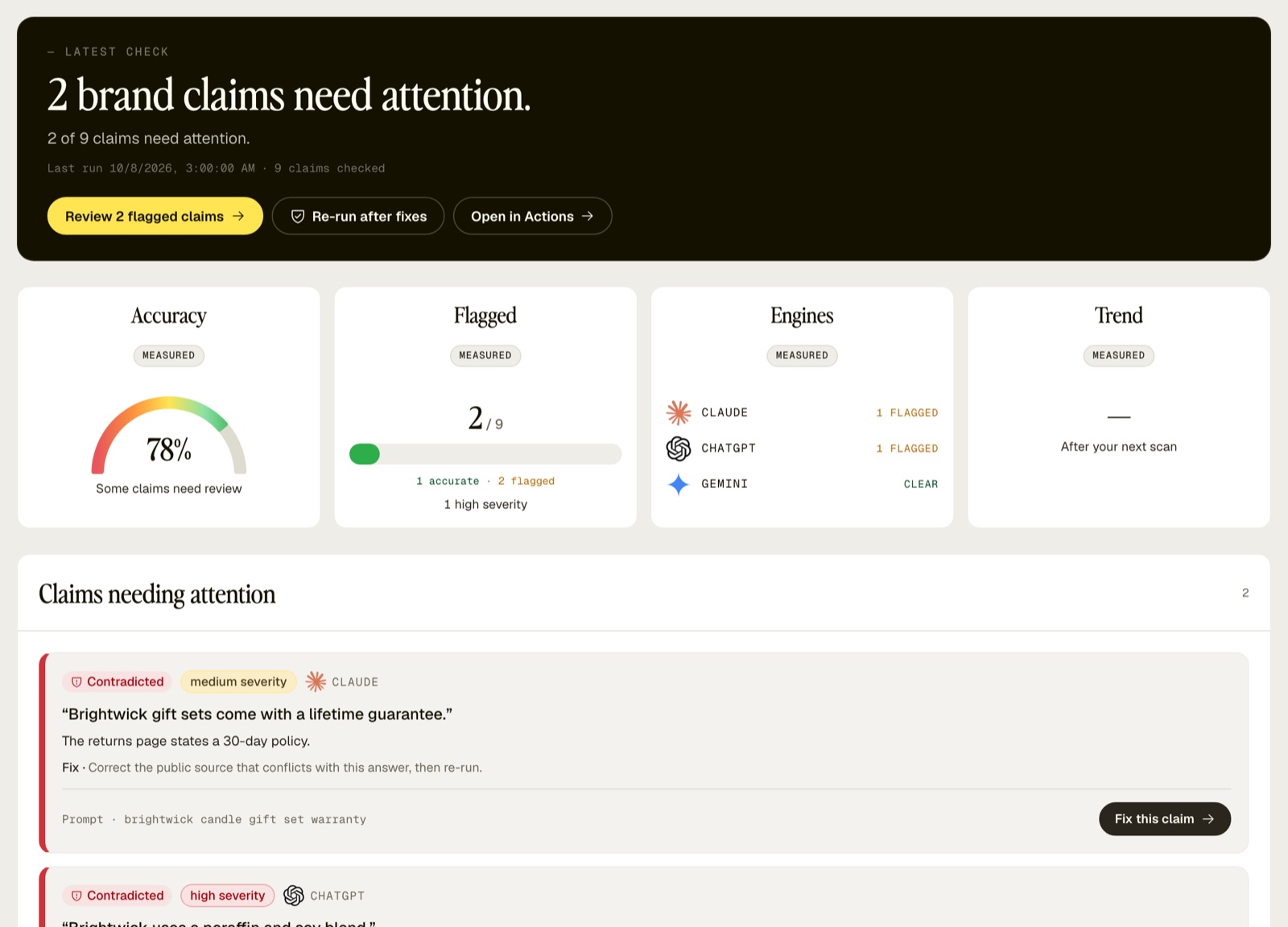
Stride reports mention rate, citation rate, per-answer sentiment, top-pick position, engine coverage and share of voice, with the raw answer kept for each prompt and engine. Scans run weekly on Starter, three times a week on Grow and daily on Scale; the scheduled scans guide has the details. Brand Integrity, on Grow and above, flags false or unsupported claims AI makes about you, explains what evidence is missing, and turns each into an action item.
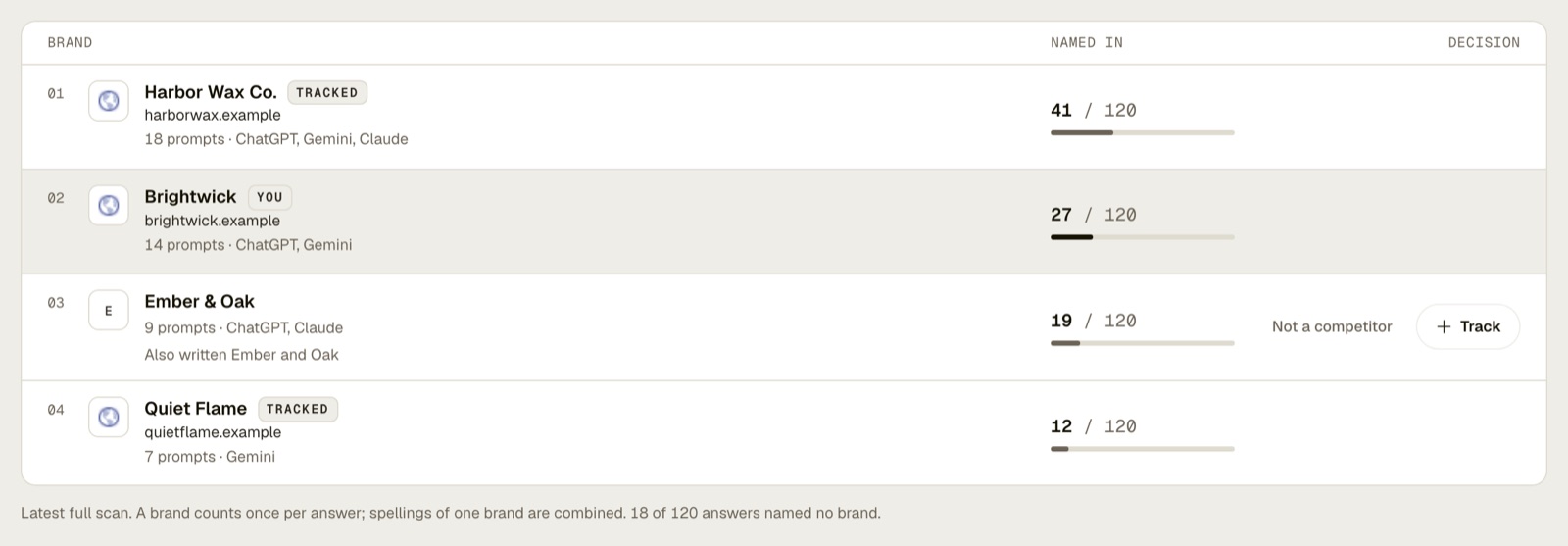
Stride's "Who AI names" leaderboard, shown with sample data.
Limits: fewer prompts per dollar than any monitor above: 25 weekly on ChatGPT only at $99. Sentiment is a per-answer signal, not a dashboard of its own. No public API or MCP. Price: Starter $99, Grow $349 ($279 billed annually), Scale $1,297 a month, per our pricing page.
8. Profound
Best for: enterprise teams that want prompt-volume data behind their monitoring.
Enterprise tracks up to nine engines daily with Prompt Volumes, unlimited seats, SSO and SOC 2. The trial runs 50 prompts daily for seven days on ChatGPT, Gemini and AI Overviews.
Limits: no paid self-serve plan with a listed price. Price: free trial, then custom, per Profound's pricing page as of October 2026.
9. Brandlight
Best for: Fortune 500 brands that need a vendor through security review.
Brandlight sells to large enterprises and global agencies and states SOC 2 Type 2 compliance on its site.
Limits: no published prices or engine list, so you can't evaluate it without a sales call. Price: contact sales, as of October 2026.
How does AI share of voice work?
Share of voice turns counts into position. The basic version:
share of voice = answers featuring your brand ÷ total answers measured
Some tools normalize instead, dividing your appearances by the sum of every tracked brand's appearances so the set adds to 100%.
Worked example: across 40 answers on one engine, you appear in 12, Competitor A in 22, Competitor B in 8. Basic share is 12 ÷ 40 = 30%. Normalized, you hold 12 ÷ 42 = 29% against Competitor A's 52%. The gap to A is the story, not the 30%.
Three choices change the number, so ask every vendor:
- What counts as an appearance. Stride counts an answer as yours if it names or cites you, and counts a competitor only when it's named.
- The sample floor. Stride shows nothing until there are at least 10 measured answers and one tracked competitor. Share over six answers is noise.
- Prompt-set stability. If the prompts change every week, the trend line means little.
Is sentiment the same as accuracy?
No. Sentiment tells you whether an answer is positive, neutral or negative about you. Accuracy tells you whether it's true. An answer can be glowing and still quote last year's price.
Most monitors classify sentiment per answer. Fewer check facts: Peec checks tracked answers against facts you set, and Stride's Brand Integrity flags false or unsupported claims. Read the underlying answers before acting on either.
When is a monitoring-first tool the better choice?
When measurement is the job and someone else owns the response. Peec, Otterly and LLMrefs give more prompts and engines per dollar than Stride, Ahrefs Brand Radar shows market-wide data without a prompt set, and Similarweb adds AI traffic data. If you report AI visibility to leadership, start there.
When is Stride the better choice?
When you want monitoring to lead straight into work. Stride flags inaccurate claims through Brand Integrity, ties every finding to an action item, and checks later scans for the result. Our AI citation tracking guide and GEO tools roundup cover the action side.
Two quick scenarios
A head of brand at a consumer fintech. Leadership wants a weekly AI visibility number and to know when answers turn negative. Peec AI fits: daily sentiment tracking, unlimited viewers, and fact-checked prompts.
A marketing lead at a supplements brand. AI keeps stating an ingredient the product no longer contains. Stride Grow fits: Brand Integrity flags the claim, names the missing evidence, and turns it into an action item.
Frequently asked questions
What is AI visibility monitoring?
AI visibility monitoring is the ongoing measurement of how AI engines answer the questions your buyers ask. A monitor runs a fixed prompt set on each engine on a schedule and records whether you are named, whether your pages are cited, the tone of the answer, and which competitors appear instead.
How is AI share of voice calculated?
Most tools divide the answers that feature your brand by the total answers measured in a prompt set. Stride counts an answer as yours if it names or cites you, counts a competitor only when it is named, and shows nothing until there are at least 10 measured answers and one tracked competitor. Some tools normalize so all tracked brands sum to 100%.
How often should I measure AI visibility?
Weekly at minimum. Advanced Web Ranking tracked 481 sites across ChatGPT, Perplexity and Google AI Overviews and found only 49% of brands stayed visible across three weeks. Daily tracking matters once you are actively changing content or in a fast-moving category.
Can a monitoring tool tell me when AI gets facts about my brand wrong?
Some can. Peec AI checks tracked answers against facts you set about your brand, and Stride's Brand Integrity, on Grow and above, flags false or unsupported claims and explains what source evidence is missing. Most monitors only report sentiment, which is not the same as accuracy.
Which AI visibility monitor is cheapest?
As of October 2026, Otterly Lite is $29 a month for 15 prompts tracked daily on four engines, and LLMrefs is $79 a month for 500 prompts with weekly reports. Peec AI's $95 Starter tracks 50 prompts daily with unlimited users.
Related comparisons
- Tool roundupsAI Citation Tracking: What It Is and 7 Tools
- Tool roundupsThe Best GEO Tools in 2026: 10 Compared
- Head to headStride vs Otterly: Monitor or Act? (2026)
- Head to headStride vs Peec AI: Which Fits Your Team? (2026)
- Alternatives6 Otterly Alternatives for More Engines (2026)
- Tool roundupsAgentic Commerce Readiness Tools: 7 Compared (2026)
How Stride does this: Brand Integrity
Product names are trademarks of their respective owners and are used here only to identify them. Stride is not affiliated with or endorsed by any company named on this page.