
Summary
The right GEO tool depends on one question: do you need to measure AI visibility, or do you need help changing it? For measurement, Peec AI gives the most per dollar at $95 a month, Otterly is the cheapest start at $29, and Trakkr covers eight engines from $100. If you want the tool to hand you the next piece of work, Promptwatch, AthenaHQ and Stride each turn findings into content, and Stride adds GA4 revenue and agent-commerce readiness checks for small teams.
Stride publishes this comparison and is one of the tools in it. Facts about Peec AI, Otterly, Promptwatch, Trakkr, AthenaHQ, Scrunch, Goodie, Ahrefs Brand Radar, Profound come from their own public pricing and product pages, checked on October 10, 2026, and are linked where they appear. Where another tool is the better choice, we say so.
How did we evaluate these tools?
Five criteria, in this order of weight:
- Engines at the tier you'd buy. A long engine list gated behind Enterprise is worth less than three engines you can afford.
- Prompts and cadence per dollar. How many questions are tracked, and how often.
- What happens after measurement. Recommendations, drafted content, technical checks, or nothing.
- Integrations. GA4 for traffic and revenue, Shopify for catalogs, API or MCP for your own reporting.
- A price you can see. A published plan you can start on without a sales call.
We checked every vendor's own pricing page on October 10, 2026. Stride publishes this page and is included on the same terms as everyone else.
How do the 10 GEO tools compare?
| Tool | Best for | Entry plan (Oct 2026) | Engines at entry | Prompts at entry | After measurement |
|---|---|---|---|---|---|
| Peec AI | Measurement depth per dollar | Starter, $95/mo | Choose 3 of 6 | 50, daily | Recommended actions, agent skills |
| Otterly | Cheapest first tool | Lite, $29/mo | 4 (more as add-ons) | 15, daily | Recommendations, GEO audits |
| Promptwatch | Tracking plus content | Essential, $95/mo | 4 | 50 | Agent credits; articles from Professional |
| Trakkr | Engine breadth at entry | Growth, $100/mo | 8 | 50, daily | 25 articles/mo, site optimization |
| Stride | Small teams that want fixes drafted | Starter, $99/mo | ChatGPT | 25, weekly | Action items, 3 drafts a week |
| AthenaHQ | Free start, many engines when paid | Essential free; Starter $295/mo | 5 free; 11 on Starter | 300 credits free | Content optimization agent (Starter) |
| Scrunch | More prompts and seats at entry | Core, $250/mo | 4 | 125 | Page optimizations, basic content |
| Goodie | Revenue attribution with strategist help | Core, $399/mo | 5 | 120 | 50 optimizations/mo |
| Ahrefs Brand Radar | Benchmarking a whole market | Brand Radar AI, from $199/mo | 6 in its index (Claude available) | 470M+ prompt index | None listed |
| Profound | Enterprise programs | Free trial; Enterprise custom | 3 on trial; up to 9 | 50 on trial | AI Marketer agents |
Facts last verified October 10, 2026. Prices and plan limits change often; each vendor's pricing page is linked so you can check today's numbers.
Each vendor's pricing page is linked in its entry below.
Which GEO tools are worth shortlisting?
1. Peec AI
Best for: SEO and marketing teams that want deep measurement at a low price.
Peec's Starter plan tracks 50 prompts daily on three models you choose from ChatGPT, Google AI Mode, AI Overviews, Microsoft Copilot, Gemini and Naver AI. Every plan includes unlimited users. Its source analytics classify each cited domain as competitor, editorial, reference or user-generated, and its gap analysis shows sources that name competitors but not you.
Limits: three models per plan unless you pay for more, and API access and SSO sit on Enterprise. Price: Starter $95, Pro $245, Advanced $495 a month, 15% off annually, per Peec's pricing page as of October 2026.
2. Otterly
Best for: a solo marketer who wants to know if AI mentions them before spending more.
Lite costs $29 a month for 15 prompts tracked daily on ChatGPT, Google AI Overviews, Perplexity and Microsoft Copilot, with unlimited team members. Gemini, AI Mode and Claude are add-ons. Standard adds API, MCP and agent analytics.
Limits: 15 prompts is a test, not a program, and Lite can't buy extra prompts. Price: Lite $29, Standard $189, Premium $489 a month, 15% off annually, per Otterly's pricing page as of October 2026.
3. Promptwatch
Best for: teams that want tracking and content in one tool.
Every plan tracks four models from a list that includes ChatGPT, Perplexity, AI Overviews, AI Mode, Claude, Gemini, Grok and DeepSeek. Professional adds five AEO articles a month and agent analytics. Business adds shopping insights and state and city tracking.
Limits: articles start at Professional, and you get four models per plan. The page's plan bullets and feature matrix disagree on whether API and MCP are live, so confirm before you buy. Price: Essential $95, Professional $245, Business $579 a month, 7-day trial on the first two, per Promptwatch's pricing page as of October 2026.
4. Trakkr
Best for: teams that want every major engine from day one.
Growth tracks one brand daily on eight engines, ChatGPT, Claude, Gemini, Perplexity, AI Overviews, Grok, DeepSeek and Meta AI, with 50 prompts, three seats and 25 articles a month. Scale covers ten brands with unlimited seats, white-label client portals and a REST API.
Limits: 50 prompts per brand on both plans, and the trial needs a card. Price: Growth $100, Scale $500 a month, 14-day trial, per Trakkr's pricing page as of October 2026.
5. Stride
Best for: small marketing teams and ecommerce brands that want findings turned into work.
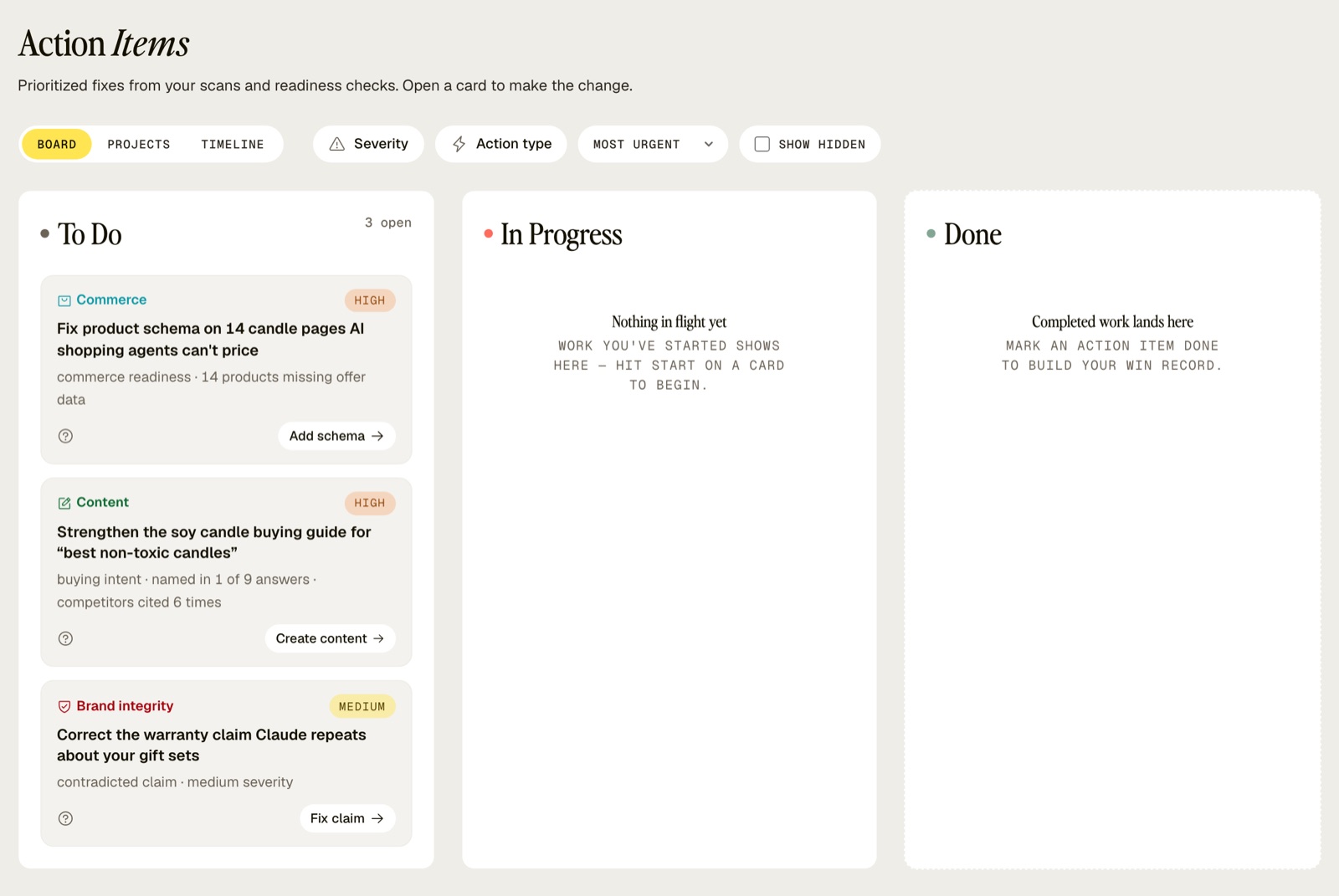
Stride turns every scan finding into an action item on one prioritized board, and drafts the page or edit where the fix is content, grounded in the answers and sources from your own scans. Later scans show whether the prompt moved. The action items and proof guide shows how the loop works.
It reads GA4 to report sessions, conversions and revenue per AI source, and AI Readiness checks your site against agent-commerce protocols such as ACP, UCP and x402. Shopify catalog sync launches with Stride's Shopify App Store listing.
Limits: Starter tracks ChatGPT only, 25 prompts weekly. At most Stride tracks four engines, ChatGPT, Gemini, Claude (beta) and Perplexity, plus Google AI Overviews, and never Copilot or AI Mode. No public API, MCP, SSO or SOC 2. Price: Starter $99, Grow $349 ($279 billed annually), Scale $1,297 a month, 7-day trial with a card, per our pricing page.
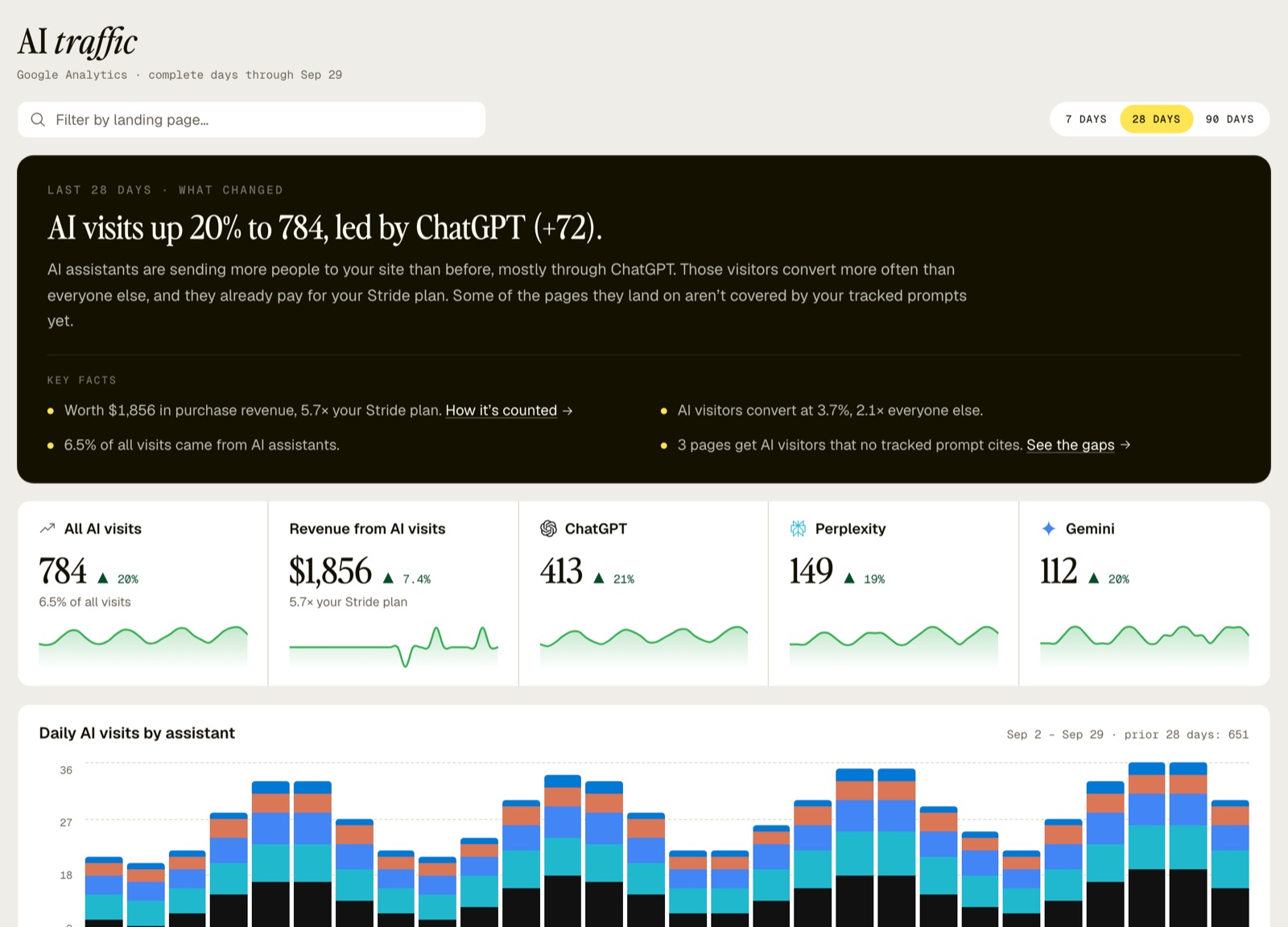
Stride's AI traffic view, shown with sample data.
6. AthenaHQ
Best for: teams that want to start free and pay for engine breadth later.
The free Essential plan includes 300 credits (one credit is one AI response) on ChatGPT, Perplexity, AI Overviews, Gemini and Copilot. Starter at $295 a month adds AI Mode, Claude, Grok, DeepSeek, Meta AI and Mistral for 11 engines, plus Shopify, Webflow, GA4 and Search Console integrations and a content optimization agent.
Limits: credits make monthly volume harder to predict, and its citation engine (ACE) and SAML SSO are Enterprise. Price: Essential free, Starter $295 a month, 17% off annually, per AthenaHQ's pricing page as of October 2026.
7. Scrunch
Best for: teams that need more prompts and seats than an entry plan usually gives.
Core includes 125 prompts, 5,000 responses a month, five users and site audits on ChatGPT, Perplexity, AI Overviews and Copilot. Enterprise expands to nine models and adds AXP, Scrunch's machine-readable version of your site for AI agents, plus API access and SAML SSO.
Limits: four engines on Core, and AXP is Enterprise only. Price: Core $250 a month, 7-day free trial, per Scrunch's pricing page as of October 2026.
8. Goodie
Best for: brands that want revenue attribution and a strategist on call.
Core tracks five engines, ChatGPT, AI Overviews, Perplexity, AI Mode and Copilot, on 120 prompts with five seats, direct revenue attribution and AEO strategist support. Pro adds Gemini, Alexa and Sparky, plus SKU-level agentic commerce visibility.
Limits: the highest self-serve entry price here, and commerce tracking starts at $999. Price: Core $399, Pro $999 a month, 7-day trial on Core, per Goodie's pricing page as of October 2026.
9. Ahrefs Brand Radar
Best for: SEO teams that want to see any brand's AI visibility without building prompts.
Brand Radar runs more than 470 million search-backed prompts through AI Overviews, AI Mode, ChatGPT, Perplexity, Gemini and Copilot, so you can benchmark competitors on day one. Custom prompt packages add your own tracking from $50 a month.
Limits: costs stack on top of an Ahrefs plan, and there's no content workflow listed. Price: Brand Radar AI from $199 a month, per Ahrefs' pricing page as of October 2026.
10. Profound
Best for: enterprise brands that need prompt-volume data, nine engines and a security review.
Enterprise covers up to nine engines including Copilot, AI Mode, Claude and DeepSeek, plus ChatGPT Shopping, Prompt Volumes, an API, SSO and SOC 2. The trial runs 50 prompts daily for seven days on ChatGPT, Gemini and AI Overviews.
Limits: no paid self-serve plan with a listed price. Price: free trial, then custom Enterprise, per Profound's pricing page as of October 2026.
Which tool fits which team?
- You need numbers for leadership and have writers: Peec AI.
- You're testing whether AI visibility matters to you: Otterly Lite or AthenaHQ's free plan.
- Your buyers use Grok, DeepSeek or Meta AI: Trakkr or AthenaHQ Starter.
- Nobody on your team has time to act on a dashboard: Stride or Promptwatch.
- You run a Shopify store: see our GEO tools for Shopify and DTC brands.
- You need SSO, SOC 2 and a procurement process: Profound or Scrunch Enterprise.
When is a measurement-first tool the better choice?
When someone already owns the work that follows. A content lead with a writing team gets more from Peec's source analysis or Ahrefs' prompt index than from drafts. Measurement-first tools also cover more engines and more prompts per dollar, so they suit teams reporting across many markets. Our AI visibility monitoring roundup goes deeper on that side.
When is Stride the better choice?
When the bottleneck is doing the work, not seeing the problem. Stride fits teams that want a prioritized list of fixes with drafts attached, proof from later scans that a fix moved the prompt, and GA4 revenue per AI source to show what AI visits are worth. It also fits online stores that want their site checked against agent-commerce protocols, with no Shopify connection needed.
Two quick scenarios
A marketing lead at a 40-person B2B software company. They report AI visibility monthly and have two content writers. Peec AI Pro fits: 150 prompts daily, unlimited users for stakeholders, and source gaps the writers can act on.
A founder running a Shopify brand with one marketer. Nobody will turn a dashboard into pages. Stride Grow fits: three engines, agent-commerce protocol checks, and action items with drafts, with GA4 showing whether AI visitors buy.
Frequently asked questions
What is a GEO tool?
A GEO (generative engine optimization) tool asks AI engines such as ChatGPT, Gemini and Perplexity the questions your buyers ask, records whether you are named or cited, and tracks that against competitors over time. Some stop at measurement. Others turn findings into recommendations, content drafts or technical fixes.
How much do GEO tools cost in 2026?
As of October 2026, self-serve entry plans run from $29 a month (Otterly Lite, 15 prompts) through $95 (Peec AI and Promptwatch, 50 prompts) and $99 (Stride Starter, 25 prompts) to $250 to $399 (Scrunch, AthenaHQ, Goodie). Profound lists a free trial and custom Enterprise pricing only.
Which GEO tool tracks the most AI engines for the money?
Of the tools here, Trakkr includes eight engines on its $100 Growth plan, and AthenaHQ includes 11 on its $295 Starter plan. Peec AI and Promptwatch let you choose three or four engines per plan. Stride tracks up to four plus Google AI Overviews, and only ChatGPT on Starter.
Do I need a GEO tool if I already do SEO?
SEO tools tell you where your pages rank. A GEO tool tells you whether AI answers name or cite you, which is a different result with different winners. Ahrefs and Semrush now sell AI visibility alongside their SEO plans, which is a sensible start if you already pay for one of them.
Where does Stride fit among GEO tools?
Stride fits small marketing teams and ecommerce brands that want each finding turned into an action item, with content drafted from scan evidence and AI visits tied to GA4 revenue. It tracks fewer engines and fewer prompts per dollar than Peec AI or Trakkr, and has no public API, MCP or SSO.
Related comparisons
- Tool roundupsBest AI Visibility Monitoring Tools in 2026
- Tool roundupsAI Citation Tracking: What It Is and 7 Tools
- Tool roundupsBest GEO Tools for Shopify and DTC Brands (2026)
- Head to headStride vs Peec AI: Which Fits Your Team? (2026)
- Alternatives6 Profound Alternatives With Published Prices (2026)
- Tool roundupsAgentic Commerce Readiness Tools: 7 Compared (2026)
How Stride does this: Action items
Product names are trademarks of their respective owners and are used here only to identify them. Stride is not affiliated with or endorsed by any company named on this page.