
Summary
Agentic commerce readiness has two halves: whether AI shopping agents can read and buy from your store, and whether AI shopping results show your products. Goodie covers both most fully, with SKU tracking across five AI shopping surfaces and feed fixes, from $999 a month billed annually. Peec AI is the budget route to SKU-level AI Shopping tracking from $95, and Stride checks a store's agent-commerce protocols and crawler access on every plan from $99, but doesn't track ChatGPT Shopping.
Stride publishes this comparison and is one of the tools in it. Facts about Goodie, Peec AI, Profound, Trakkr, Scrunch, Brandlight come from their own public pricing and product pages, checked on October 13, 2026, and are linked where they appear. Where another tool is the better choice, we say so.
What does agentic commerce readiness mean?
A shopper asks ChatGPT for a two-person tent under $300. An AI agent reads product pages, compares offers and may complete the checkout itself. Your store can lose that sale at three points:
- Access. AI crawlers are blocked or your product content only loads with JavaScript.
- Data. Prices, stock or attributes in AI answers are wrong or missing.
- Transaction. The agent can't find a supported way to check out or pay.
Shopping visibility tools measure the outcome (which products AI shows). Readiness tools look at the causes. Most stores need some of each.
How did we evaluate these tools?
- Agent-facing checks: protocol discovery, crawler access, machine-readable pages.
- AI shopping tracking: SKU-level results on surfaces such as ChatGPT Shopping.
- Catalog connection: Shopify, CSV or merchant feeds.
- Fixes: whether the tool helps correct what it finds.
- Price of the plan where these features start.
We checked each vendor's own pricing or product page on October 13, 2026. Stride publishes this page and is ranked by fit.
How do the seven tools compare?
| Tool | Where commerce features start (Oct 2026) | Agent-facing checks | AI shopping tracking | Catalog source |
|---|---|---|---|---|
| Goodie | Pro $999/mo billed annually | Feed fixes and schema injection | SKU-level on ChatGPT, Perplexity, AI Mode, Alexa and Walmart's Sparky | Shopify, BigCommerce, feeds |
| Peec AI | Starter $95/mo | Crawlability audit (40+ bots) | SKU visibility, position and win rate | Shopify, CSV or Google Merchant Center |
| Stride | Starter $99/mo | ACP, AP2, UCP, MPP and x402 discovery, crawler access, llms.txt | Not tracked | Shopify sync launching, not open yet |
| Profound | Enterprise, custom | Agent Analytics from server logs | ChatGPT Shopping, SKU and merchant layer | Not described |
| Trakkr | $49 per brand a month add-on | AI crawler optimization | ChatGPT Shopping product cards | Not described |
| Scrunch | Enterprise, custom | Agent Pages for AI agents (Enterprise) | Product observability (Enterprise) | Not described |
| Brandlight | Contact sales | Crawl and indexability tracking | SKUs across retailers and marketplaces | Not described |
Facts last verified October 13, 2026. Prices and plan limits change often; each vendor's pricing page is linked so you can check today's numbers.
Which agentic commerce tools are worth a look?
1. Goodie
Best for: retail and DTC brands that want shopping visibility, fixes and revenue in one tool.
Goodie's Agentic Commerce Suite tracks individual SKUs on ChatGPT, Perplexity, AI Mode, Amazon's Alexa and Walmart's Sparky, including which merchants sell your products and which competitor products appear beside yours. It can push feed fixes, product copy, FAQs and schema to your storefront, and integrates with Shopify and BigCommerce.
Limits: SKU-level commerce starts on Pro, not Core. Price: Pro $999 a month billed annually, per Goodie's pricing page as of October 2026.
2. Peec AI
Best for: stores that want SKU-level AI Shopping tracking at the lowest entry price here.
Peec's AI Shopping feature pulls your catalog from Shopify, a CSV or Google Merchant Center, then reports visibility, position and win rate per product, plus top merchants and the sources AI used. Its plan table lists AI Shopping and a 40-bot crawlability audit from Starter.
Limits: three models per standard plan. It measures shopping results and crawl access but doesn't check commerce protocols. Price: Starter $95 a month, per Peec's pricing page as of October 2026.
3. Stride
Best for: stores that want to know whether agents can read and transact with their site, with the fixes drafted.
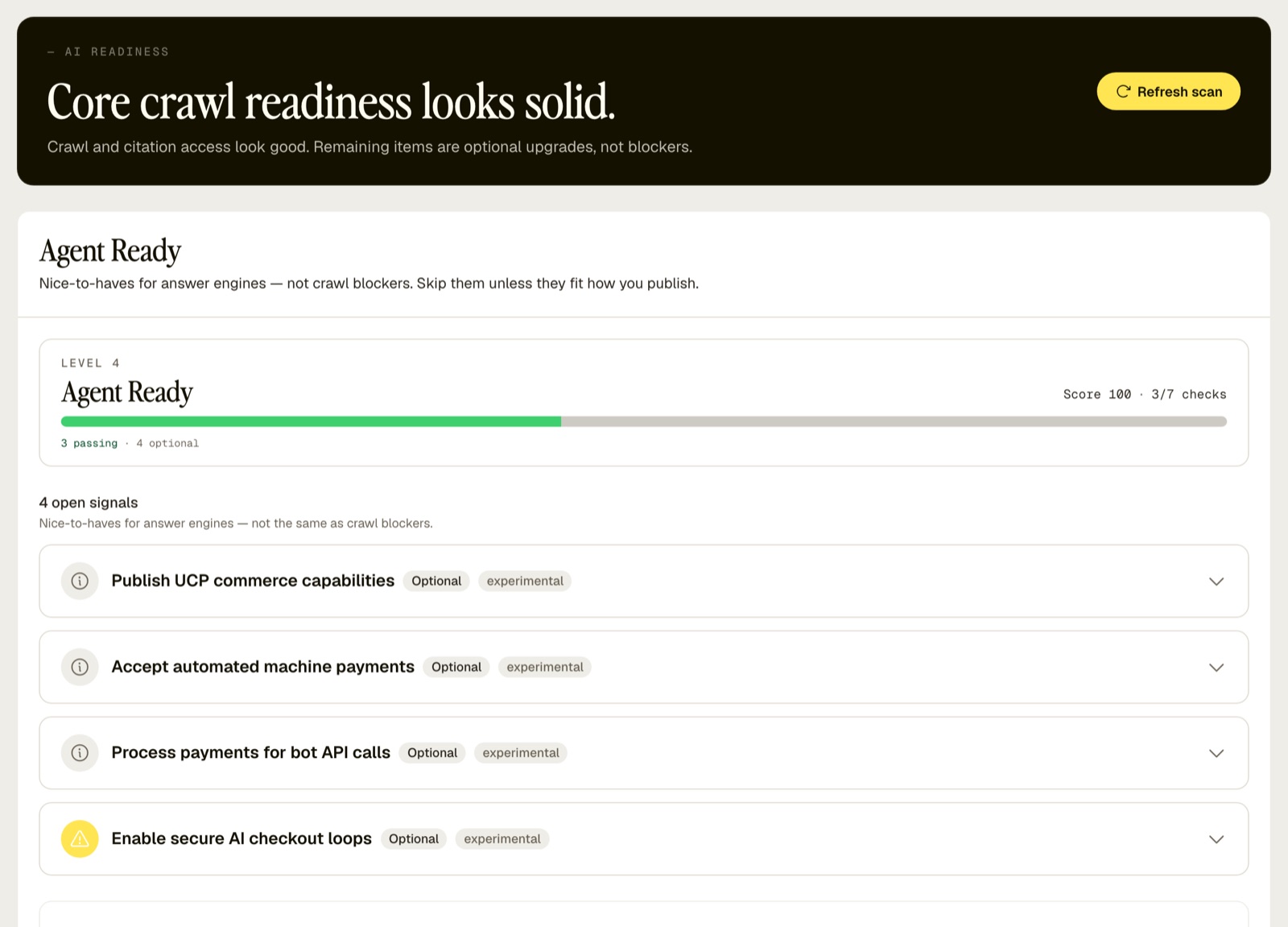
Stride's AI Readiness agent-commerce checks, shown with sample data.
Stride's AI Readiness scan checks robots.txt, sitemaps, llms.txt and whether the bots behind ChatGPT, Perplexity, Claude and AI Overviews can read your pages. It also looks for public signs of ACP, AP2, UCP, MPP and x402, and when it finds one, checks the published profile or HTTP 402 payment challenge is well-formed. On Grow and up, each gap opens as an action item.
Limits: the protocol checks are labelled experimental, read only public metadata, and never place an order or payment. Stride doesn't track ChatGPT Shopping or audit schema, and its Shopify catalog sync isn't open to new customers yet. Price: Starter $99, Grow $349 ($279 billed annually), Scale $1,297 a month, per our pricing page.
4. Profound
Best for: large retailers focused on ChatGPT Shopping.
Profound's Shopping product tracks how often your category triggers ChatGPT's shopping interface, how your SKUs rank and are described, and which retailers own the checkout for your products. It points to the feed fields and structured data to fix.
Limits: ChatGPT Shopping is Enterprise-only; the free trial doesn't include it. Price: free 7-day trial, then custom Enterprise, per Profound's pricing page as of October 2026.
5. Trakkr
Best for: brands that want ChatGPT Shopping tracking added to an eight-engine plan.
Trakkr's Shopping add-on asks ChatGPT your buying questions every day and shows whether your products appear in its product cards, which competitors appear instead and which shops get the buy links.
Limits: ChatGPT only, and charged per brand. Price: $49 per brand a month on top of Growth ($100), first month free, per Trakkr's pricing page as of October 2026.
6. Scrunch
Best for: enterprise sites that want to serve AI agents a separate, optimized version of their pages.
Scrunch's Agent Pages detect agent traffic and deliver optimized content to it, and its Shopping product shows which of your products AI recommends and which retailers get the click.
Limits: Agent Pages (AXP) and product observability are Enterprise-only; Core has agent traffic but not shopping. Price: Core $250 a month, Enterprise custom, per Scrunch's pricing page as of October 2026.
7. Brandlight
Best for: enterprise and multi-brand retailers buying a full AI search suite.
Brandlight's commerce module tracks how AI agents rank and select products across retailers and marketplaces, the queries that trigger shopping results, and competing retailers and reviews.
Limits: no published pricing or self-serve plan. Price: contact sales, per Brandlight's commerce page as of October 2026.
When is another tool the better choice?
If you need to see your products in ChatGPT Shopping, Stride can't show you that: Peec AI is the cheapest way in, and Goodie or Profound go deepest. If you want an agent-ready version of your pages served to AI agents, that's Scrunch Enterprise. Our GEO tools for Shopify and DTC brands roundup covers the wider store-owner view.
When is Stride the better choice?
When you want to know whether agents can get in and pay before you spend on shopping tracking. Stride's readiness scan runs on every plan with no Shopify connection, and on Grow each gap becomes a task with copyable instructions. Our Stride vs Goodie page compares the two for stores.
Two quick scenarios
A Shopify outdoor brand with 400 SKUs. The team wants to know which tents show up in AI shopping results. Peec AI fits: catalog import and SKU tracking from $95.
A DTC brand whose developer is evaluating UCP. They want to confirm the profile is published and readable before announcing it. Stride fits: the readiness scan checks the profile and the crawler access around it.
Frequently asked questions
What is agentic commerce readiness?
It's whether AI shopping agents can find your products, read accurate details about them, and complete a purchase or payment on a buyer's behalf. It has two halves. Readiness is about your site and feeds being readable and transactable by agents; visibility is about whether AI shopping results actually show your products.
What are ACP, AP2, UCP, MPP and x402?
They are emerging protocols for agent commerce. UCP lets a business publish a profile of its commerce services at a well-known address, AP2 adds authorized agent checkout through UCP, and ACP covers merchant feeds and checkout through partner enrollment. MPP and x402 let a site ask a machine client for payment with an HTTP 402 response.
Which tools track products in ChatGPT Shopping?
As of October 2026, Profound (Enterprise), Goodie (Pro and up), Trakkr (a $49 per brand add-on) and Peec AI (AI Shopping, from a Shopify, CSV or Google Merchant Center catalog) list ChatGPT or AI shopping tracking. Stride does not track ChatGPT Shopping today.
Does Stride connect to Shopify?
Stride's Shopify catalog sync and commerce readiness launch with its Shopify App Store listing and aren't open to new customers yet. Its AI Readiness scan, including the agent-commerce protocol checks, works on any store today with no Shopify connection.
Do I need to support every agent-commerce protocol?
No. Most stores need none of them yet, and some, such as x402 and MPP, only apply to resources sold to machine clients per request. Start by making sure AI crawlers can read your product pages and that your product data is accurate, then add a protocol when a channel you sell through requires it.
Related comparisons
- Tool roundupsBest GEO Tools for Shopify and DTC Brands (2026)
- Head to headStride vs Goodie: Which Fits Your Budget? (2026)
- Head to headStride vs Scrunch: Which Fits Your Brand? (2026)
- Head to headStride vs Brandlight: Which Fits Your Company? (2026)
- Head to headStride vs Peec AI: Which Fits Your Team? (2026)
- Tool roundupsAI Brand Accuracy Monitoring Tools: 7 Compared (2026)
How Stride does this: AI readiness
Product names are trademarks of their respective owners and are used here only to identify them. Stride is not affiliated with or endorsed by any company named on this page.