
Summary
Most GEO tools treat a store like any other website. For a Shopify or DTC brand, the shortlist is the tools that understand products: Peec AI tracks AI visibility per SKU from $95 a month, Trakkr adds ChatGPT Shopping tracking for $49 a brand, and Stride checks your store against agent-commerce protocols and ties AI visits to GA4 revenue. Goodie and Profound cover agentic commerce and ChatGPT Shopping at higher price points.
Stride publishes this comparison and is one of the tools in it. Facts about Peec AI, Trakkr, AthenaHQ, Goodie, Promptwatch, Profound, Otterly come from their own public pricing and product pages, checked on October 10, 2026, and are linked where they appear. Where another tool is the better choice, we say so.
How did we evaluate these tools for ecommerce?
Five criteria, weighted for a store with a lean team:
- Product-level visibility. Does the tool tell you which SKUs AI recommends, not only whether it names your brand?
- ChatGPT Shopping coverage. Is the product-card surface tracked, separately from conversational answers?
- Catalog readiness. Does it check whether AI shopping agents can read your product data, offers and policies?
- Revenue. Can it connect AI visits to conversions and revenue?
- Price a store can start on. A published plan without a sales cycle.
No tool wins all five. We checked each vendor's own pricing page on October 10, 2026. Stride publishes this page and is ranked by fit, not first by default.
How do the eight tools compare for Shopify stores?
| Tool | Entry price (Oct 2026) | Product-level tracking | ChatGPT Shopping | Shopify connection | Traffic and revenue |
|---|---|---|---|---|---|
| Peec AI | $95/mo | SKU visibility, position, win rate | Not stated on pricing page | Catalog import (Shopify, CSV, Merchant Center) | AI referrals; Google Analytics integration |
| Trakkr | $100/mo | Via Shopping add-on | Add-on, $49/brand/mo | Not stated on pricing page | Not stated on pricing page |
| AthenaHQ | Free; Starter $295/mo | Not stated on pricing page | Not stated on pricing page | Shopify integration (Starter) | GA4 integration (Starter) |
| Stride | $99/mo | Not today; per-product readiness launches with Stride's Shopify App Store listing | Not tracked | Launching with Stride's Shopify App Store listing | GA4 sessions, conversions, revenue per AI source |
| Goodie | $399/mo; commerce from Pro, $999/mo | SKU-level agentic commerce (Pro) | Not stated on pricing page | Not stated on pricing page | Direct revenue attribution |
| Promptwatch | $95/mo; shopping from Business, $579/mo | Shopping insights (Business) | Not stated on pricing page | Not stated on pricing page | Conversion tracking listed |
| Profound | Free trial; Enterprise custom | Through ChatGPT Shopping | Enterprise | Not stated on pricing page | Agent Analytics, incl. AI visitors who convert |
| Otterly | $29/mo | No | No | No | No |
Facts last verified October 10, 2026. Prices and plan limits change often; each vendor's pricing page is linked so you can check today's numbers.
"Not stated on pricing page" means we couldn't confirm it on the vendor's own pricing page today, not that the feature is missing. Ask the vendor before you rule it out.
Which tools fit a Shopify or DTC brand?
1. Peec AI
Best for: stores that want to know which products AI recommends, at the lowest price.
Peec's AI Shopping features pull your catalog from Shopify, a CSV or Google Merchant Center and track visibility, position and win rate for each product, alongside brand-level metrics. It also shows which domains AI retrieved when it recommended a product, which tells you where to earn coverage. Peec's documentation covers catalog upload and shopping prompts.
Limits: Peec measures; it doesn't check whether your product data is readable by AI agents, and its pricing page doesn't list ChatGPT Shopping. Price: Starter $95, Pro $245, Advanced $495 a month, unlimited users, per Peec's pricing page as of October 2026.
2. Trakkr
Best for: stores whose buyers shop inside ChatGPT.
Trakkr's Shopping add-on asks ChatGPT your buying questions daily and shows whether your products appear in its product cards, which competitors appear instead, and which shops get the buy links. The base Growth plan tracks eight engines on 50 prompts with three seats.
Limits: the shopping view is an add-on, and the pricing page doesn't mention a Shopify connection. Price: Growth $100 a month plus $49 per brand for Shopping, 14-day trial with a card, per Trakkr's pricing page as of October 2026.
3. AthenaHQ
Best for: stores that want Shopify and GA4 connected to a wide engine list.
AthenaHQ's Starter plan includes Shopify, Webflow, GA4 and Search Console integrations, 11 engines and a content optimization agent, on 3,600 credits a month. The free Essential plan lets you test five engines first.
Limits: the pricing page doesn't describe product-level tracking, and credits make volume harder to plan. Price: Essential free, Starter $295 a month, per AthenaHQ's pricing page as of October 2026.
4. Stride
Best for: lean teams that want agent-commerce gaps fixed and AI revenue proven in GA4.
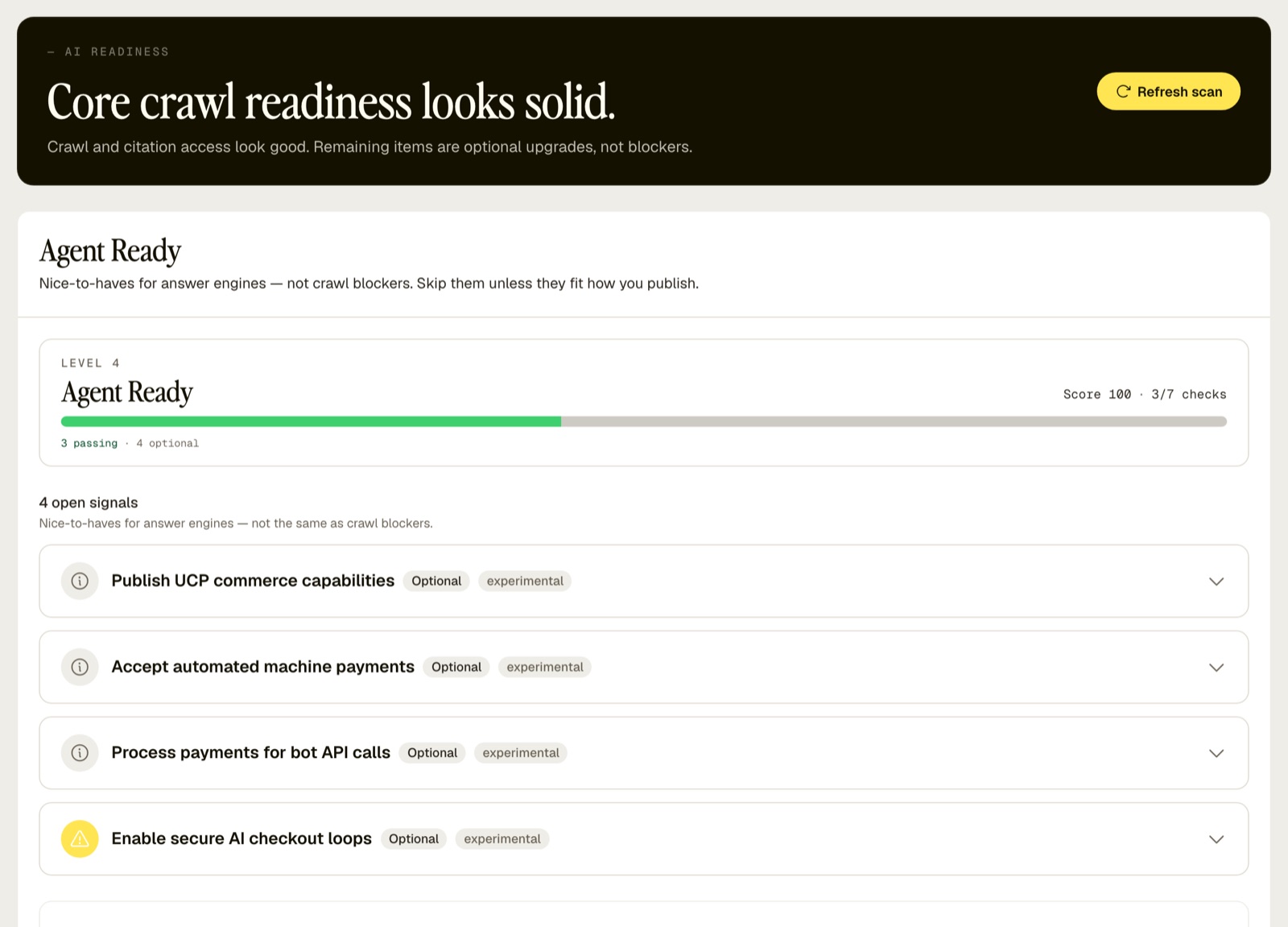
Stride's AI Readiness crawls your store and checks it against agent-commerce protocols: ACP, AP2/UCP, MPP, UCP and x402. It needs no Shopify connection. Every gap becomes an action item, with a draft where the fix is content.
Stride's AI traffic view reads GA4 and reports sessions, conversions and revenue for each AI source, so you can see whether ChatGPT visitors buy.
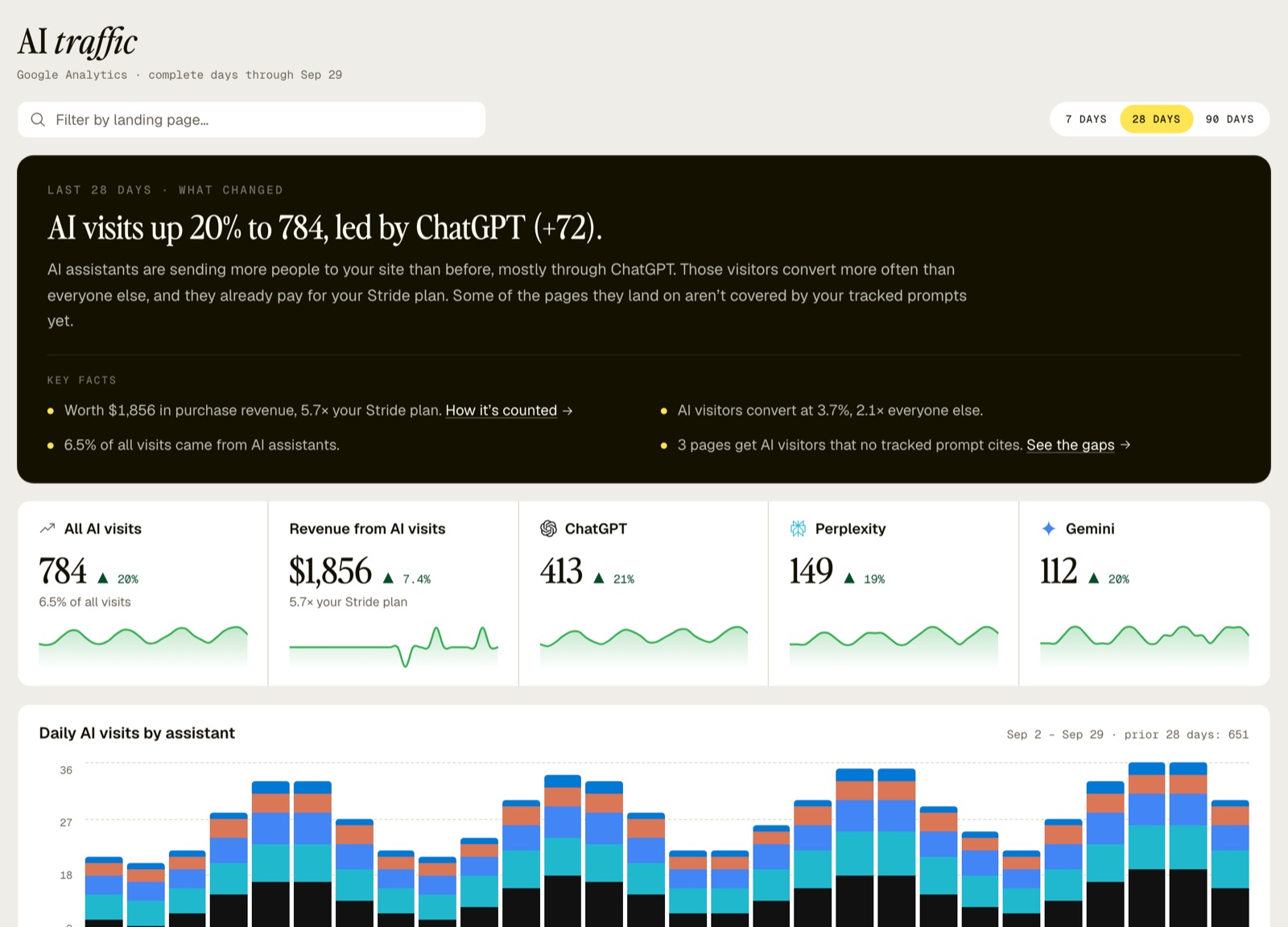
Stride's AI traffic view, shown with sample data.
Stride's Shopify catalog sync and commerce readiness, which grade product data, offer schema, shopper prompts and policy content for each product, launch with its Shopify App Store listing. The Shopify integration guide explains what changes then.
Limits: no product-level data today, because the catalog sync isn't open to new stores yet. No ChatGPT Shopping tracking and no SKU-level visibility scores, and Starter tracks ChatGPT only. Revenue comes from GA4, not Shopify orders, and there's no WooCommerce sync. Price: Starter $99, Grow $349 ($279 billed annually), Scale $1,297 a month, 7-day trial with a card, per our pricing page.
5. Goodie
Best for: larger brands that sell through AI assistants such as Alexa.
Goodie's Pro plan lists SKU-level agentic commerce visibility across five or more models, on eight tracked engines including Alexa and Sparky, with direct revenue attribution on every plan.
Limits: commerce tracking starts at $999 a month. Price: Core $399, Pro $999 a month, per Goodie's pricing page as of October 2026.
6. Promptwatch
Best for: brands that want shopping data alongside tracking and content.
Promptwatch's Business plan adds shopping insights and Ads Radar to 350 prompts and ten AEO articles a month.
Limits: shopping data starts on Business. Price: Essential $95, Professional $245, Business $579 a month, per Promptwatch's pricing page as of October 2026.
7. Profound
Best for: enterprise retailers with a procurement process.
Profound's Enterprise plan includes ChatGPT Shopping, up to nine engines, Prompt Volumes and SSO. Its Agent Analytics reads CDN and server logs, with Shopify and Adobe among its listed sources.
Limits: ChatGPT Shopping isn't in the trial, and Enterprise pricing isn't published. Price: free trial, then custom, per Profound's pricing page as of October 2026.
8. Otterly
Best for: a store that first wants to know if AI mentions it at all.
Otterly has no ecommerce features listed, and at $29 a month that's fine. Lite tracks 15 prompts daily on ChatGPT, AI Overviews, Perplexity and Copilot. Start here, confirm the problem, then move to a product-aware tool. Price: Lite $29 a month, per Otterly's pricing page as of October 2026.
Why does ecommerce need its own GEO tool list?
Because AI shopping answers recommend products, not brands. A store can be named in a category answer and still lose the sale if the assistant can't read its prices, stock or return policy.
The money is real. Adobe found that AI referrals to US retail sites converted 31% more than other traffic during the 2025 holiday season, and revenue per AI visit rose 254%.
What should a Shopify brand do first?
Match the tool to your bottleneck:
- "We don't know where we stand." Start with Otterly Lite.
- "AI recommends competitors' products." Peec AI for SKU visibility, or AthenaHQ to update product content in Shopify.
- "We don't know if AI shopping agents can buy from us." Stride's agent-commerce protocol checks.
- "Our buyers shop in ChatGPT." Trakkr's Shopping add-on, or Profound if you're enterprise.
- "We need to prove revenue." Stride or AthenaHQ with GA4 connected, or Goodie.
When is another tool the better choice?
If you want product-by-product visibility scores, Peec AI does it for less than any tool here. If you want a tool that reads your Shopify catalog today, Peec and AthenaHQ connect now, and Stride's catalog sync launches with its Shopify App Store listing. If ChatGPT Shopping placement is the question, Trakkr or Profound answers it and Stride doesn't. If you need eight or more engines, AthenaHQ, Trakkr and Goodie all cover more than Stride's four plus AI Overviews.
When is Stride the better choice?
When you need to know whether AI shopping agents can read and buy from your store, and nobody on the team has time to fix what they can't. Stride checks your site against agent-commerce protocols, drafts the fix, and shows in GA4 whether AI visitors bought. Product-by-product grading follows when its Shopify App Store listing opens. Our Stride vs Peec AI comparison covers that trade-off in detail.
Two quick scenarios
A two-person team running a Shopify skincare brand. Their products are missing from AI answers and nobody writes product content full time. Stride Grow fits: agent-commerce protocol checks and drafted fixes today, GA4 revenue per AI source, and catalog readiness once Stride's Shopify App Store listing opens.
An ecommerce manager at a 500-SKU outdoor brand. They have a content team and need to know which products ChatGPT recommends against which rivals. Peec AI Pro, plus Trakkr's Shopping add-on for the product cards, fits better.
Frequently asked questions
Do AI assistants send ecommerce stores traffic that converts?
Yes. Adobe found that AI referrals to US retail sites converted 31% more than other traffic during the 2025 holiday season, and revenue per AI visit rose 254%. Volumes are still smaller than search, but the visitor arrives already advised.
Which GEO tools track ChatGPT Shopping?
As of October 2026, Trakkr sells a ChatGPT Shopping add-on for $49 per brand a month that shows whether your products appear in ChatGPT's product cards, and Profound includes ChatGPT Shopping on Enterprise. Stride does not track ChatGPT Shopping.
Which GEO tools track AI visibility per product?
Peec AI tracks visibility, position and win rate per product from a catalog pulled from Shopify, a CSV or Google Merchant Center. Goodie lists SKU-level agentic commerce visibility on its $999 Pro plan, and Promptwatch lists shopping insights on its $579 Business plan.
What should a Shopify store look for in a GEO tool?
A tool that reads your catalog rather than only crawling the storefront, reports at product level, and turns gaps into store-specific fixes. Then decide whether you need ChatGPT Shopping tracking, agent-commerce readiness checks or revenue per AI source, because no tool here does all three.
Can a GEO tool show which AI engine drives revenue?
Partly. Stride reads GA4 and reports sessions, conversions and revenue per AI source. AthenaHQ integrates GA4 on Starter, and Goodie lists direct revenue attribution. Stride does not read Shopify orders, so its figures are as good as your GA4 ecommerce tracking.
Related comparisons
- Tool roundupsThe Best GEO Tools in 2026: 10 Compared
- Head to headStride vs Peec AI: Which Fits Your Team? (2026)
- Head to headStride vs AthenaHQ: Where They Differ (2026)
- Head to headStride vs Profound: Enterprise or Self-Serve? (2026)
- Tool roundupsAI Citation Tracking: What It Is and 7 Tools
- Tool roundupsAgentic Commerce Readiness Tools: 7 Compared (2026)
How Stride does this: AI Readiness
Product names are trademarks of their respective owners and are used here only to identify them. Stride is not affiliated with or endorsed by any company named on this page.