
Summary
Semrush™, now part of Adobe, is the better buy for SEO teams that already work in its tools: $99 a month tracks 25 prompts daily on four AI engines, and its prompt research adds search volume, difficulty and intent. Stride fits small marketing teams and online stores that want each finding turned into a drafted fix, with AI visits tied to revenue in GA4. If keyword research and rank tracking are your daily work, a Semrush bundle is the better value; if nobody has time to act on another report, look at Stride.
Stride publishes this comparison and is one of the tools in it. Facts about Semrush come from its own public pricing and product pages, checked on October 12, 2026, and are linked where they appear. Where another tool is the better choice, we say so.
How do Stride and Semrush compare at a glance?
| Stride | Semrush AI Visibility Toolkit | |
|---|---|---|
| Entry AI plan | Starter, $99/mo | $99/mo per domain, shown billed annually |
| Prompts and frequency at entry | 25 prompts, weekly | 25 prompts, daily |
| AI engines at entry | ChatGPT | ChatGPT, Google AI, Gemini, Perplexity |
| Most engines on a self-serve plan | ChatGPT, Gemini, Claude (beta), Perplexity, plus Google AI Overviews (Scale) | Same four, listed "& more" on its bundle page |
| SEO and AI bundles | None; Stride covers AI search only | Starter $199 (50 prompts), Pro+ $299 (100), Advanced $549 (200) a month |
| Prompt research with volume data | No; prompt suggestions come from your scans and Search Console | Volume, difficulty and intent |
| Team users | 2, 3 or 5 seats by plan; unlimited on Agency | Each extra toolkit user needs a $99 license; extra Semrush users from $45/mo |
| Drafts content from findings | Yes, every plan (3 a week on Starter, 25 or 100 a month on Grow and Scale) | AI-generated recommendations; content optimization on Pro+ |
| AI traffic and revenue | GA4 sessions, conversions and revenue per AI source | Not listed on its AI pricing page |
| AI site checks | AI Readiness, including agent-commerce protocol checks | AI Search Site Audit, up to 100 pages on the toolkit |
| API, MCP | None | MCP from the Starter bundle; API on Advanced and Enterprise |
| Free option | Free audit, no account; 7-day trial, card required | Free plan with limited AI reports; no trial on the standalone toolkit |
Facts last verified October 12, 2026. Prices and plan limits change often; each vendor's pricing page is linked so you can check today's numbers.
Semrush's figures come from its AI pricing page, its SEO and AI plans page and its AI Visibility Toolkit knowledge base article. Stride's come from our pricing page.
What does each tool do with what it finds?
Semrush's toolkit is built around research. Visibility Overview scores your AI mentions against the median of your top competitors. Competitor Research finds prompts where rivals are cited and you aren't. Prompt Research works like keyword research for AI prompts, and Brand Performance reports share of voice, sentiment and the narratives AI repeats about you, with AI-generated recommendations.
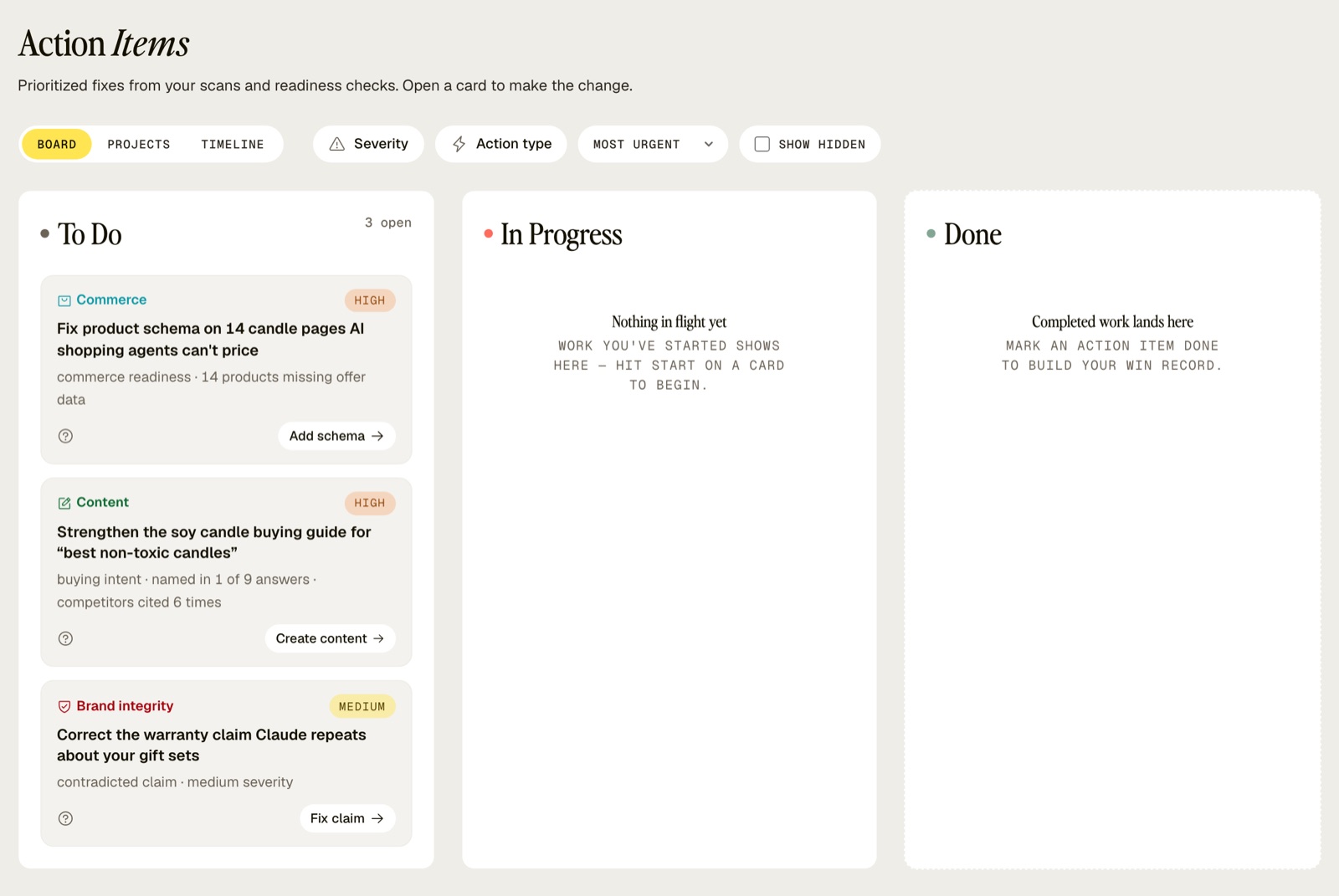
Stride spends its effort on the step after. Every scan finding becomes an action item, and for content gaps Stride drafts the page or the edit, grounded in the answers and sources from your own scans. When you publish, later scans show whether the prompt moved.
If your team already writes and ships content from research, Semrush's reports feed that process well. If nobody owns that work, Stride closes more of the loop. The action items feature shows how it works.
Which tracks more AI engines?
Semrush, at entry. Its $99 toolkit covers ChatGPT, Google AI, Gemini and Perplexity, with prompt tracking in more than 220 countries and territories and Brand Performance across more than 68,000 locations, according to its knowledge base. For a brand selling in many markets, that reach matters.
Stride's Starter plan tracks ChatGPT only. Grow adds Gemini and Claude (still in beta), plus Google AI Overviews on the first 15 prompts you add. Scale adds Perplexity and full AI Overviews. Stride doesn't track Copilot, Google AI Mode, Meta AI or DeepSeek.
Stride does run every tracked prompt on Claude from Grow up. Semrush's AI pages don't list Claude by name today, so if Claude matters to your buyers, check before you choose.
What does a team like mine actually pay?
For a team that wants SEO and AI tracking in one subscription, Semrush's Starter bundle is $199 a month, or $165.17 billed annually. It includes 50 daily prompts, five websites and 500 keywords tracked daily. Pro+ at $299 doubles the prompts to 100 and adds historical SEO data and content optimization.
Stride's closest plan is Grow at $349 a month, or $279 billed annually: 50 prompts scanned three times a week on ChatGPT, Gemini and Claude (beta), three seats, and 25 content drafts a month. It includes no keyword rank tracking or backlink data.
So Semrush costs less and covers SEO too. Stride's price includes production, which matters only if you would otherwise pay a writer or an agency to turn findings into pages. Semrush takes up to 17% off for annual billing; Stride takes 20% off Grow and Scale.
Do I need an SEO suite as well?
Most teams do, and that is Semrush's strongest argument. Keyword data, backlinks and site health still shape which of your pages AI engines can find and cite. Buying both from one vendor keeps the data in one place and on one invoice.
Stride doesn't try to replace an SEO suite. It connects to Google Search Console to surface demand you aren't tracking yet and to GA4 to report what AI visitors do on your site. Teams that already pay for an SEO tool can add Stride for the AI side without changing their stack. If that tool is Ahrefs, our Stride vs Ahrefs Brand Radar page covers its AI add-on.
When is Semrush the better choice?
- You already use Semrush for SEO and want AI visibility in the same account.
- You want prompt research with volume, difficulty and intent before you choose what to track.
- You want daily tracking on four engines for $99 a month.
- You track brands across many countries or cities.
- You need MCP or API access, which Stride does not offer.
When is Stride the better choice?
- You want findings turned into drafted content, not another report to act on.
- You need to show what AI visits are worth. Stride's AI traffic view reads GA4 conversions and revenue for each AI source.
- You sell online and want your store checked against agent-commerce protocols such as ACP, UCP and x402.
- You want Brand Integrity, on Grow and up, to flag false claims AI makes about you and route the fix into your action items.
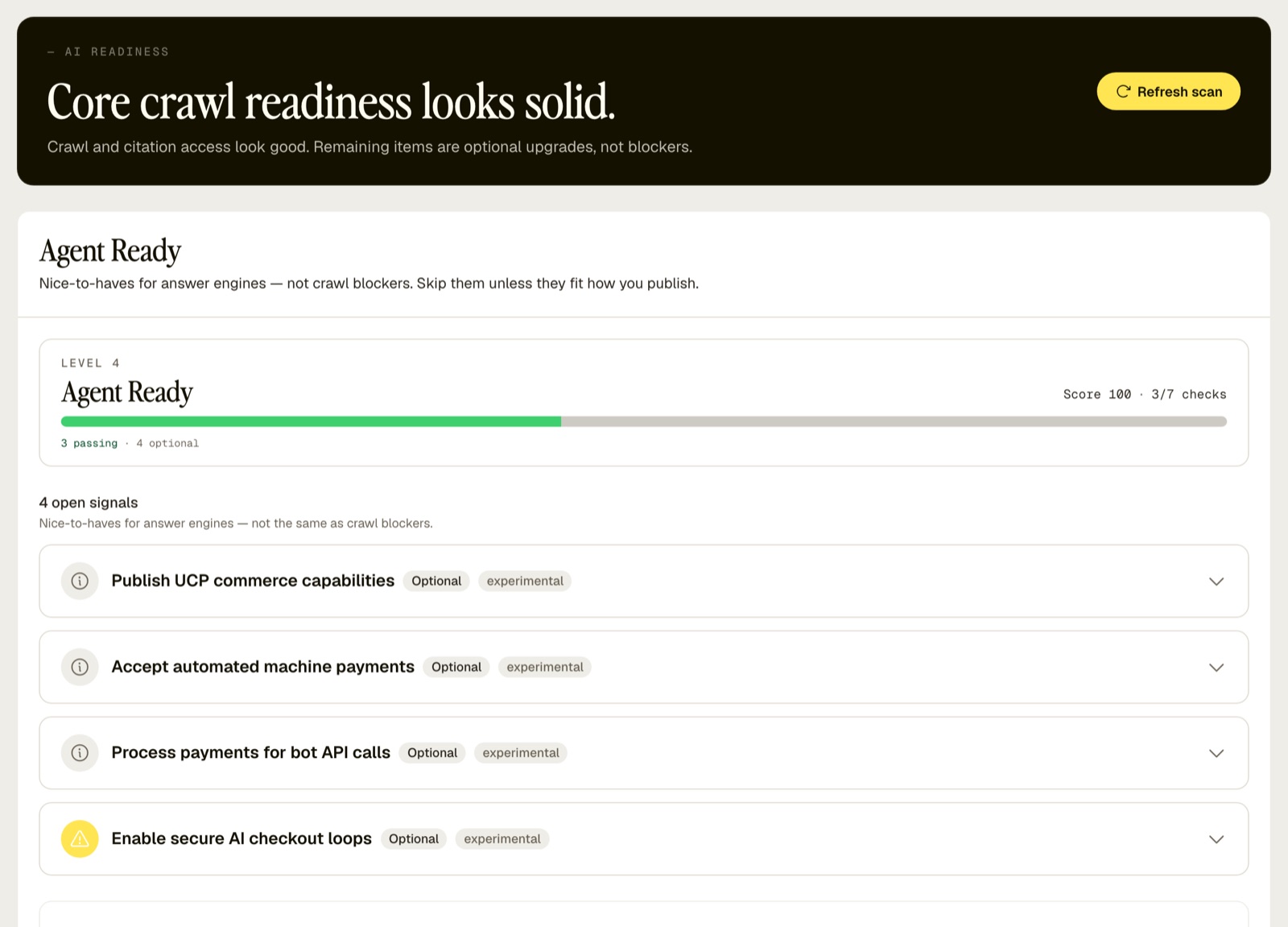
Stride's AI Readiness agent-commerce checks, shown with sample data.
Stride has limits to weigh. Starter scans weekly on one engine, and there is no API, MCP, SSO or SOC 2, so it won't pass a security review that requires them.
Two quick scenarios
An in-house SEO manager at a software company. They already run keyword research and rank tracking in Semrush and need to report AI visibility next quarter. Semrush fits: the Starter bundle adds 50 daily prompts to the tool they know, and prompt research shows which questions are worth tracking.
A three-person team running a home goods store. Nobody has time to turn research into pages, and the owner wants to know whether AI visitors buy. Stride fits: each gap becomes an action item with a draft, AI Readiness checks whether shopping agents can read the store, and GA4 shows revenue from AI visits. Our Semrush AI toolkit alternatives page covers other options.
Frequently asked questions
Is Semrush's AI Visibility Toolkit or Stride cheaper?
Both start at $99 a month. Semrush's toolkit tracks 25 prompts daily on ChatGPT, Google AI, Gemini and Perplexity, priced per domain and shown billed annually on its AI pricing page. Stride Starter tracks 25 prompts weekly on ChatGPT, with two seats and three content drafts a week.
Which tracks more AI engines, Semrush or Stride?
Semrush, at entry. Its AI pricing page lists ChatGPT, Google AI, Gemini and Perplexity on the $99 toolkit. Stride Starter tracks ChatGPT only; Grow adds Gemini, Claude (beta) and Google AI Overviews, and Scale adds Perplexity. Stride does not track Copilot or Google AI Mode.
Do I need a Semrush SEO plan to use its AI toolkit?
No. Semrush sells the AI Visibility Toolkit on its own at $99 a month per domain, and its SEO and AI bundles combine its SEO tools with 50 to 200 daily prompts from $199 a month. Stride covers AI search only and connects to Google Search Console and GA4 on every plan.
Can Semrush or Stride draft the fix?
Semrush's Brand Performance report gives AI-generated recommendations, and its Pro+ bundle adds content optimization. Stride turns each scan finding into an action item and drafts content for gaps, with 3 drafts a week on Starter, 25 a month on Grow and 100 a month on Scale.
Can I try both before paying?
Semrush has a free plan with limited AI visibility reports and a 7-day trial on its Starter and Pro+ bundles; its knowledge base lists no trial for the standalone AI toolkit. Stride has a free audit that needs no account and a 7-day free trial on Starter, Grow and Scale, which requires a card.
Related comparisons
- AlternativesAI Visibility Tools for SEO Teams: 6 Compared (2026)
- Head to headStride vs Ahrefs Brand Radar: Which to Pick? (2026)
- Head to headStride vs HubSpot AEO: Which Fits Your Team? (2026)
- Head to headStride vs Peec AI: Which Fits Your Team? (2026)
- Tool roundupsThe Best GEO Tools in 2026: 10 Compared
- Tool roundupsAI Visibility Tools Under $100 a Month (2026)
How Stride does this: Action items
Product names are trademarks of their respective owners and are used here only to identify them. Stride is not affiliated with or endorsed by any company named on this page.