
Summary
AthenaHQ and Stride overlap more than most pairs in this category: both draft content, connect to GA4 and sell to agencies. AthenaHQ is the better fit if you want a free plan, 11 engines, a Shopify integration you can connect today and content published straight to your CMS, and the $295 Starter plan is generous for that. Stride fits ecommerce teams who want revenue per AI source, a check on whether AI shopping agents can read and buy from the store, and a $99 starting point.
Stride publishes this comparison and is one of the tools in it. Facts about AthenaHQ come from its own public pricing and product pages, checked on October 10, 2026, and are linked where they appear. Where another tool is the better choice, we say so.
How do Stride and AthenaHQ compare at a glance?
| Stride | AthenaHQ | |
|---|---|---|
| Free option | Free audit, no account; 7-day trial, card required | Essential plan, free: 300 credits plus $25 credit |
| First paid plan | Starter, $99/mo | Starter, $295/mo |
| How usage is measured | Fixed prompts and scan frequency per plan | Credits: 1 credit = 1 AI response; Starter includes 3,600 a month |
| AI engines | Up to 4 (ChatGPT, Gemini, Claude beta, Perplexity) plus Google AI Overviews; Starter is ChatGPT only | Free: 5. Starter: 11, incl. AI Mode, Copilot, Grok, DeepSeek, Meta AI, Mistral |
| Team users | 2, 3 or 5 seats by plan; unlimited on Agency | Unlimited on every plan |
| Content | Drafts from scan evidence (3 drafts a week on Starter, 25 or 100 a month on Grow and Scale) | Content optimization agent; publishes to Shopify, WordPress, Webflow, Framer and more |
| GA4 | Sessions, conversions and revenue per AI source | Traffic, engagement and conversions next to AI results (Starter and up) |
| Shopify | Catalog sync and commerce readiness launch with Stride's Shopify App Store listing | Publishes to store blog; updates product titles, descriptions, metadata, FAQs |
| Agent-commerce protocol checks | ACP, AP2/UCP, MPP, UCP, x402 | Not listed on its pricing page |
| Checks AI's claims about you | Brand Integrity (Grow and up) | Claim review and discrepancy detection (Enterprise) |
| API, MCP, SSO | None | API add-on; MCP; SSO on Enterprise |
Facts last verified October 10, 2026. Prices and plan limits change often; each vendor's pricing page is linked so you can check today's numbers.
AthenaHQ's figures come from its pricing page and integrations page. Stride's come from our pricing page.
Where do they overlap?
More than you'd expect. Both track brand mentions, citations and sentiment across AI engines. Both turn findings into content work. Both connect to Google Analytics 4, and both run an agency program.
So skip the feature checklist and look at where they split.
How do credits compare to Stride's fixed plans?
AthenaHQ sells credits, where one credit is one AI response. Starter's 3,600 credits a month could run 30 prompts on four engines every day, or a wider set of prompts less often across all 11 engines. You choose the mix.
Stride sells a fixed allowance. Grow, at $349 a month or $279 billed annually, scans 50 prompts on ChatGPT, Gemini and Claude three times a week, plus Google AI Overviews on the first 15 prompts you add. That's roughly 1,950 engine answers a month, fewer than AthenaHQ's 3,600, with a cadence you don't have to manage.
On raw measurement per dollar, AthenaHQ Starter is a better deal than Stride Grow. Stride's lower floor is Starter at $99, which buys 25 prompts weekly on ChatGPT only. AthenaHQ's floor is free.
Which tracks more AI engines?
AthenaHQ. Its free Essential plan covers ChatGPT, Perplexity, Google AI Overviews, Gemini and Copilot. Starter adds Google AI Mode, Claude, Grok, DeepSeek, Meta AI and Mistral, for 11 in total.
Stride's Starter plan tracks ChatGPT only. Grow adds Gemini and Claude (still in beta), plus AI Overviews on the first 15 prompts you add. Scale adds Perplexity and full AI Overviews. Stride doesn't track Copilot, AI Mode, Grok, Meta AI or DeepSeek.
What does each do with a Shopify store?
This is the clearest split, and today it favours AthenaHQ. AthenaHQ's Shopify integration writes to your store: it publishes to the store blog and updates product titles, descriptions, metadata and FAQs. Its homepage says the integration also attributes revenue to AI search. If you want optimized content to land in Shopify without copy-paste, AthenaHQ does that and Stride doesn't.
Stride's Shopify catalog sync and commerce readiness, which grade each product for AI shopping agents, launch with its Shopify App Store listing. A new store can't connect them yet.
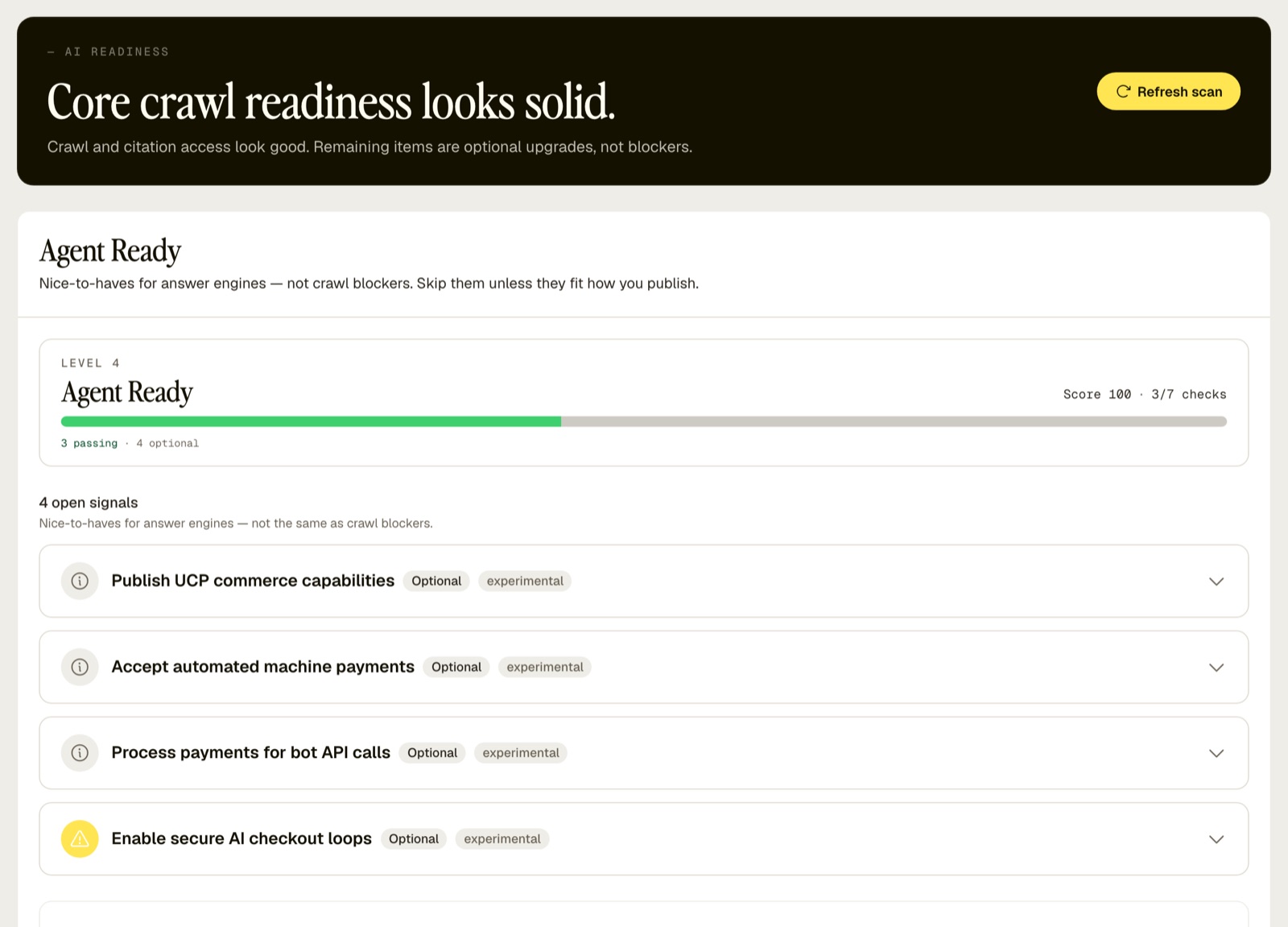
What a store can use today is crawl-based. AI Readiness checks your site against agent-commerce protocols, including ACP, UCP and x402, which AthenaHQ's pricing page doesn't list, and it needs no Shopify connection. Each gap becomes an action item. The Shopify integration guide covers what changes when the listing opens.
What does each report from GA4?
Both connect it, so this is a narrower gap than it looks. AthenaHQ shows GA4 traffic, engagement and conversions alongside your AI search results.
Stride's AI traffic view goes one column further: revenue for each AI source, next to sessions and conversions. For a store that reports AI search as a revenue channel, that column is the one leadership reads. It works on any site with GA4 ecommerce, Shopify or not.
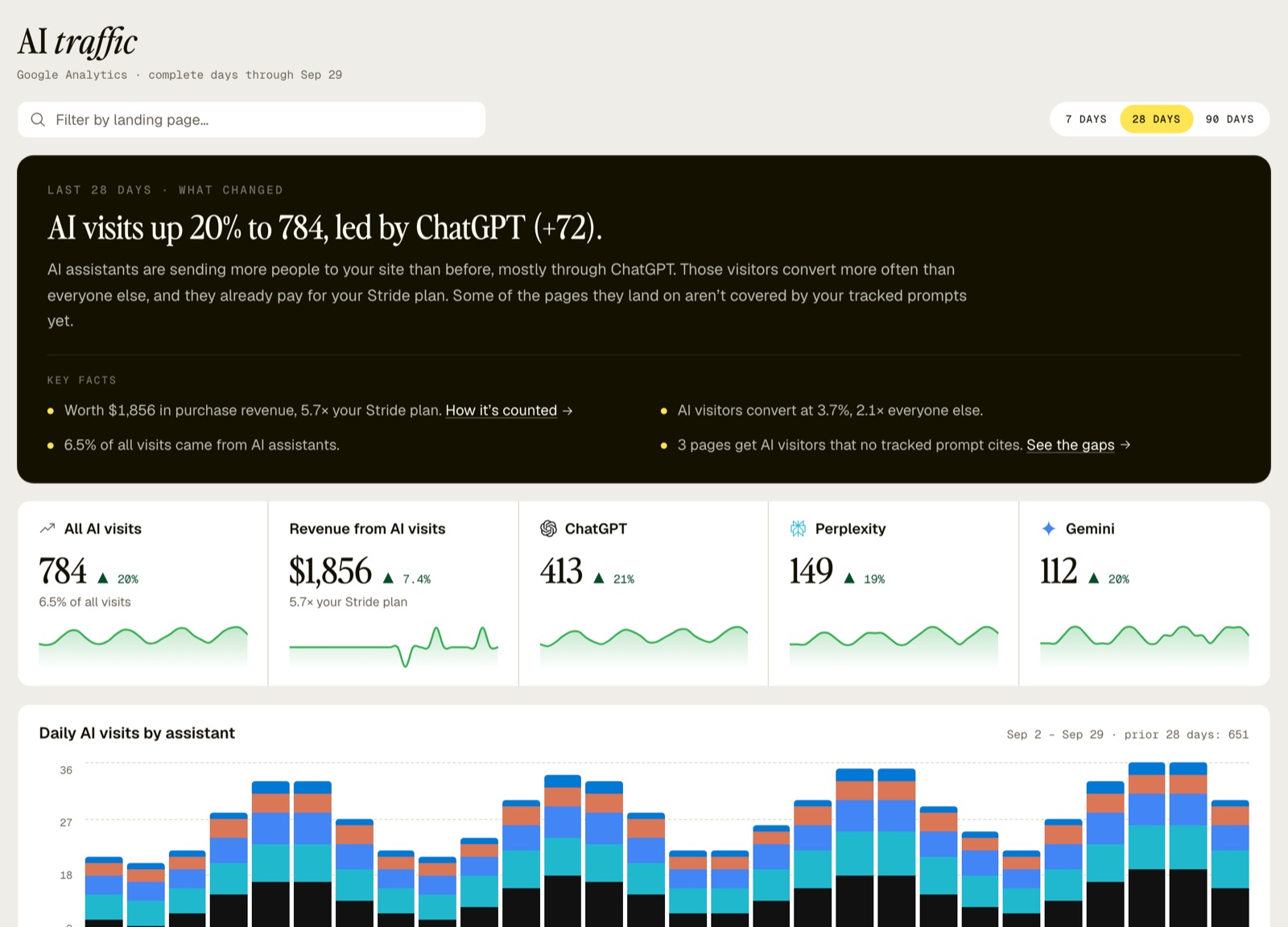
Stride's AI traffic view, shown with sample data.
Which is better for agencies?
Different models. AthenaHQ's agency program offers discounted licenses you can bundle with your services, pitch workspaces with ready-made insights, a dedicated growth manager, and client leads routed to partners after GEO certification. Those leads are a real draw for a young agency. Its pages don't mention white-label.
Stride Agency is a $499 monthly platform fee plus a Starter, Grow or Scale plan per client at a discount, on one invoice. Team seats are unlimited, clients get their own logins with view-only or edit access, branding carries across the dashboard and reports, and a client's site and history can move to their own account if they take the work in-house.
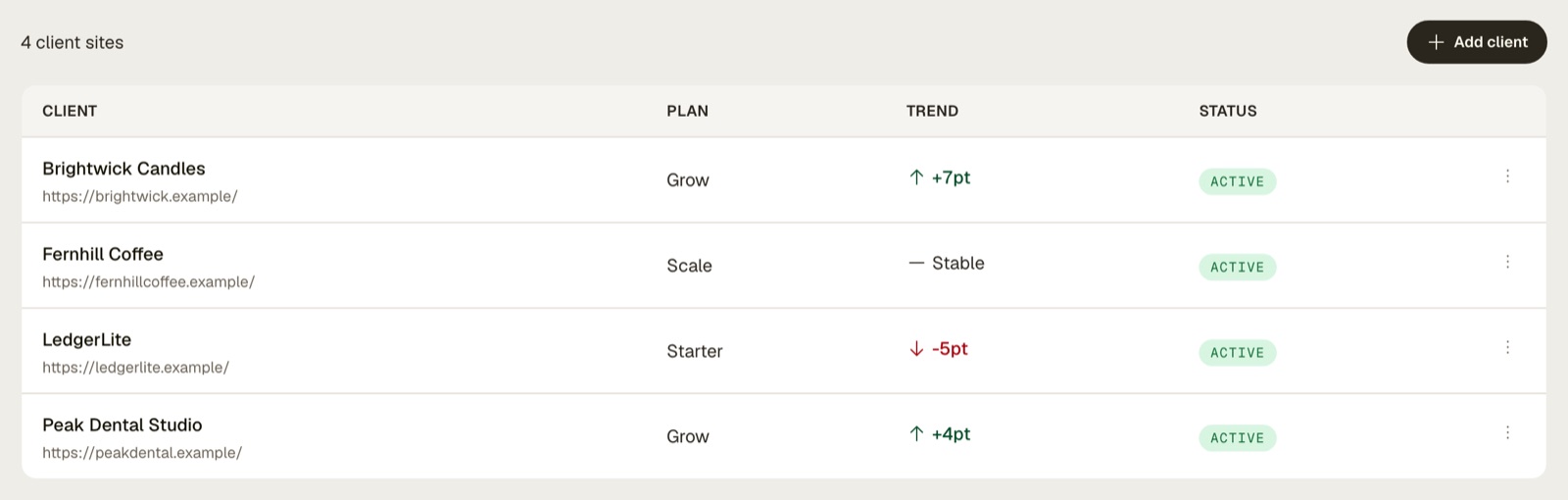
Stride's agency client table, shown with sample data.
When is AthenaHQ the better choice?
- You want to start free and stay free while you learn.
- You need Copilot, AI Mode, Grok, DeepSeek, Meta AI or Mistral tracked.
- You want content published straight to Shopify, WordPress, Webflow or another CMS.
- You need a Shopify integration you can connect today.
- You want unlimited seats, an API or MCP access.
- You're an agency that wants referred client leads.
When is Stride the better choice?
- You need revenue per AI source from GA4 in your reports.
- You want your store checked against agent-commerce protocols such as ACP, UCP and x402, with no Shopify connection needed.
- You want to catch false claims AI makes about you without an Enterprise contract.
- You run an agency that wants white-label branding and per-client plans you can mark up.
Two quick scenarios
A content lead at a fintech startup. They publish weekly on Webflow, need Copilot and Grok tracked, and have no budget yet. AthenaHQ fits: start on the free plan, move to Starter, and publish from one place.
An ecommerce manager at a Shopify homewares brand. They need to prove AI search earns money and want the store ready for AI shopping agents. Stride fits: AI Readiness flags what shopping agents can't read on the site, each gap becomes an action item, and GA4 reports revenue per AI source. The AthenaHQ alternatives page covers the wider field.
Frequently asked questions
Does AthenaHQ have a free plan?
Yes. AthenaHQ's Essential plan is free, with 300 credits plus a $25 credit, five engines and unlimited members. Stride has no free plan; it offers a free audit that needs no account and a 7-day free trial on Starter, Grow and Scale, which requires a card.
Which tracks more AI engines, AthenaHQ or Stride?
AthenaHQ. Its $295 Starter plan covers 11 engines, including Google AI Mode, Copilot, Grok, DeepSeek, Meta AI and Mistral. Stride tracks up to four, ChatGPT, Gemini, Claude (beta) and Perplexity, plus Google AI Overviews, and its $99 Starter plan tracks ChatGPT only.
Do AthenaHQ and Stride both connect to GA4 and Shopify?
Both connect to GA4. AthenaHQ shows GA4 traffic, engagement and conversions next to AI search results, and Stride reports revenue for each AI source. AthenaHQ's Shopify integration publishes to your store's blog and updates product content today. Stride's Shopify catalog sync launches with its Shopify App Store listing; its agent-commerce protocol checks work on any store now.
How do AthenaHQ credits compare to Stride's plans?
AthenaHQ sells credits, where one credit is one AI response; Starter includes 3,600 a month, which you spend across engines and prompts as you choose. Stride sells a fixed allowance per plan, for example 50 prompts on three engines scanned three times a week on Grow.
Is AthenaHQ or Stride better for agencies?
It depends on the agency. AthenaHQ offers discounted licenses, pitch workspaces and client leads routed to certified partners. Stride Agency is a $499 monthly platform fee plus a discounted plan per client, with unlimited seats, client logins, white-label branding and account transfer when a client leaves.
Related comparisons
- Alternatives5 Simpler, Cheaper AthenaHQ Alternatives (2026)
- Head to headStride vs Peec AI: Which Fits Your Team? (2026)
- Head to headStride vs Otterly: Monitor or Act? (2026)
- Tool roundupsBest GEO Tools for Shopify and DTC Brands (2026)
- Tool roundupsAI Brand Accuracy Monitoring Tools: 7 Compared (2026)
- Tool roundupsAI Traffic Analytics Tools That Show Revenue (2026)
How Stride does this: AI Readiness
Product names are trademarks of their respective owners and are used here only to identify them. Stride is not affiliated with or endorsed by any company named on this page.