
Summary
Promptwatch is the better buy for teams that want deep tracking, developer access and an agent that writes and publishes articles: $95 a month gets 50 prompts tracked daily on four models, with MCP and API access on every plan. Stride fits teams that need to show what AI visits are worth, with GA4 conversions and revenue per AI source, plus checks on what AI says about the brand and agency plans built for handing a client back. SEO and growth teams with a developer will usually prefer Promptwatch; small marketing teams, online stores and agencies that report revenue should look hard at Stride.
Stride publishes this comparison and is one of the tools in it. Facts about Promptwatch come from its own public pricing and product pages, checked on October 12, 2026, and are linked where they appear. Where another tool is the better choice, we say so.
How do Stride and Promptwatch compare at a glance?
| Stride | Promptwatch | |
|---|---|---|
| Entry plan | Starter, $99/mo | Essential, $95/mo |
| Prompts and frequency at entry | 25 prompts, weekly | 50 prompts, daily |
| AI engines at entry | ChatGPT | 4 models, chosen from a list of 11 |
| Next tier up | Grow, $349/mo ($279 billed annually) | Professional, $245/mo |
| Team seats | 2, 3 or 5 by plan; unlimited on Agency | 1, 2 or 5 by plan; 10 on agency plans |
| Content from findings | Drafts on every plan: 3 a week on Starter, 25 or 100 a month on Grow and Scale | 5 AEO articles a month on Professional, 10 on Business; none on Essential |
| AI traffic | GA4 sessions, conversions and revenue per AI source | AI-referred visits through its own tracking script |
| Crawler logs | Beta on Scale and Agency | Professional and up |
| Finds threads and drafts replies for your team to post | Tracks which Reddit threads and subreddits AI cites | |
| Checks AI's facts about you | Brand Integrity (Grow and up) | Not listed on its pricing page |
| Agent-commerce protocol checks | ACP, AP2, UCP, MPP and x402, every plan | Not listed on its pricing page |
| API and MCP | None | Every plan |
| Free option | Free audit, no account; 7-day trial, card required | 7-day free trial on Essential and Professional |
Facts last verified October 12, 2026. Prices and plan limits change often; each vendor's pricing page is linked so you can check today's numbers.
Promptwatch's figures come from its pricing page, checked in a browser on October 12, 2026. Stride's come from our pricing page.
Which tracks more for the money?
Promptwatch, clearly. Essential tracks 50 prompts every day on four models for $95. Professional tracks 150 prompts on four models for $245, and Business tracks 350 for $579. Annual billing costs ten times the monthly price, so two months are free.
You pick your four models from ChatGPT, Perplexity, Google AI Overviews, Google AI Mode, Claude, Gemini, Meta Llama, DeepSeek and Grok, and the list also includes the coding agents OpenCode and Claude Code. That flexibility matters if your buyers use AI Mode or Grok.
Stride's Starter plan tracks 25 prompts on ChatGPT once a week. Grow adds Gemini, Claude (beta) and Google AI Overviews on the first 15 prompts you add, with 50 prompts three times a week. Scale adds Perplexity and full AI Overviews. Stride does not track AI Mode, Copilot, Grok, Meta AI or DeepSeek.
If daily data across many engines is the job, Promptwatch wins this round.
Which one turns findings into content?
Both do, in different ways. Promptwatch's Content Agent works from a ranked content-gap backlog, writes drafts grounded in your brand book and knowledge base, and can publish to Webflow or Framer on a schedule. It starts in auto-publish mode, and you can switch to review-first. Articles start on Professional: five a month, or ten on Business.
Stride drafts on every plan, including the $99 Starter. Each scan finding becomes an action item, and where the fix is content, Stride drafts the page or the edit from the answers and sources in your own scans. You review and publish it yourself, since Stride doesn't publish to your site. Later scans show whether the prompt moved.
If you want an agent that ships articles while you sleep, Promptwatch goes further. If you want a short list of fixes with a draft attached, Stride gets you there for less.
Which shows what AI traffic is worth?
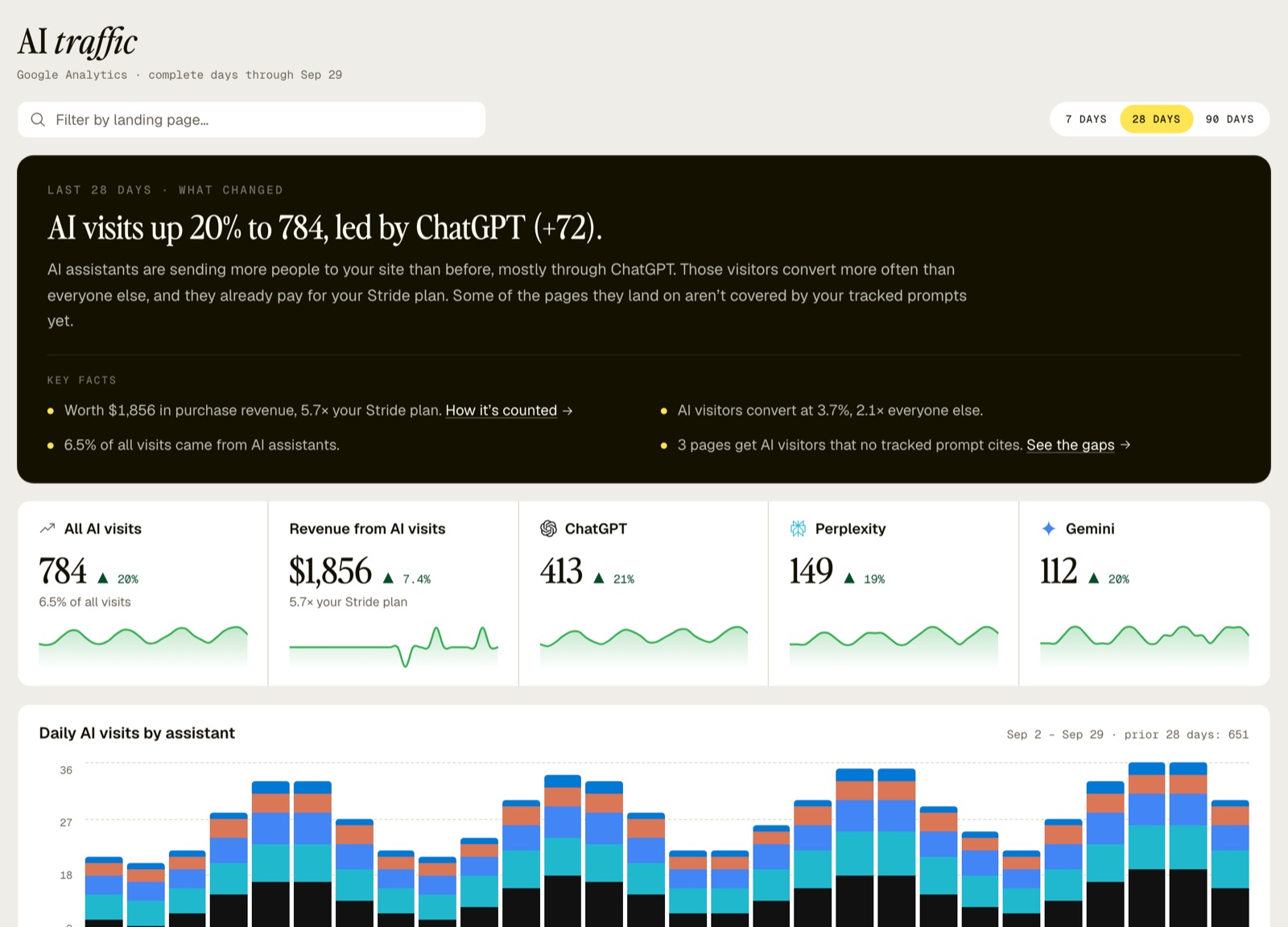
This is where Stride pulls ahead. Its AI traffic view connects to GA4 and shows sessions, conversions and revenue for each AI source, ChatGPT, Perplexity, Gemini and the rest, on every plan.
Promptwatch counts AI-referred visits with a script you add to your site, and Professional adds crawler logs. Its guide to attributing AI traffic says revenue lives in your own analytics or CRM, and walks you through segmenting it there. That works if someone on your team owns analytics. Stride puts the revenue next to the visibility data, so a marketing lead can see it without building a report.
Which helps when AI gets your facts wrong?
Stride, for now. Brand Integrity, on Grow and up, reads what AI engines say about you, flags claims that are false or unsupported, explains which source evidence is missing, and turns each one into an action item. Think of a wrong price or a returns policy you changed last year.
Promptwatch tracks sentiment and the sources AI cites, which shows you how AI feels about you. Its pricing page doesn't list a check of AI's claims against your own facts.
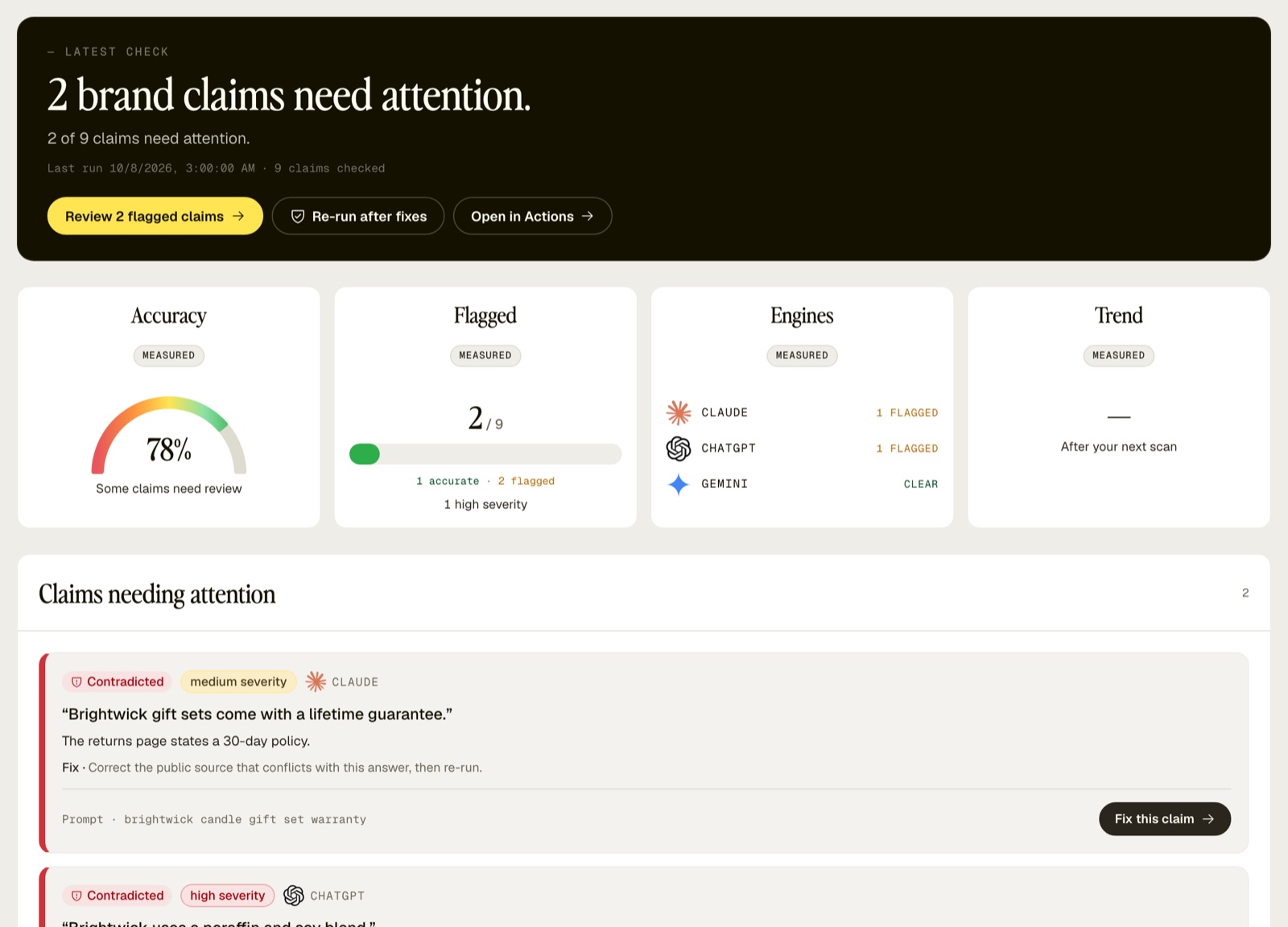
Stride's Brand Integrity view, shown with sample data.
Which is better for an online store?
It depends on the question you're asking. Promptwatch's Shopping Insights, on the $579 Business plan, matches products you upload by CSV against the products AI shopping answers recommend, and shows appearances, position and merchants. That is the view you want if the question is which SKUs AI recommends.
Stride asks whether an AI shopping agent can read and buy from your store. AI Readiness crawls any site and checks it against agent-commerce protocols such as ACP, AP2, UCP, MPP and x402, on every plan. Each gap becomes an action item, and GA4 shows whether AI visitors bought. Stride's Shopify catalog sync and product-by-product commerce readiness launch with its Shopify App Store listing, so today it doesn't track individual products.
Which is better for agencies?
Promptwatch has the cheaper way in. Its agency plans are $199, $399 and $799 a month, with unlimited projects and pitch projects, unlimited prompts, every model, 10 seats and a white-label dashboard. Clients get read-only branded access. The agency itself pays one invoice.
Stride Agency is a $499 monthly platform fee plus a discounted Starter, Grow or Scale plan for each client, all on one invoice. Team seats are unlimited, clients log in with view-only or edit access, and branding carries across the dashboard and reports.
When a client takes the work in-house, account transfer moves their site and history into their own account. Agencies that resell AI visibility as a retainer can mark up a per-client plan. The agency page covers the model.
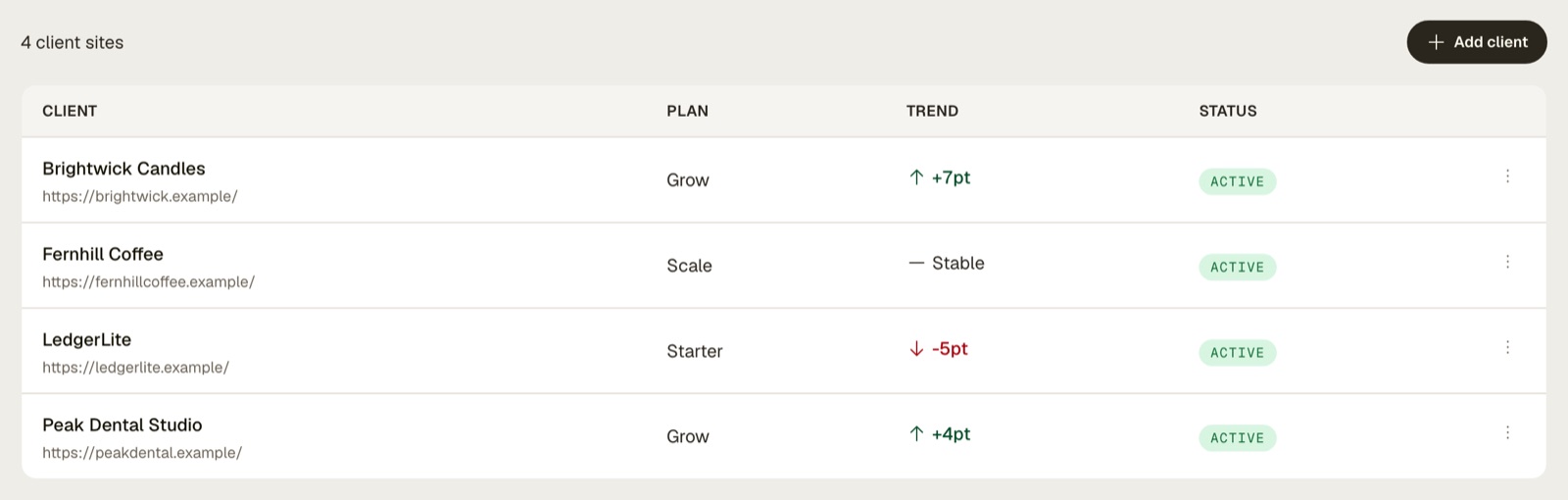
Stride's agency client table, shown with sample data.
When is Promptwatch the better choice?
- You want the most tracking per dollar: 50 prompts a day on four models from $95.
- Your buyers use Google AI Mode, Grok, DeepSeek or Meta Llama.
- You need an API or MCP to pull AI visibility data into your own tools.
- You want an agent that writes articles and publishes them to Webflow or Framer.
- You run an agency that wins clients with pitch projects and wants many brands for $199 to $799 a month.
When is Stride the better choice?
- You need to show leadership what AI visits are worth, with conversions and revenue per AI source from GA4.
- You want to know when AI states something false about your brand, and get the fix as an action item.
- You sell online and want your store checked against agent-commerce protocols, not only tracked for mentions.
- You want drafted fixes on the $99 plan, with no article tier to climb.
- You run an agency that bills per client and wants a clean handoff when a client leaves.
Two quick scenarios
A growth lead at a venture-backed SaaS company. They have a developer who wants AI visibility data in the company warehouse, and their buyers ask Claude and AI Mode. Promptwatch fits: daily tracking on the right four models, an API from the first plan, and an agent that keeps the blog stocked.
A marketing manager at a home goods brand. The CEO keeps asking whether AI search is worth the effort. Stride fits: GA4 shows the revenue each AI source brought in, Brand Integrity catches the wrong return policy ChatGPT keeps repeating, and AI Readiness shows what a shopping agent can't read on the store.
Frequently asked questions
Is Promptwatch or Stride cheaper?
At entry they cost about the same, $95 a month for Promptwatch Essential and $99 for Stride Starter. Promptwatch gives more tracking for the money, 50 prompts daily on four models, while Stride Starter tracks 25 prompts weekly on ChatGPT and includes three content drafts a week.
Does Promptwatch have an API and MCP?
Yes. As of October 2026, Promptwatch lists MCP and API access on every plan, from the $95 Essential plan up. Stride has no public API or MCP server.
Which tool shows revenue from AI traffic?
Stride connects to GA4 and shows sessions, conversions and revenue for each AI source on every plan. Promptwatch counts AI-referred visits with its own tracking script, and its docs say revenue is read in your own analytics or CRM.
Is Promptwatch or Stride better for agencies?
Both have agency plans. Promptwatch's start at $199 a month with unlimited projects, unlimited pitch projects, 10 seats and a white-label dashboard. Stride Agency is a $499 monthly platform fee plus a discounted plan per client, with unlimited seats, client logins, white-label branding and account transfer when a client leaves.
Can I try both before paying?
Yes. Promptwatch offers a 7-day free trial on Essential and Professional. Stride has a free audit that needs no account and a 7-day free trial on Starter, Grow and Scale, which requires a card.
Related comparisons
- Alternatives6 Promptwatch Alternatives, Ranked by Fit (2026)
- Head to headStride vs Peec AI: Which Fits Your Team? (2026)
- Head to headStride vs Goodie: Which Fits Your Budget? (2026)
- Head to headStride vs Scrunch: Which Fits Your Brand? (2026)
- Tool roundupsThe Best GEO Tools in 2026: 10 Compared
- Tool roundupsAI Traffic Analytics Tools That Show Revenue (2026)
How Stride does this: AI traffic
Product names are trademarks of their respective owners and are used here only to identify them. Stride is not affiliated with or endorsed by any company named on this page.