
Summary
AI brand accuracy tools catch the false things ChatGPT, Gemini and other engines say about your business, such as a wrong price or a minimum you don't have. Profound's FactCheck goes deepest for enterprises, tracing each wrong claim to the URL behind it; Peec AI fact-checks tracked prompts from $95 a month; and Waikay is the cheapest at $24.95. Stride fits teams that want claims checked against their own website, with no fact list to maintain, and each error turned into a task, on Grow from $349 a month.
Stride publishes this comparison and is one of the tools in it. Facts about Profound, Peec AI, Waikay, Goodie, AthenaHQ, seoClarity come from their own public pricing and product pages, checked on October 13, 2026, and are linked where they appear. Where another tool is the better choice, we say so.
What does a brand accuracy tool check?
A 20-person company asks ChatGPT for HR software. The answer says one vendor needs at least 50 employees, though its pricing page has no minimum. The buyer crosses it off and never gets in touch.
Accuracy tools catch that. They pull the factual claims out of AI answers about you, compare each one with a reference, and flag the mismatches. The tools differ in three ways:
- The reference. A list of facts you write, a "brand truth" the tool drafts and you approve, or your live website.
- Coverage. Continuous checks on every tracked answer, or checks you run when you need them.
- What happens next. A flag in a dashboard, a traced source URL, or a task with a fix.
How did we evaluate brand accuracy tools?
- How claims are checked and against what reference.
- Source tracing: whether the tool shows which page drives a wrong claim.
- Engines covered by the accuracy check.
- Fix workflow after a claim is flagged.
- Price of the plan that includes accuracy checks.
We checked each vendor's own pricing or product page on October 13, 2026. Stride publishes this page and is ranked by fit.
How do the seven tools compare?
| Tool | Where accuracy checks start (Oct 2026) | Checks claims against | Traces wrong claims to a source | Fix workflow |
|---|---|---|---|---|
| Profound | Enterprise, custom | Your ground truth | Yes, to the exact URL | Profound Agent remediation |
| Peec AI | Starter $95/mo (5 prompts, 5 facts) | Facts you set | Source analytics alongside | Recommended actions |
| Stride | Grow $349/mo | Your public website | Shows the evidence your site is missing | Action items |
| Waikay | Site Owners $24.95/mo | Claims you mark right or wrong | Suggested sources, as leads | Action plans |
| Goodie | Enterprise, custom | A brand truth you approve | Adverse citation share metric | Ranked fixes in Optimization Actions |
| AthenaHQ | Enterprise, custom | Knowledge base and claim review | Not described | Not described |
| seoClarity | Accuracy add-on, quote only | Not described | Not described | Not described |
Facts last verified October 13, 2026. Prices and plan limits change often; each vendor's pricing page is linked so you can check today's numbers.
Which brand accuracy tools are worth a look?
1. Profound
Best for: enterprises in regulated or high-stakes categories that need every claim traced.
Profound's FactCheck extracts each factual assertion AI makes about your brand, checks it against your ground truth, and traces each inaccurate claim to the URL behind it: your page, a competitor's or a publisher's. It tracks an accuracy score across answer engines and can launch a Profound Agent to correct a claim.
Limits: the pricing page lists only a free trial and custom Enterprise, and doesn't say which plan includes FactCheck. Price: custom, per Profound's pricing page as of October 2026.
2. Peec AI
Best for: teams that already know which facts matter and want them checked daily.
Peec's fact-checked prompts compare tracked AI answers with statements you set about your brand. Starter checks 5 prompts against 5 facts, and Pro checks 10 prompts against 20 facts. It also scores brand attributes and groups the objections AI raises against you.
Limits: you write and maintain the fact list, and the check covers the prompts you choose. Price: Starter $95, Pro $245 a month, per Peec's pricing page as of October 2026.
3. Stride
Best for: small teams that want errors checked against their own site and turned into tasks.
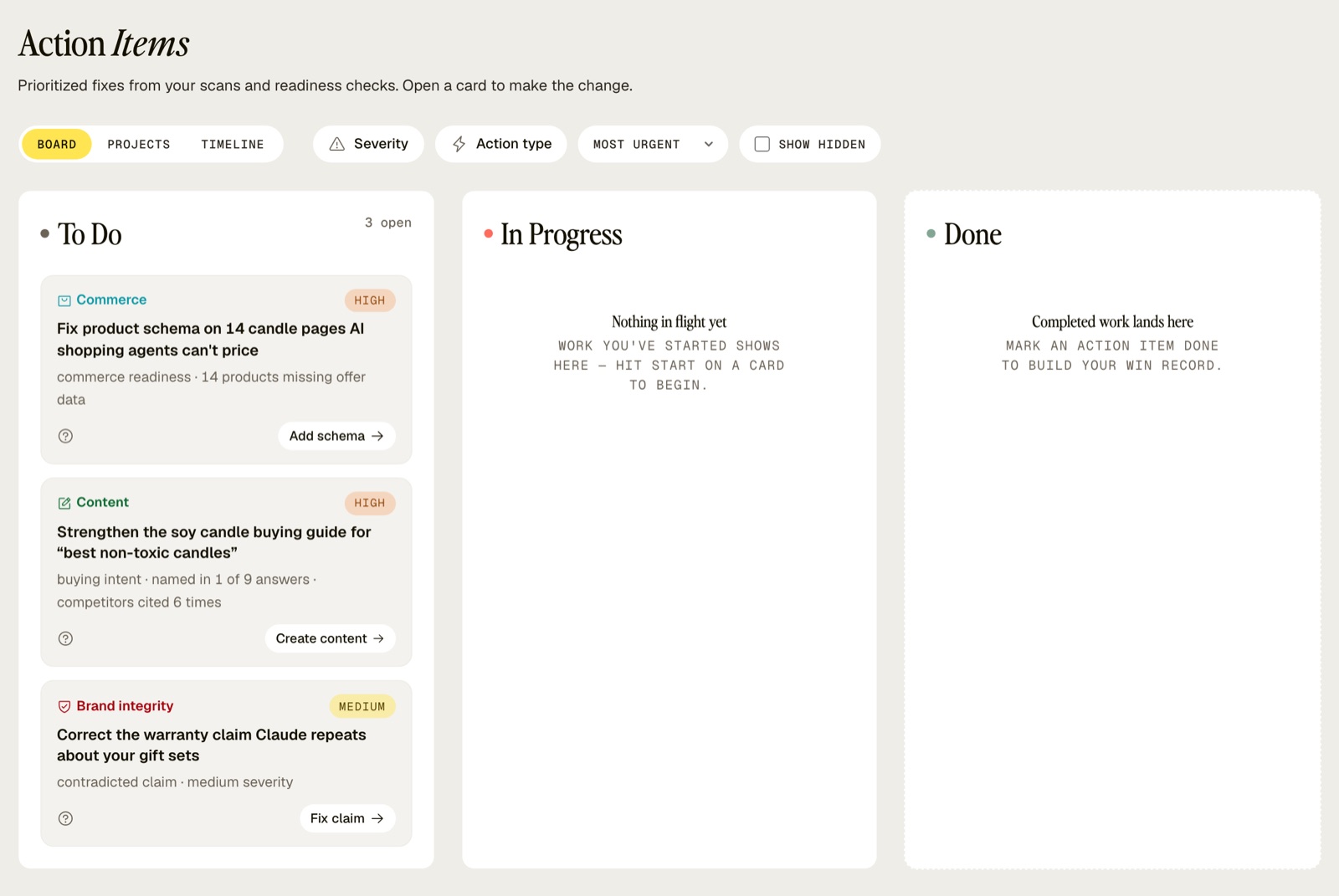
Stride's Action Items board with a brand claim correction, shown with sample data.
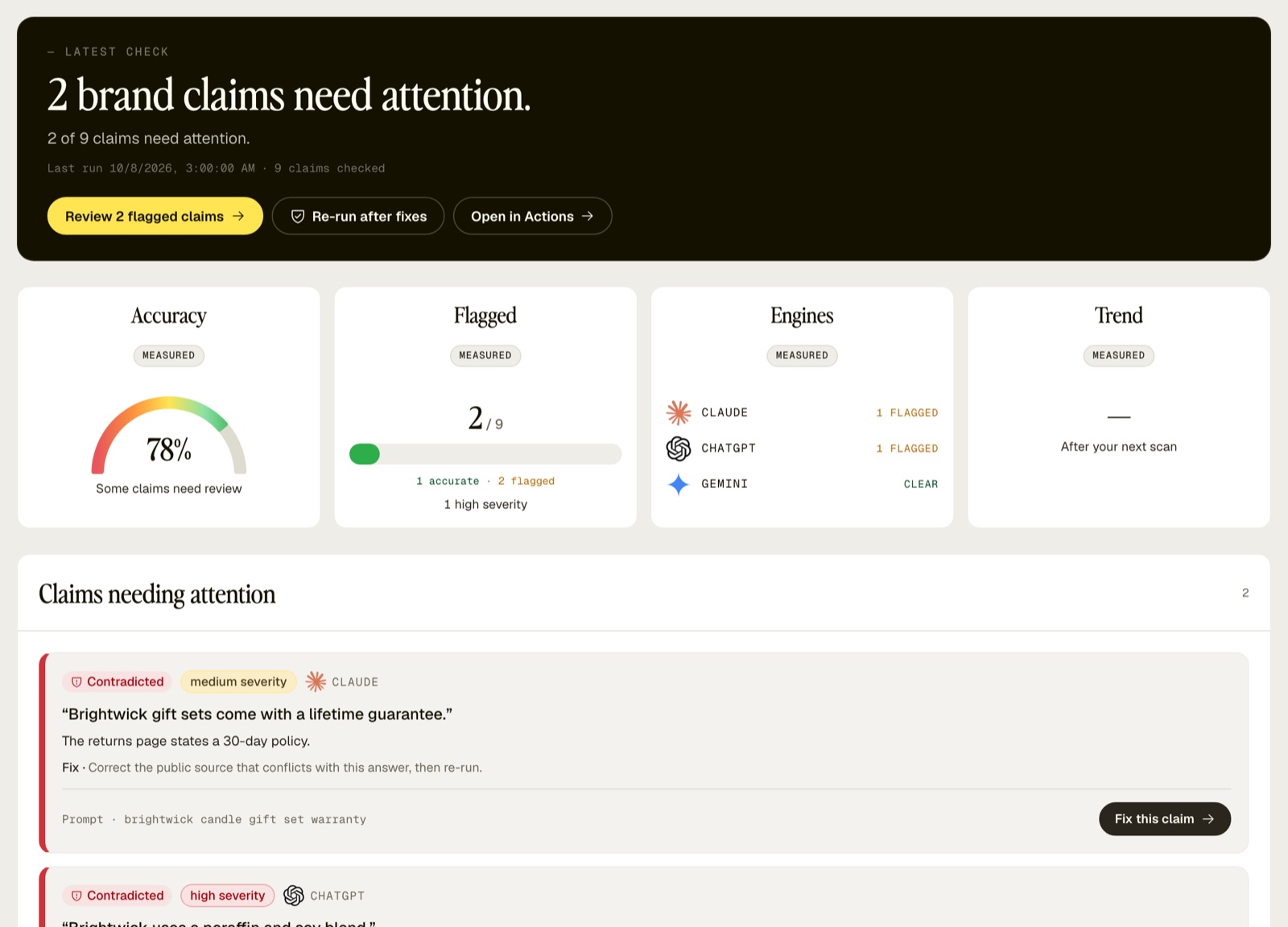
Stride's Brand Integrity reads up to 15 recent AI answers that name you and checks each claim about prices, features or policies against your public pages. Accurate means your site backs it up, unsupported means your site doesn't mention it, and contradicted means your site says something different. Each flagged claim becomes an action item, and you re-run the check after the next scan to see whether the answer changed.
Limits: checks run when you start them, not continuously, and read up to 15 answers each time. Brand Integrity is on Grow and Scale only, using ChatGPT, Gemini and Claude (beta) on Grow, plus Perplexity on Scale. Price: Grow $349 ($279 billed annually), Scale $1,297 a month, per our pricing page.
4. Waikay
Best for: consultants and small brands that want hallucination checks for the least money.
Waikay's Fact Tracker pulls full statements about your brand from AI answers in its topic reports, tags each with the model that said it, and lets you mark it correct or flag it. It asks the models for likely sources, which Waikay itself calls starting points for investigation. It covers ChatGPT, Gemini, Claude and Perplexity's Sonar.
Limits: you review each claim yourself; there's no reference document. Price: Site Owners $24.95, Small Teams $69.95 a month, per Waikay's pricing as of October 2026.
5. Goodie
Best for: enterprise brands that want accuracy, narrative and recommendation share in one view.
Goodie's Brand Command drafts your brand narrative from your site and documents, your team approves it, and every AI answer is then held to it. It reports inaccuracy rate, narrative coverage, adverse citation share and recommendation rate, and routes ranked fixes into Optimization Actions.
Limits: Brand Command is listed on Enterprise only. Price: custom Enterprise, per Goodie's pricing page as of October 2026.
6. AthenaHQ
Best for: existing AthenaHQ Enterprise customers.
AthenaHQ's Enterprise plan lists "Knowledge Base and claim review" and "Oracle discrepancy detection" alongside SSO and BI connectors.
Limits: Enterprise-only, and the plans page doesn't describe how claim review works. Price: custom, per AthenaHQ's plans page as of October 2026.
7. seoClarity
Best for: enterprise SEO teams already on seoClarity.
seoClarity's ArcAI sells accuracy monitoring, described as detecting hallucinations and errors in AI responses, as an add-on for brand protection.
Limits: quote-only, and the add-on's method isn't described on the pricing page. Price: ask for a quote, per seoClarity's ArcAI pricing as of October 2026.
When is another tool the better choice?
If you need to know which URL is feeding a false claim, Profound's FactCheck shows it. If you want daily checks on a fixed list of facts, Peec AI. If budget is the constraint and you're happy to review claims by hand, Waikay. Our Stride vs Profound page goes deeper on the enterprise trade-off.
When is Stride the better choice?
When you'd rather not maintain a fact list. Stride treats your public site as the truth, so a contradicted claim points straight at the page to correct, and the fix lands in the same action items as the rest of your AI work. Our Stride vs Peec AI page compares the two approaches side by side.
Two quick scenarios
A fintech marketing team with compliance review. Every wrong claim about fees needs a source and an audit trail. Profound fits: claim-level tracing to the URL and an accuracy score over time.
A 15-person software company. ChatGPT keeps quoting an old price. Stride fits: Brand Integrity flags the contradiction against the current pricing page, and the action item tracks the correction until a later check shows the answer changed.
Frequently asked questions
What is AI brand accuracy monitoring?
It's checking the factual claims AI engines make about your brand, such as prices, features, policies or eligibility, against a source of truth, and flagging the ones that are wrong. Most tools compare answers either to a list of facts you write or to your own website.
Can I make ChatGPT stop saying something false about my brand?
Not directly. No tool can edit an AI model's answer. What works is correcting or publishing the page the engine should rely on, fixing third-party pages that repeat the error, and checking whether later answers change.
Which tool is cheapest for checking AI hallucinations about a brand?
As of October 2026, Waikay's Site Owners plan costs $24.95 a month and includes fact and hallucination checks on ChatGPT, Gemini, Claude and Perplexity's Sonar. Peec AI's $95 Starter fact-checks 5 tracked prompts against 5 facts you set.
How does Stride check AI answers about my brand?
Stride's Brand Integrity reads up to 15 recent AI answers that name you and checks each factual claim against your public pages. Claims are marked accurate, unsupported or contradicted, and flagged ones become action items. It's on Grow and Scale, and you start each check yourself.
Do I have to write a list of facts for these tools?
It depends on the tool. Peec AI checks against facts you set, Goodie and Profound start from a brand truth or ground truth you approve, and Waikay has you mark each extracted claim right or wrong. Stride uses your public website as the reference, so there's no separate fact list to maintain.
Related comparisons
- Head to headStride vs Profound: Enterprise or Self-Serve? (2026)
- Head to headStride vs Peec AI: Which Fits Your Team? (2026)
- Head to headStride vs AthenaHQ: Where They Differ (2026)
- Head to headStride vs Goodie: Which Fits Your Budget? (2026)
- Head to headStride vs Enterprise SEO Suites: Which Fits? (2026)
- Tool roundupsAgentic Commerce Readiness Tools: 7 Compared (2026)
How Stride does this: Brand integrity
Product names are trademarks of their respective owners and are used here only to identify them. Stride is not affiliated with or endorsed by any company named on this page.