
Summary
AI citation tracking measures which pages AI engines use as sources when they answer your buyers' questions, which is a different number from how often they name your brand. For source analysis on a budget, Peec AI at $95 a month classifies every cited domain and shows the gaps; Ahrefs Brand Radar suits teams that want to see citations across a whole market without writing prompts. Stride fits teams that want each citation gap turned into an action item, with owned citations tracked per prompt and engine.
Stride publishes this comparison and is one of the tools in it. Facts about Peec AI, Ahrefs Brand Radar, Otterly, LLMrefs, Trakkr, Scrunch come from their own public pricing and product pages, checked on October 10, 2026, and are linked where they appear. Where another tool is the better choice, we say so.
What is AI citation tracking?
AI citation tracking is monitoring the URLs AI engines cite, link or attribute as sources when they generate an answer, and whether your pages are among them. A tracker runs the same set of buyer questions on each engine, on a schedule, and saves the source list behind every answer.
The output is a ranking of the domains and pages that win citations for your questions, how that changes over time, and how you compare with competitors.
How are citations different from mentions?
Ask an AI engine for the best running socks for marathon training. The answer might name three brands while citing two magazine roundups and one brand's buying guide. That one answer holds both:
- Mentions are brands named in the text. They reflect what the engine has read about you across the web, so you influence them slowly.
- Citations are pages the engine pulled as sources at answer time. You influence them directly, by publishing the page worth pulling.
The four combinations tell you what to do. Named and cited means you're the reference.
Named but never cited means other people's pages are describing you. Cited but not named means your content is working harder than your brand. Neither means you're absent, and the citation usually comes before the mention.
What is an owned citation?
An owned citation points at a domain you control, such as your store, blog or docs. A third-party citation is someone else's page that features you: useful, but not yours to edit.
Stride counts a citation as owned when the cited URL's hostname matches your site's hostname, ignoring www. Most tools use a similar hostname match, so check how subdomains are handled before you compare numbers across tools.
Why do citations matter?
Because they respond to work. The original generative engine optimization paper, accepted to KDD 2024, found that targeted content changes lifted a page's visibility in generative engine responses by up to 40%. The changes that worked best added statistics, quotations and cited sources: sentences an engine can lift and attribute.
A mention depends on what the whole web says about you. A citation depends on whether your page is the best source for one specific question, which you can change this month.
How did we evaluate citation tracking tools?
- Citations separated from mentions, with the cited URLs visible.
- Page-level detail, including owned versus third-party pages.
- Source classification: what kind of site is winning (editorial, forum, competitor).
- Engines covered at the plan you'd buy.
- Price and cadence for a tracked prompt.
We checked each vendor's own pricing or product page on October 10, 2026. Stride publishes this page and is ranked by fit.
How do the seven citation tracking tools compare?
| Tool | Entry price (Oct 2026) | Engines at entry | Prompts and cadence at entry | Citation features listed |
|---|---|---|---|---|
| Peec AI | $95/mo | Choose 3 of 6 | 50, daily | Citation share, source classification, domain and URL detail, gap analysis |
| Ahrefs Brand Radar | From $199/mo | 6 in its index (Claude available) | 470M+ prompt index | Cited pages and domains for any brand |
| Stride | $99/mo | ChatGPT | 25, weekly | Citation rate, owned citations, cited URLs per answer |
| LLMrefs | $79/mo | All supported, no per-engine fee | 500, weekly reports | Citation tracking of sources |
| Trakkr | $100/mo | 8 | 50, daily | Citation sources |
| Otterly | $29/mo | 4 | 15, daily | Link citation analysis, domain ranking |
| Scrunch | $250/mo | 4 | 125 | Citations and sources |
Facts last verified October 10, 2026. Prices and plan limits change often; each vendor's pricing page is linked so you can check today's numbers.
Which citation tracking tools are worth a trial?
1. Peec AI
Best for: analysts and SEO teams that want to know which sources win their category.
Peec reports citation share, classifies every cited source as competitor, editorial, reference or user-generated, and drills from domain to URL. Its gap analysis lists sources that cite competitors but not you, by domain, subdomain and URL, which is a ready outreach list.
Limits: three models per plan without add-ons. Price: Starter $95, Pro $245 a month, unlimited users, per Peec's pricing page as of October 2026.
2. Ahrefs Brand Radar
Best for: SEO teams that want market-wide citation data without building a prompt set.
Brand Radar runs more than 470 million search-backed prompts through AI Overviews, AI Mode, ChatGPT, Perplexity, Gemini and Copilot, and shows the pages cited for any brand, including competitors. Custom prompt tracking is an add-on.
Limits: costs stack with an Ahrefs plan, and it doesn't turn findings into content. Price: Brand Radar AI from $199 a month, custom prompts from $50, per Ahrefs' pricing page as of October 2026.
3. Stride
Best for: small teams that want each citation gap turned into work.
Every Stride scan stores the full answer and the cited URLs for each prompt and engine, and reports citation rate and owned citations. The Competitive view compares citation rates with tracked competitors on the same prompts. The cited sources guide shows how to read which sources AI relies on. Gaps become action items, with a page or edit drafted from the evidence, and later scans show whether the prompt started citing you.
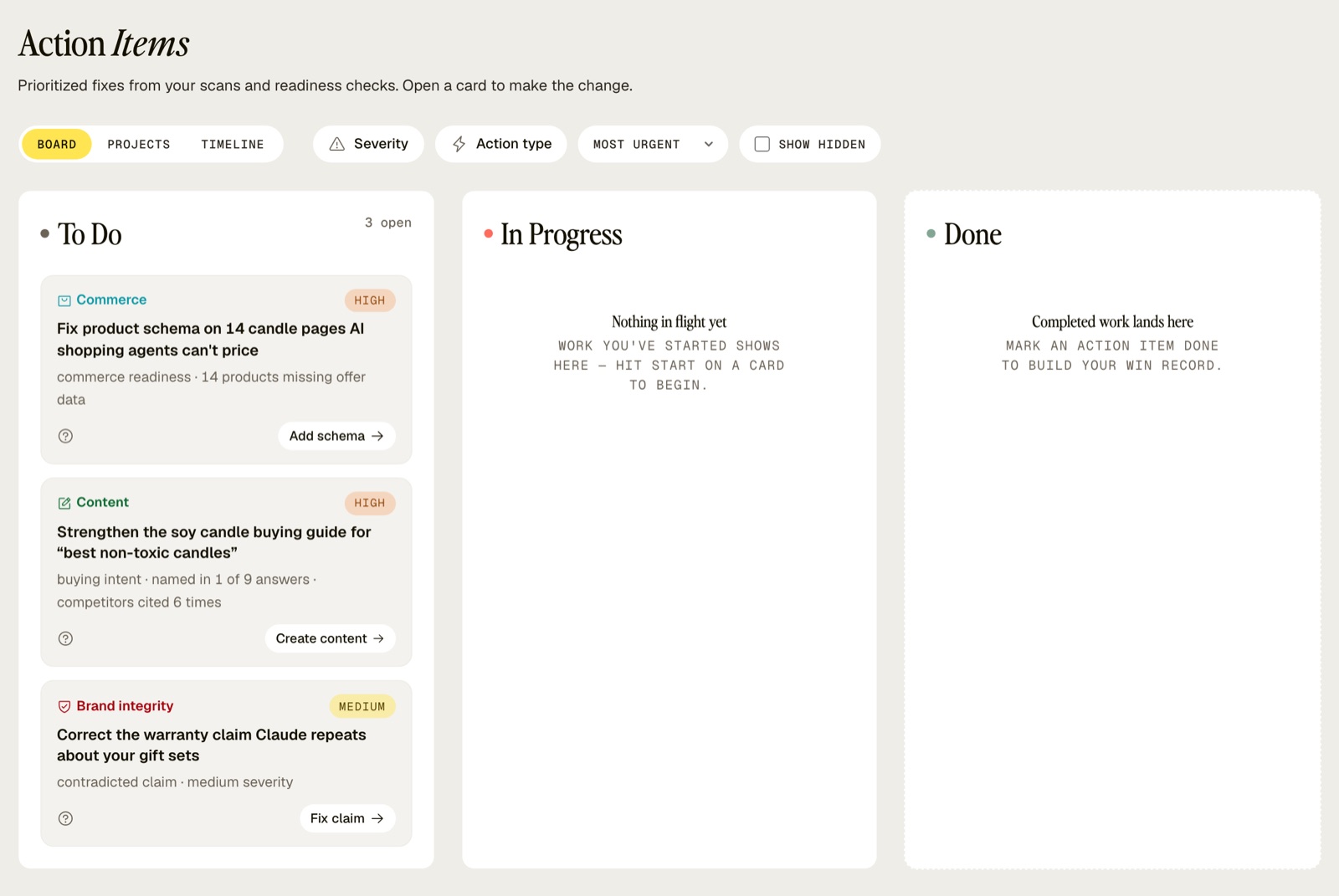
Stride's Action Items board, shown with sample data.
Limits: Starter tracks 25 prompts weekly on ChatGPT only, and Google AI Overviews results record your mention and citation URLs but not competitors. No public API or MCP. Price: Starter $99, Grow $349 ($279 billed annually), Scale $1,297 a month, per our pricing page.
4. LLMrefs
Best for: the most tracked prompts for the money.
LLMrefs' single plan tracks 500 prompts for mentions, sources and fan-out queries, across every engine it supports with no per-engine fee, with unlimited team members and projects. Reports refresh weekly.
Limits: weekly, not daily, and the $79 price is labelled limited time. Price: $79 a month, 7-day trial, per LLMrefs' pricing page as of October 2026.
5. Trakkr
Best for: citation sources across eight engines from one plan.
Trakkr's Growth plan tracks citation sources and perception daily on ChatGPT, Claude, Gemini, Perplexity, AI Overviews, Grok, DeepSeek and Meta AI, with 50 prompts and three seats.
Limits: 50 prompts per brand, and the trial needs a card. Price: Growth $100 a month, per Trakkr's pricing page as of October 2026.
6. Otterly
Best for: the cheapest way to see which links AI cites.
Otterly lists link citation analysis and domain ranking on every plan, tracked daily on four engines with unlimited team members.
Limits: 15 prompts on Lite. Price: Lite $29, Standard $189 a month, per Otterly's pricing page as of October 2026.
7. Scrunch
Best for: teams that want citations alongside agent-traffic data.
Scrunch Core includes citations and sources, sentiment and AI bot traffic on 125 prompts with five users, on ChatGPT, Perplexity, AI Overviews and Copilot.
Limits: four engines until Enterprise. Price: Core $250 a month, per Scrunch's pricing page as of October 2026.
How do you earn more citations?
Lead with the answer. Engines lift passages, not pages. Open with a two-sentence answer to the page's question.
Build the comparison page your category lacks. For buying questions, engines want a page that weighs options against stated criteria. Write the fair version, the one that names where rivals win.
Keep crawlers allowed. A page can't be cited if GPTBot, PerplexityBot, ClaudeBot or Google-Extended are blocked in robots.txt. Product, FAQPage and Organization schema help engines read the page.
Refresh pages that already earn citations. They're proven assets, and updating their data and dates is cheaper than earning a first citation elsewhere.
When is another tool the better choice?
If you want the deepest source analysis per dollar, Peec AI. If you want to see competitors' citations across a whole market without setting up prompts, Ahrefs Brand Radar. If you need hundreds of prompts on a small budget and weekly data is enough, LLMrefs. Our AI visibility monitoring roundup covers the measurement side in more depth.
When is Stride the better choice?
When you know citations matter but nobody has time to turn a source report into pages. Stride ties each citation gap to an action item, drafts the content, and checks later scans for the result.
Two quick scenarios
An SEO manager at a software company. They need to report which publications AI cites in their category and pitch those editors. Peec AI fits: source classification and gap analysis by URL.
A marketer at a DTC brand. Competitors' buying guides get cited and theirs doesn't exist. Stride fits: the gap becomes an action item with a drafted guide, and later scans show whether it earns citations.
Frequently asked questions
What is AI citation tracking?
AI citation tracking records which web pages AI engines use as sources when they answer a question, and whether your pages are among them. A tracker runs a set of buyer questions on each engine, saves the cited URLs behind every answer, and reports which domains and pages win those slots over time and against competitors.
What is the difference between an AI mention and an AI citation?
A mention is your brand named in the answer text. A citation is a page the answer used as a source. You can be named without being cited, when the engine relies on other people's pages to describe you, and cited without being named, when your guide sources an answer that recommends someone else.
What is an owned citation?
A citation whose URL is on a domain you control, such as your store, blog or docs. Stride counts a citation as owned when the cited URL's hostname matches your site's hostname, ignoring www. Owned citations matter because you can edit the page the engine trusted.
Can I increase how often AI engines cite my pages?
Yes. The original GEO research paper, accepted to KDD 2024, found that targeted content changes such as adding statistics, quotations and cited sources lifted visibility in generative engine responses by up to 40%. In practice that means pages that answer the question directly and back claims with sources.
Which citation tracking tool is cheapest?
As of October 2026, Otterly Lite costs $29 a month for 15 prompts with link citation analysis, and LLMrefs costs $79 a month for 500 prompts with citation tracking, refreshed weekly. Peec AI's $95 Starter adds source classification and daily tracking.
Related comparisons
- Tool roundupsBest AI Visibility Monitoring Tools in 2026
- Tool roundupsThe Best GEO Tools in 2026: 10 Compared
- Alternatives6 Peec AI Alternatives for Action and Agencies (2026)
- Alternatives6 Otterly Alternatives for More Engines (2026)
- Tool roundupsAgentic Commerce Readiness Tools: 7 Compared (2026)
- Tool roundupsAI Brand Accuracy Monitoring Tools: 7 Compared (2026)
How Stride does this: Citations
Product names are trademarks of their respective owners and are used here only to identify them. Stride is not affiliated with or endorsed by any company named on this page.