
Summary
Writesonic pairs AI visibility tracking with an article writer, so the best alternatives do both. Trakkr gives the most engines and articles for about the same entry price, Siftly adds auto-publishing for less, and Stride fits teams that want each draft tied to a gap its scans found. Pick Gauge for heavy daily tracking with publishing, or AirOps for content workflows at scale.
Stride publishes this comparison and is one of the tools in it. Facts about Writesonic come from its own public pricing and product pages, checked on October 13, 2026, and are linked where they appear. Where another tool is the better choice, we say so.
Why do people look for Writesonic alternatives?
Mostly engine coverage. As of October 2026, Writesonic's pricing page shows Starter, Basic and Growth tracking ChatGPT, Gemini and Google AI Overviews. Its full list of eight AI platforms, plus shopping and agentic commerce tracking, SSO and SOC 2 Type II, sits on custom Enterprise.
Writesonic is generous where it started. Starter is $99 a month, or $79 billed annually, for 50 prompts tracked daily, 15 AI articles a month, ten site audits and ads monitoring. Its agencies page lists white-label reporting and client workspaces, and Basic and Growth scale articles to 25 and 50 a month.
Two other limits come up. Starter includes one user and one project. Sentiment analysis starts on Growth, and the full Action Center needs Enterprise; Growth gets a trial of 5 on-page and 5 off-page actions a month.
How we evaluated
We looked for tools that track AI answers and help produce the content to fix them, with a price on the vendor's own page on October 13, 2026 (AirOps is the exception, and we say so). We ranked them by fit for a small marketing team leaving Writesonic: engines at entry, content included, seats, and cost.
Prices are monthly in US dollars unless noted. Stride's facts come from our pricing page.
Which Writesonic alternatives are worth a look?
| Tool | Entry price (Oct 2026) | Engines at entry | Prompts at entry | Content at entry | Seats at entry |
|---|---|---|---|---|---|
| Writesonic | $99/mo ($79 annual) | ChatGPT, Gemini, AI Overviews | 50, daily | 15 articles/mo | 1 |
| Trakkr | $100/mo | 8 | 50, daily | 25 articles/mo | 3 |
| Siftly | $79/mo | ChatGPT, AI Overviews, Perplexity | 50, daily | 8 posts/mo, auto-publish | Not stated |
| Stride | $99/mo | ChatGPT | 25, weekly | 3 drafts a week | 2 |
| Promptwatch | $95/mo | 4 you choose | 50 | None; 5 articles/mo on $245 plan | 1 |
| Gauge | $599/mo | 6 | 600, daily | 18 articles/mo | 5 |
| AirOps | Not published | ChatGPT on Solo; 7+ on Pro | Not published | Task-based content workflows | 1 on Solo; unlimited on Pro |
Facts last verified October 13, 2026. Prices and plan limits change often; each vendor's pricing page is linked so you can check today's numbers.
1. Trakkr
Best for: small teams that want more engines and more articles than Writesonic Starter, at about the same price.
Trakkr's Growth plan is $100 a month for one brand and 50 prompts tracked daily across eight models: ChatGPT, Claude, Gemini, Perplexity, Google AI Overviews, Grok, DeepSeek and Meta AI. It includes 25 articles a month, three seats and MCP access. Scale is $500 for ten brands, unlimited seats, white-label client portals and an API.
Strengths: every model on every plan, with no per-model fees, and a ChatGPT Shopping add-on at $49 per brand a month.
Limits: 50 prompts per brand. The 14-day trial needs a card.
Price: from $100 a month on Trakkr's pricing page, as of October 2026.
2. Siftly
Best for: founders who want posts written and published for them on a small budget.
Siftly's Starter plan is $79 a month for 50 prompts tracked daily on ChatGPT, Google AI Overviews and Perplexity. It includes 8 blog posts a month with auto-publish and 5 citation outreach campaigns. Growth is $249 for 100 prompts, 30 posts, Gemini, Reddit engagement, AI bot crawl tracking and GA4 and Search Console.
Strengths: publishing and citation outreach on the entry plan, plus a free tier with 10 prompts and weekly refreshes.
Limits: three engines on Starter; Copilot, Grok and DeepSeek arrive on the $599 Scale plan and Claude on Enterprise.
Price: from $79 a month on Siftly's pricing page, as of October 2026.
3. Stride
Best for: teams that want each draft tied to a gap their scans found, and proof in GA4 that it paid off.
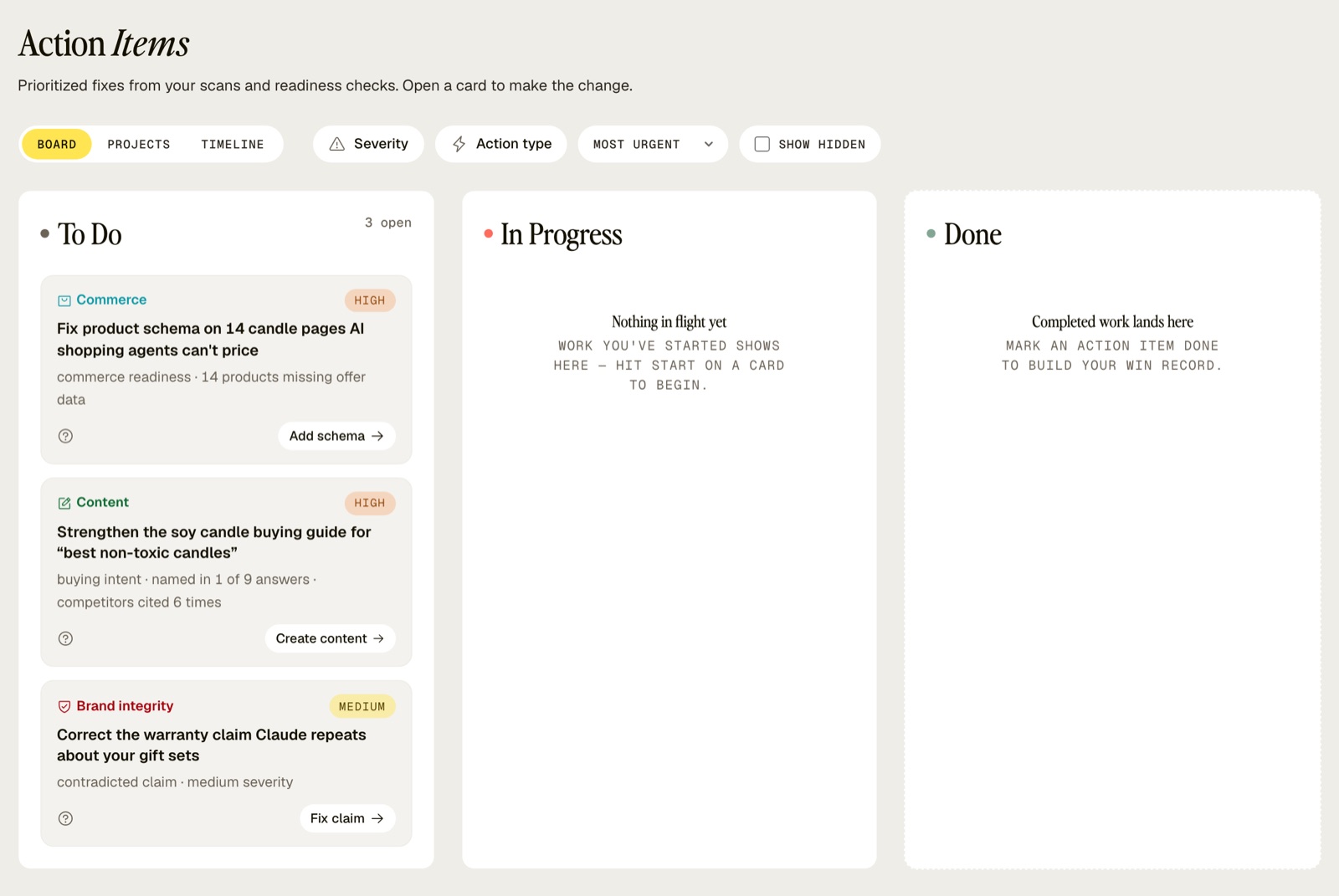
Writesonic writes articles on topics you pick. Stride starts from the scan: every finding becomes an action item, and where a page is missing, Stride drafts it from your own scan evidence. You publish, and later scans check whether it worked. The AI traffic view reads GA4 conversions and revenue for each AI source.
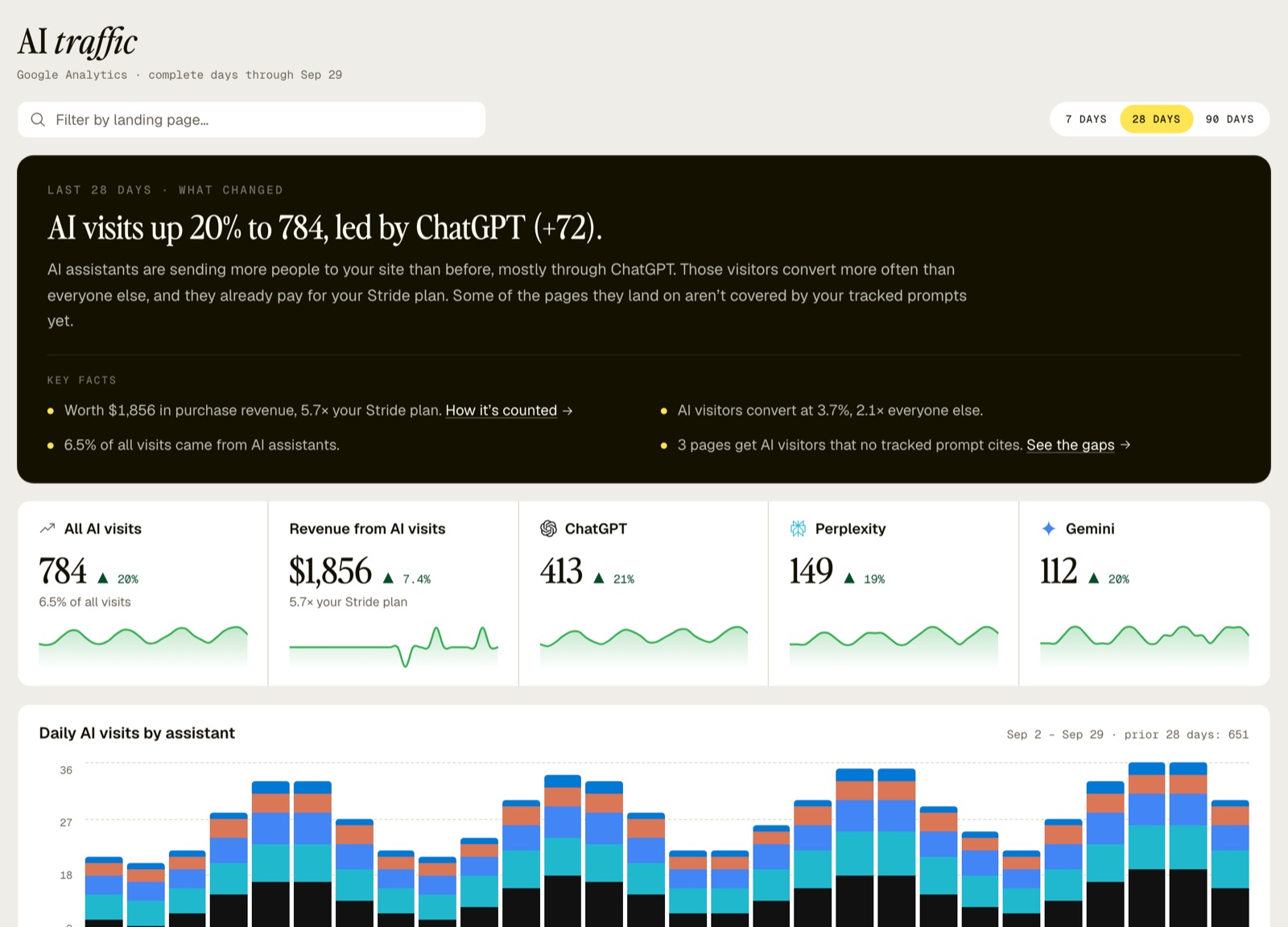
Stride's AI traffic view with revenue per AI source, shown with sample data.
Strengths: drafts on every plan (3 a week on Starter, 25 a month on Grow, 100 on Scale), Brand Integrity on Grow to catch false claims AI makes about you, and an Agency plan with white-label and client logins.
Limits: fewer pieces than Writesonic, and Stride doesn't publish for you. Starter tracks ChatGPT only, 25 prompts weekly. The widest plan covers ChatGPT, Gemini, Claude (beta) and Perplexity plus Google AI Overviews. No API, SSO or SOC 2.
Price: Starter $99, Grow $349 ($279 annual), Scale $1,297 ($1,037 annual). Our Stride vs Writesonic page compares the two in detail.
4. Promptwatch
Best for: teams that want an API, AI agent analytics and articles from one self-serve tool.
Promptwatch tracks four models per plan, chosen from a list that includes ChatGPT, Perplexity, AI Overviews, AI Mode, Claude, Gemini and Grok. Essential is $95 a month for 50 prompts and one seat, with no articles. Professional is $245 for 150 prompts, two seats, Agent Analytics and 5 AEO articles a month. Business is $579 for 350 prompts and 10 articles.
Strengths: MCP and API access on every plan and a Content Agent built on the sources AI cites.
Limits: fewer articles per dollar than Writesonic, and one seat at entry. Our Promptwatch alternatives page covers the trade-offs.
Price: from $95 a month on Promptwatch's pricing page, as of October 2026.
5. Gauge
Best for: content teams with budget that want high daily tracking volume and direct publishing.
Gauge's Growth plan is $599 a month for 600 prompts run daily across ChatGPT, Google AI Overviews, AI Mode, Gemini, Perplexity and Copilot. It includes 18 publish-ready articles a month, five seats, MCP, GA4 and Search Console integrations, and publishing to Webflow, Framer, Sanity and GitHub. Claude and Grok run on any plan with your own API key.
Strengths: the most tracking volume in this group, at about 108,000 answers a month.
Limits: the entry price is six times Writesonic Starter's.
Price: $599 a month on Gauge's pricing page, with a 1-week free trial, as of October 2026.
6. AirOps
Best for: content operations teams that build repeatable workflows across many pages.
AirOps is a content production platform with AI visibility insights built in. Its pricing page shows Solo, Pro and Enterprise without dollar prices. Solo covers ChatGPT insights only with 35,000 tasks; Pro adds insights across 7+ answer engines, 100,000 tasks and unlimited seats.
Strengths: brand kits, knowledge bases, playbooks, human review and approvals, and an MCP and API.
Limits: no listed price, and task-based billing takes estimating. It ranks last here because it fits a larger content team better than a small one. Our AirOps alternatives page covers it in detail.
Price: not published on its pricing page today; Solo and Pro start free.
How to switch without losing your baseline
- Export first. Pull your tracked prompts, competitors and recent results from Writesonic while your plan is live.
- Keep your articles where they are. Published pages belong to your site. Only the drafts inside the tool need copying out.
- Rebuild the same prompts. Load the exact list into the new tool so the trend lines mean something.
- Match engines. Compare ChatGPT, Gemini and AI Overviews first, since those are what Writesonic tracked below Enterprise.
- Run both for two to four weeks, then record the new tool's settled week as your baseline.
Frequently asked questions
How much does Writesonic cost?
As of October 2026, Writesonic's pricing page lists Starter at $99 a month or $79 billed annually, Basic at $249 or $199, Growth at $499 or $399, and custom Enterprise. Starter includes 50 prompts on ChatGPT, Gemini and Google AI Overviews, 15 AI articles a month and one user.
Which Writesonic alternative tracks the most engines for the price?
Trakkr. Its $100 Growth plan tracks 50 prompts daily across eight models, including Claude, Perplexity, Grok and DeepSeek, and includes 25 articles a month and three seats. Writesonic tracks three engines below Enterprise.
Which alternative publishes articles for me?
Siftly and Gauge both list publishing. Siftly's $79 Starter plan includes 8 blog posts a month with auto-publish. Gauge's $599 Growth plan includes 18 articles a month and publishing integrations for Webflow, Framer, Sanity and GitHub. Stride drafts and your team publishes.
Where does Stride fit as a Writesonic alternative?
Stride fits a team that wants every draft tied to a specific gap its scans found, plus AI visits and revenue from GA4, from $99 a month. It writes fewer pieces than Writesonic (3 drafts a week on Starter) and tracks only ChatGPT on Starter.
How do I switch from Writesonic without losing my baseline?
Export your tracked prompts and recent results before you cancel, rebuild the same prompts in the new tool, and run both for two to four weeks on the engines both track. Keep your published articles where they are; they belong to your site, not the tool.
Related comparisons
- Head to headStride vs Writesonic: Which Fits Your Team? (2026)
- Head to headStride vs Promptwatch: Which Should You Pick? (2026)
- Alternatives6 Promptwatch Alternatives, Ranked by Fit (2026)
- Alternatives6 AirOps Alternatives With Published Prices (2026)
- Tool roundupsThe Best GEO Tools in 2026: 10 Compared
- Tool roundupsGEO Tools for Agencies: White-Label Options Compared
How Stride does this: Create content
Product names are trademarks of their respective owners and are used here only to identify them. Stride is not affiliated with or endorsed by any company named on this page.