
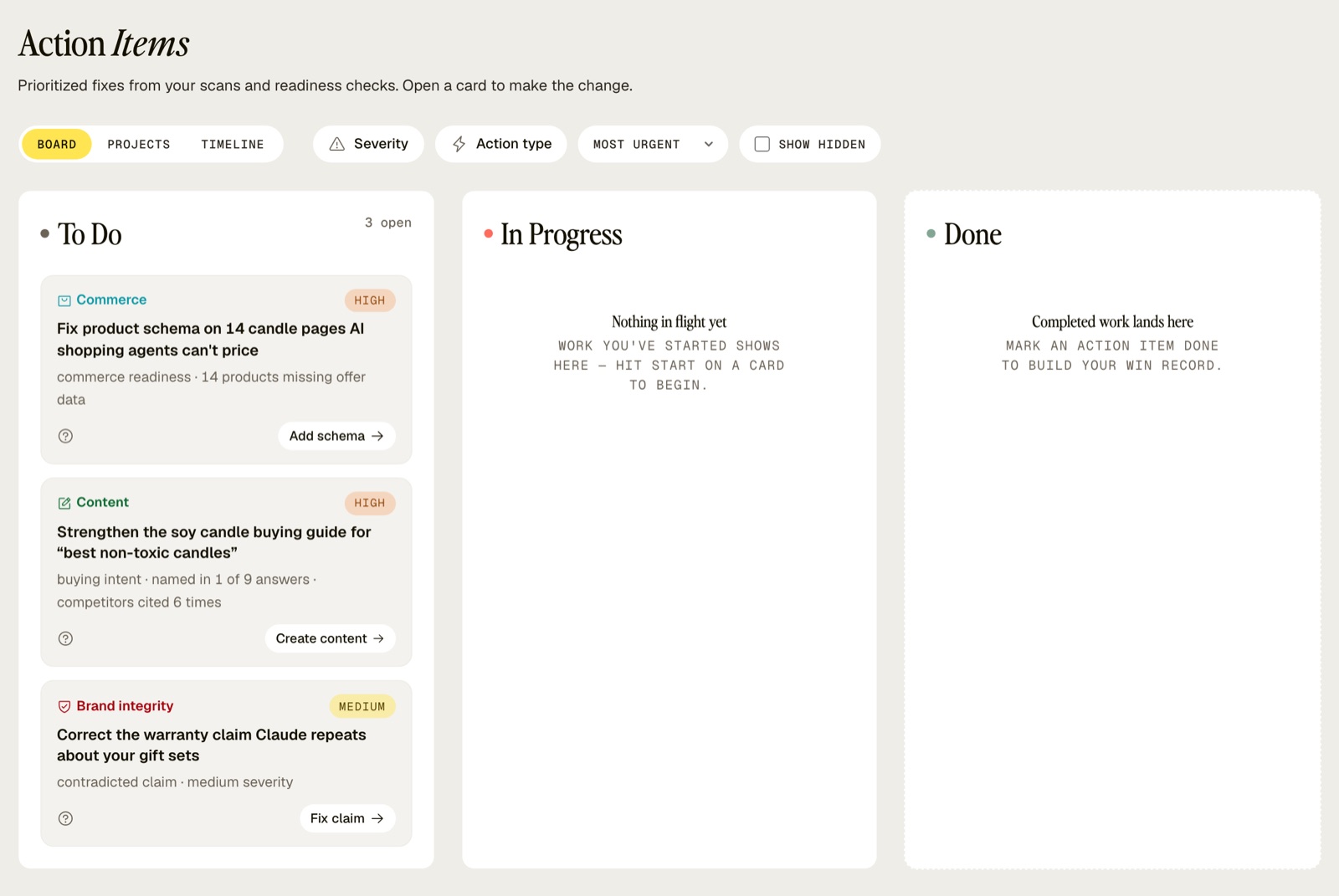
Summary
Most GEO tools stop at the report: you see the gap and still have to write the page. If you want a tool that drafts and publishes, Promptwatch and Gauge go furthest, with articles built from citation data and CMS publishing; Writesonic and Siftly put the most articles in a sub-$100 plan. Stride fits small teams that want every gap from their own scans turned into a reviewed draft, then checked in later scans to see whether it worked.
Stride publishes this comparison and is one of the tools in it. Facts about Promptwatch, Writesonic, Siftly, Gauge, Goodie, AirOps, Surfer, Geoptie, Knowatoa come from their own public pricing and product pages, checked on October 13, 2026, and are linked where they appear. Where another tool is the better choice, we say so.
What counts as a GEO tool that writes content?
A tool qualifies here if a paid plan drafts the fix itself, beyond a brief or a score. We looked at five things:
- Grounding. Is the draft built from the AI answers and cited sources the tool collected, or from a keyword?
- Volume. Drafts or articles per month at the entry plan.
- Publishing. Does it push to your CMS, or hand you a draft?
- Engines. What the tool measures at that plan, because a draft can only target gaps the tool can see.
- Proof. Does the tool check whether the page changed the answer?
We checked each vendor's own pricing page on October 13, 2026. Stride publishes this page and is ranked by fit, not placed first.
How do the ten tools compare?
| Tool | Entry price with content (Oct 2026) | Content at that plan | Publishing | Engines at that plan |
|---|---|---|---|---|
| Promptwatch | $245/mo (Professional) | 5 AEO articles a month | Webflow, Framer integrations | 4 chosen models |
| Stride | $99/mo (Starter) | 3 drafts a week | You publish | ChatGPT |
| Writesonic | $79/mo billed annually | 15 AI articles a month | WordPress listed; plan not stated | ChatGPT, Gemini, AI Overviews |
| Siftly | $79/mo | 8 blog posts a month | Auto-publish to your CMS | 3 |
| Gauge | $599/mo | 18 articles a month | Webflow, Framer, Sanity, GitHub | 6 |
| Goodie | $399/mo billed annually | 50 optimizations a month | Not stated for Core | 5 |
| AirOps | Not published | Task-based content workflows | CMS integrations | ChatGPT on Solo, 7+ on Pro |
| Surfer | $99/mo billed yearly (Standard) | 360 documents | Not stated | ChatGPT |
| Geoptie | $41/mo billed annually | Unlimited content generation | Not stated | Any 4 of 7 |
| Knowatoa | $59/mo (Starter) | AI article generation listed; plan not stated | CMS publishing listed | ChatGPT, AI Overviews, AI Mode |
Facts last verified October 13, 2026. Prices and plan limits change often; each vendor's pricing page is linked so you can check today's numbers.
Which GEO tools draft or publish the fix?
1. Promptwatch
Best for: marketing teams that want articles written from what AI engines actually cite.
Promptwatch's Content Agent analyzes the sources AI cites and writes articles meant to be referenced more often. Professional includes 5 AEO articles and 1,500 agent credits a month. Its feature list includes content gap analysis and content refresh, and every plan has API and MCP access.
Limits: Essential at $95 includes no AEO articles. Each plan tracks 4 models. Price: Professional $245, Business $579 (10 articles) a month, per Promptwatch's pricing page.
2. Stride
Best for: small teams that want each gap turned into a reviewed draft and checked afterwards.
Every Stride scan stores the full answer and the cited URLs for each question and engine. Gaps become action items, and each one can open a draft grounded in that evidence, with editorial checks and a pricing-claim check before you see it. Later scans show whether the question started naming or citing you. Our content drafting page shows how a draft is built.
Limits: your team publishes each draft; Stride doesn't list CMS auto-publishing. Starter tracks 25 questions weekly on ChatGPT only. No public API or MCP. Price: Starter $99 (3 drafts a week), Grow $349 (25 a month), Scale $1,297 (100 a month), per our pricing page.
3. Writesonic
Best for: the most articles per dollar alongside tracking.
Writesonic Starter tracks 50 prompts daily on ChatGPT, Gemini and Google AI Overviews and includes 15 AI articles, a brand voice and 10 site audits a month, so writing and tracking sit in one plan.
Limits: three engines below Enterprise; sentiment arrives on Growth and the full Action Center on Enterprise. Price: Starter $79, Basic $199, Growth $399 a month billed annually, per Writesonic's pricing page.
4. Siftly
Best for: teams that want posts written and published without touching the CMS.
Siftly Starter tracks 50 prompts daily and includes 8 GEO-optimized blog posts a month with auto-publish, plus 5 citation outreach campaigns. Growth adds Reddit engagement, 30 posts a month and GA4 and Search Console.
Limits: Starter tracks 3 engines with one seat. Price: Starter $79, Growth $249, Scale $599 a month, 7-day trial with no card, per Siftly's pricing page.
5. Gauge
Best for: teams that want high-volume tracking and publishing in one plan.
Gauge Growth runs 600 prompts daily across six platforms and includes 18 publish-ready articles a month, published to Webflow, Framer, Sanity or GitHub. GA4 and Search Console sit alongside.
Limits: one self-serve plan at $599. Price: Growth $599 a month with a 1-week trial, per Gauge's pricing page.
6. Goodie
Best for: brands that want content agents plus a strategist.
Goodie's agents table lists an AEO content writer, blog generation, content optimization and outreach agents. Core includes 50 optimizations a month, 120 prompts on five engines and a 30-minute onboarding call with a strategist.
Limits: $399 is the annual rate; it shows $478.80 on quarterly billing. Price: Core $399, Pro $999 a month billed annually, per Goodie's pricing page.
7. AirOps
Best for: content teams that want to build their own production workflows.
AirOps is a content operations platform: playbooks, workflows, brand kits, knowledge bases and human review, with answer engine insights on top. Solo starts free with ChatGPT insights and 35,000 tasks.
Limits: Pro and Enterprise prices aren't published. Price: see AirOps' pricing page.
8. Surfer
Best for: SEO writers who already work in a content editor.
Surfer Standard pairs a content editor and AI writing assistant (360 documents) with 25 AI prompts tracked weekly on ChatGPT. Pro tracks 50 prompts daily on five engines.
Limits: tracking on Standard is ChatGPT only and weekly. Price: Standard $99, Pro $182 a month billed yearly, per Surfer's pricing page.
9. Geoptie
Best for: the lowest price for unlimited drafts.
Every Geoptie plan includes unlimited content generation and optimization, daily tracking on any 4 of 7 engines and unlimited team members.
Limits: 15 monitoring prompts on Starter. Price: Starter $41, Professional $83 a month billed annually, per Geoptie's pricing page.
10. Knowatoa
Best for: teams that want drafts plus founder-led help.
Knowatoa's features page lists AI article generation for your highest-priority tracked questions, with internal linking, SEO metadata and CMS publishing. Its pricing page doesn't say which plan includes it.
Limits: Starter tracks ChatGPT, AI Overviews and AI Mode. Price: Starter $59, Growth $199 a month, per Knowatoa's pricing page.
Which tools only measure?
Many good tools stop at the report. LLMrefs tracks 500 prompts on every engine it supports for $79 and shows content gaps, but its pricing page lists no writer. Rankscale's pricing page lists recommendations and page audits but no writer. Otterly lists recommendations and GEO URL audits.
These suit teams with writers who want clean data. If nobody on your team has hours to turn a source report into pages, the report tends to sit unread.
How do you check that a drafted page worked?
Don't count articles; count answers. Before you publish, note which tracked questions name or cite a competitor. After the page is live and crawled, compare the same questions on the same engines.
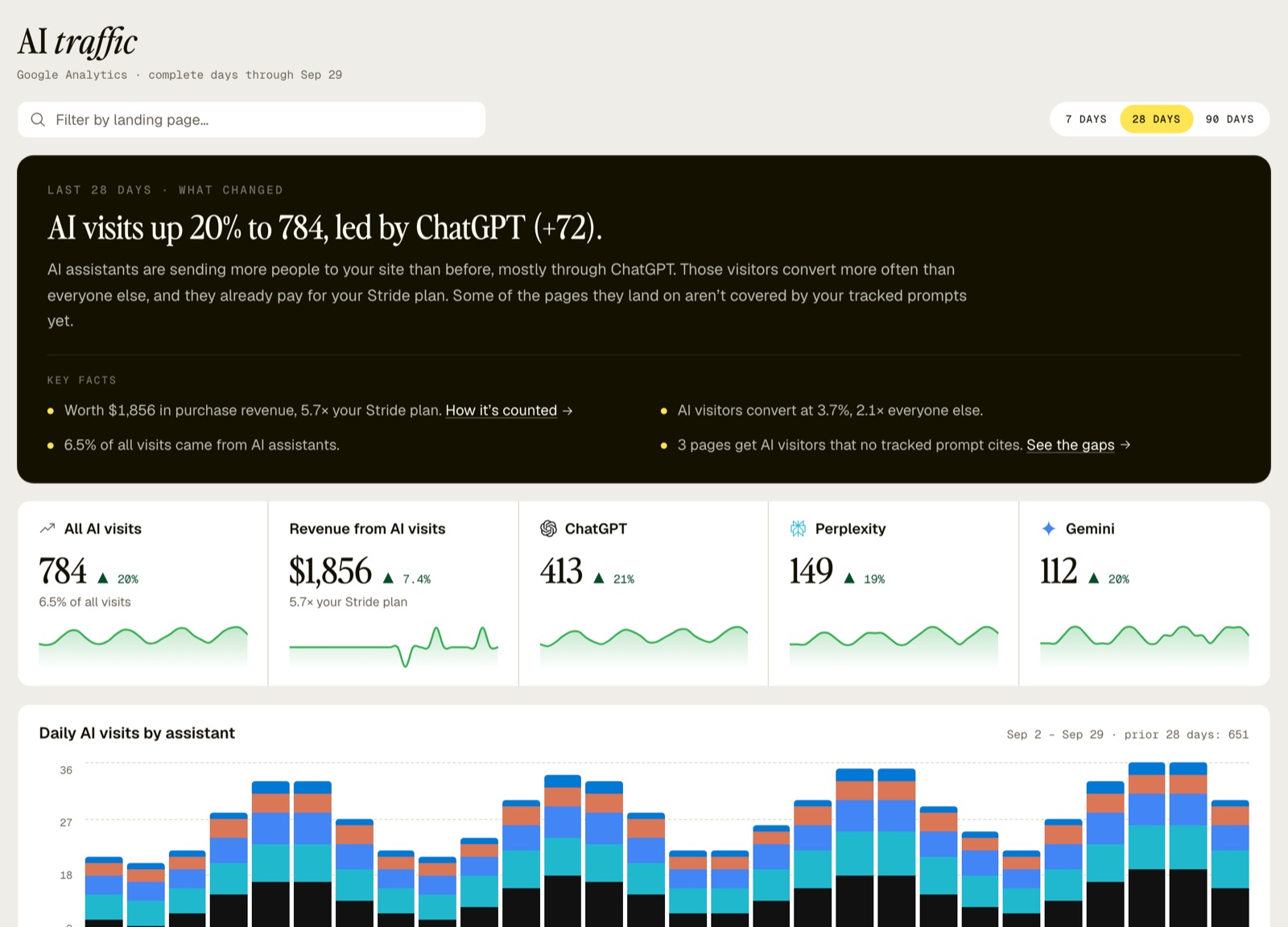
Stride's AI traffic view, shown with sample data.
Then check traffic. Stride reads GA4 on every plan and reports sessions, conversions and revenue for each AI source, so you can see whether the cited page sent buyers.
When is another tool the better choice?
If you want articles published without opening your CMS, Siftly or Gauge. If you want the most articles for the money, Writesonic or Geoptie. If your writers live in a content editor, Surfer. If you want articles written from citation data with API and MCP access, Promptwatch; our Stride vs Promptwatch comparison goes deeper.
When is Stride the better choice?
When you want fewer, better-grounded drafts and proof they worked. Each Stride draft starts from the AI answers and sources in your own scans, passes editorial and pricing checks, and stays tied to the action item that later scans close.
Two quick scenarios
A two-person SaaS marketing team on Webflow. They want two articles a week live with no CMS work. Siftly or Gauge fits, depending on budget.
An online store's marketing lead. A competitor's buying guide gets cited for "best trail shoes for wide feet" and theirs doesn't exist. Stride fits: the gap becomes an action item with a drafted guide, and later scans show whether it started earning citations.
Frequently asked questions
What is the difference between a GEO monitoring tool and one that writes content?
A monitoring tool asks AI engines your buyers' questions and reports whether you were named or cited. A tool that writes content also drafts the page, edit or article meant to close the gap it found. Some go further and publish to your CMS for you; others leave publishing to your team.
Which GEO tools publish content to my website automatically?
As of October 2026, Siftly lists auto-publish to your CMS from its $79 Starter plan, Gauge publishes to Webflow, Framer, Sanity and GitHub on its $599 Growth plan, and Promptwatch lists Webflow and Framer integrations. Stride drafts the fix and your team publishes it.
Which is the cheapest GEO tool that writes content?
Geoptie lists unlimited content generation on every plan, from $41 a month billed annually. Writesonic Starter includes 15 AI articles a month at $79 billed annually, Siftly Starter includes 8 blog posts at $79, and Stride Starter includes 3 drafts a week at $99.
Do AI-written pages get cited by AI engines?
Only if they answer the question better than the pages already cited. The original GEO research paper, accepted to KDD 2024, found that adding statistics, quotations and cited sources lifted visibility in generative engine responses by up to 40%. A draft grounded in the sources an engine already trusts has a better starting point than a generic article.
Should I let a tool publish without review?
We would not. Drafts can repeat a wrong price, an old feature or a competitor's claim. Pick a tool that shows you the evidence behind each draft, and keep a person between the draft and the publish button.
Related comparisons
- Head to headStride vs Promptwatch: Which Should You Pick? (2026)
- Head to headStride vs Goodie: Which Fits Your Budget? (2026)
- Head to headStride vs Surfer AI Tracker: Which Fits You? (2026)
- Tool roundupsThe Best GEO Tools in 2026: 10 Compared
- Tool roundupsBest AI Visibility Monitoring Tools in 2026
- Tool roundupsAgentic Commerce Readiness Tools: 7 Compared (2026)
How Stride does this: Action items
Product names are trademarks of their respective owners and are used here only to identify them. Stride is not affiliated with or endorsed by any company named on this page.