
Summary
ziptie.ai is the better buy if you want to pay only for the AI tracking you use: about a cent per prompt per engine per check, seven engines including Bing AI Overview and Microsoft Copilot, and unlimited seats and projects. Stride charges a flat plan and puts more of the work after measuring into it, with drafted fixes, revenue per AI source from GA4, store readiness checks and white-label agency reporting. Analysts and lean teams who want cheap, flexible monitoring will usually prefer ziptie.ai; teams that need fixes and proof should look at Stride.
Stride publishes this comparison and is one of the tools in it. Facts about ziptie.ai come from its own public pricing and product pages, checked on October 13, 2026, and are linked where they appear. Where another tool is the better choice, we say so.
How do Stride and ziptie.ai compare at a glance?
| Stride | ziptie.ai | |
|---|---|---|
| Pricing model | Flat plans: Starter $99, Grow $349, Scale $1,297 a month | Usage-based: prompts × cadence × engines; presets from $42.75/mo |
| Annual discount | 20% off Grow and Scale | 5% quarterly, 10% semi-annual, 20% annual, on prompts only |
| Prompts | 25, 50 or 300 by plan | As many as you buy, in daily, weekly and monthly pools |
| Frequency | Weekly on Starter, 3 times a week on Grow, top 100 daily on Scale | Daily, weekly or monthly, set per project |
| Engines | ChatGPT on Starter; Gemini, Claude (beta) and AI Overviews on Grow; Perplexity on Scale | ChatGPT, Google AI Overviews, Perplexity, AI Mode, Copilot, Bing AI Overview, Gemini |
| Seats and projects | 2, 3 or 5 seats by plan; unlimited on Agency | Unlimited seats, projects and competitors |
| Content | Drafts from scan findings, included: 3 a week on Starter, 25 or 100 a month on Grow and Scale | Add-on, $20/mo per context: 8 briefs and 4 pieces a month |
| AI traffic | GA4 sessions, conversions and revenue per AI source | Google Search Console clicks and impressions |
| API and MCP | None | Add-on, $10/mo |
| White-label | Agency plan; $99/mo report add-on on other plans | Not offered, per its pricing page |
| Trial | Free audit, no account; 7-day trial, card required | 7-day trial, no card; no refunds on paid plans |
Facts last verified October 13, 2026. Prices and plan limits change often; each vendor's pricing page is linked so you can check today's numbers.
ziptie.ai's figures come from its pricing page and agency page. Stride's come from our pricing page.
How does usage-based pricing compare with a flat plan?
ziptie.ai's model is simple to reason about once you see it. One prompt checked once on one engine costs $0.01. A weekly prompt costs a seventh of a daily one and a monthly prompt a thirtieth. Price follows how many engines you run, not which ones.
Its calculator puts 50 daily prompts on ChatGPT, Google AI Overviews and Perplexity at $42.75 a month, and smaller setups cost less because you pay for the prompts, engines and cadence you choose.
That makes ziptie.ai hard to beat for pure monitoring. Its own worked examples price an in-house brand with 50 daily, 300 weekly and 1,000 monthly prompts on all seven engines at $230.95 a month, or $184.76 paid yearly.
Stride's plans bundle tracking with work that ziptie.ai either sells as an add-on or doesn't list: drafted content, Brand Integrity on Grow and up, AI Readiness, GA4 revenue reporting and action items. If you only need the data, ziptie.ai costs less. If you'd buy those extras anyway, compare the full bill.
Which tracks more AI engines?
ziptie.ai, including one Stride doesn't track at all: Bing AI Overview. Its seven engines are ChatGPT, Google AI Overviews, Perplexity, Google AI Mode, Microsoft Copilot, Bing AI Overview and Google Gemini. Google AI Overviews checks also capture Google's top 10 organic results, and Bing AI Overview checks capture Bing's, at no extra cost.
Stride's Starter tracks ChatGPT only. Grow adds Gemini, Claude (beta) and Google AI Overviews on the first 15 prompts you add. Scale adds Perplexity and full AI Overviews.
Stride tracks Claude, which ziptie.ai's engine list doesn't include, and doesn't track Copilot, Bing, AI Mode, Grok, Meta AI or DeepSeek. For B2B buyers who work in Microsoft tools, the Copilot and Bing coverage can decide this on its own.
What does each tool do after it measures?
ziptie.ai's add-ons go past monitoring. UGC Impact Analysis, at 80% on top of the prompt price, ranks the third-party platforms AI engines cite, reads the Reddit threads and YouTube videos behind them and suggests prompts from those conversations. Content Generation, at $20 a month per brand or product line, adds 8 briefs and 4 finished pieces a month with a built-in fact check and footnote citations.
Stride includes drafting in every plan and ties it to scans. Every finding becomes an action item on one board. Where the fix is content, Stride drafts it from the answers and sources in your own scans, and later scans show whether the prompt moved. Brand Integrity, on Grow and up, flags when AI states something false about you and routes the fix to the same board.
Can either show what AI visitors are worth?
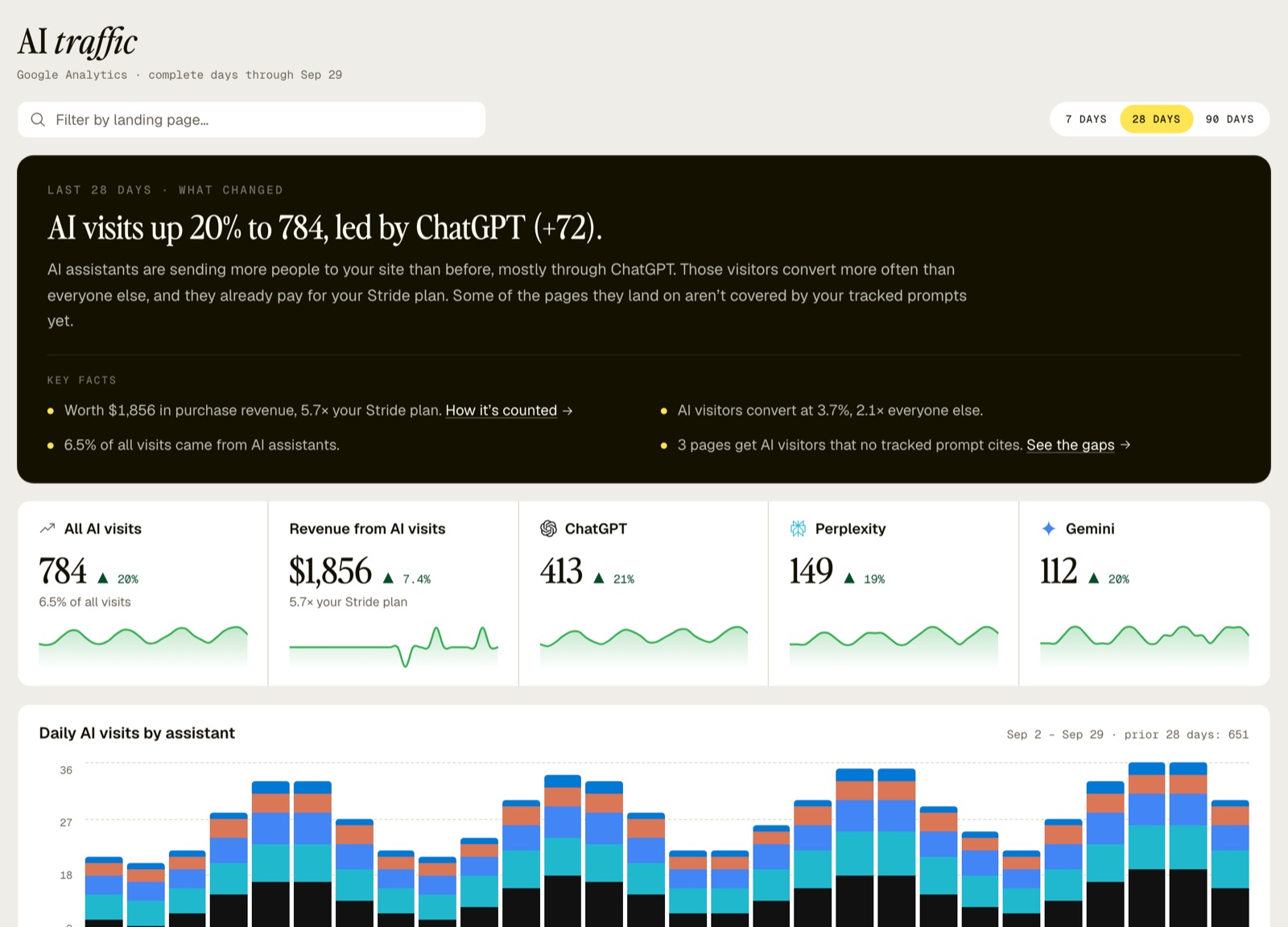
Stride's AI traffic view connects Google Analytics 4 on every plan and reports sessions, conversions and revenue for each AI source. ziptie.ai connects Google Search Console and shows clicks and impressions next to your AI data; its pricing page doesn't mention Google Analytics or revenue.
Its API reference covers pulling prompts, responses and citations into your own reports. If you report visibility to an SEO lead, ziptie.ai has what you need. If a founder asks what ChatGPT visitors bought last month, Stride answers that.
Which is better for agencies?
ziptie.ai is cheap to scale across clients. A new client costs only its prompts, every project draws on one shared pool, seats are unlimited, and clients can be invited as viewers of their own project. Its own example prices ten clients at 50 weekly prompts each on all seven engines at $130.72 a month. Its pricing page also names two gaps plainly: no white-label reports, and no view that rolls clients up together.
Stride Agency covers both. It's a $499 monthly platform fee plus a discounted Starter, Grow or Scale plan per client, on one invoice, with unlimited team seats, client logins with view-only or edit access, white-label branding across the dashboard and reports, a portfolio view of every client, and account transfer that moves a client's site and history into their own account if they leave. The agency page has the details.
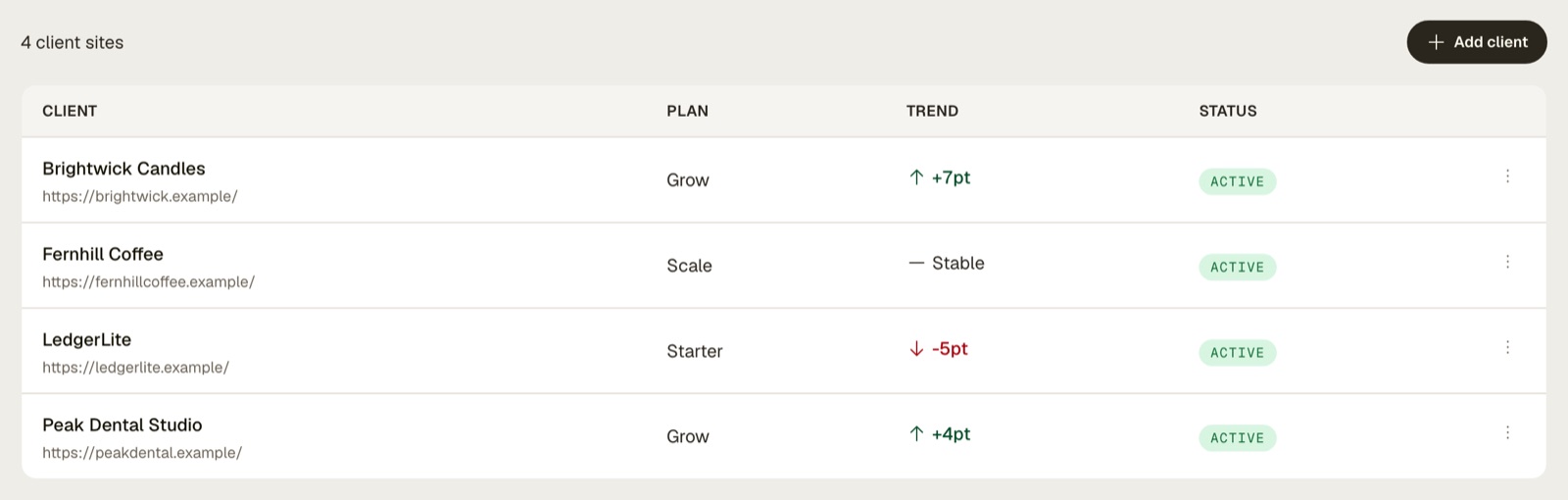
Stride's agency client table, shown with sample data.
When is ziptie.ai the better choice?
- You want to pay only for the prompts and engines you track.
- Your buyers use Microsoft Copilot or Bing, or you want Google and Bing organic results alongside AI answers.
- You need unlimited seats and projects without a plan upgrade.
- You want an API and MCP server for $10 a month.
- You want to test for seven days without entering a card.
When is Stride the better choice?
- You want drafted fixes, action items and Brand Integrity included in the price.
- You need revenue per AI source from GA4.
- You sell online and want your store checked against agent-commerce protocols such as ACP, UCP and x402.
- You track Claude.
- You run an agency that needs white-label reports, a portfolio view and a clean handoff when a client leaves.
Stride's limits: a higher entry price, weekly scans and one engine on Starter, no API or MCP, and no Copilot, Bing or AI Mode.
Two quick scenarios
A data analyst at a software company. They want 500 prompts checked monthly on every engine, piped into the company's BI tool, and don't need anyone to write content. ziptie.ai fits: the long tail costs little on a monthly cadence, and the API add-on is $10.
An agency with twelve ecommerce clients. Clients expect branded reports, revenue numbers and the fixes done. Stride fits: per-client plans on one invoice, white-label reporting, GA4 revenue per AI source, and drafts for each content gap.
Frequently asked questions
How does ziptie.ai pricing work?
ziptie.ai has no tiers. You pay for the prompts you monitor, how often they run and how many engines run them, at about a cent per prompt per engine per check, plus optional add-ons. As of October 2026 its presets start at $42.75 a month, and seats, projects and competitors are unlimited.
Is ziptie.ai cheaper than Stride?
For monitoring alone, yes. ziptie.ai's calculator prices 50 daily prompts on three engines at $42.75 a month. Stride Starter costs $99 a month for 25 prompts scanned weekly on ChatGPT, with content drafts, GA4 revenue reporting and AI Readiness included.
Does ziptie.ai track Bing and Copilot?
Yes. ziptie.ai tracks seven engines, including Bing AI Overview and Microsoft Copilot, and its Bing AI Overview checks also capture Bing's top 10 organic results. Stride tracks up to four AI engines, ChatGPT, Gemini, Claude (beta) and Perplexity, plus Google AI Overviews, and does not track Bing or Copilot.
Is ziptie.ai or Stride better for agencies?
ziptie.ai is cheaper per client and has unlimited seats, but its pricing page says it has no white-label reports and no cross-client rollup. Stride Agency is a $499 monthly platform fee plus a discounted plan per client, with unlimited seats, client logins, white-label branding and account transfer when a client leaves.
Can I try both before paying?
Yes. ziptie.ai offers a 7-day trial with 25 daily prompts on ChatGPT, Google AI Overviews and Microsoft Copilot, with no card required. Stride has a free audit that needs no account and a 7-day free trial on Starter, Grow and Scale, which requires a card.
Related comparisons
- Head to headStride vs Otterly: Monitor or Act? (2026)
- Head to headStride vs Geoptie: Which Fits Your Budget? (2026)
- Head to headStride vs Peec AI: Which Fits Your Team? (2026)
- Tool roundupsBest AI Visibility Monitoring Tools in 2026
- Tool roundupsAI Citation Tracking: What It Is and 7 Tools
- Tool roundupsAgentic Commerce Readiness Tools: 7 Compared (2026)
How Stride does this: AI traffic
Product names are trademarks of their respective owners and are used here only to identify them. Stride is not affiliated with or endorsed by any company named on this page.