
Summary
LLMrefs is the better buy if you want the most AI visibility data for the least money: $79 a month tracks 500 prompts across ten AI engines, refreshed weekly, with unlimited seats and projects. Stride fits teams that want each finding turned into a drafted fix, scans more often than weekly, and AI visits tied to revenue in GA4. SEO consultants and agencies reporting on many brands will usually prefer LLMrefs; small teams that need the work done, not only measured, should look at Stride.
Stride publishes this comparison and is one of the tools in it. Facts about LLMrefs come from its own public pricing and product pages, checked on October 13, 2026, and are linked where they appear. Where another tool is the better choice, we say so.
How do Stride and LLMrefs compare at a glance?
| Stride | LLMrefs | |
|---|---|---|
| Entry price | Starter, $99/mo | One plan, $79/mo ("limited time only") |
| Prompts at entry | 25 | 500 |
| Refresh frequency | Weekly (Starter), 3 a week (Grow), daily top 100 (Scale) | Weekly reports; every keyword updated at least weekly |
| AI engines | ChatGPT; Grow adds Gemini, Claude (beta), AI Overviews; Scale adds Perplexity | 10 listed, all included: ChatGPT, AI Overviews, AI Mode, Gemini, Perplexity, Claude, Grok, Copilot, Meta AI, DeepSeek |
| How you set it up | Prompts you choose, plus suggestions | Keywords; LLMrefs generates the prompts |
| Team users and brands | 2, 3 or 5 seats; 1 or 3 sites; unlimited seats on Agency | Unlimited team members and projects |
| Drafts content from findings | Yes, every plan | Not listed on its pricing page |
| AI traffic | GA4 sessions, conversions and revenue per AI source | Not listed on its pricing page |
| API | None | CSV export and API |
| Free option | Free audit, no account; 7-day trial, card required | Free account, no card; 7-day trial |
Facts last verified October 13, 2026. Prices and plan limits change often; each vendor's pricing page is linked so you can check today's numbers.
LLMrefs's figures come from its pricing page. Stride's come from our pricing page.
What does $79 against $99 actually buy?
On raw tracking, LLMrefs gives you far more. Its single plan covers 500 prompts for brand mentions, sources and fan-out queries, every engine it supports with no extra fees, monthly prompt volume estimates, geo-targeting in 50+ countries, CSV export and an API. Seats and projects are unlimited, so one subscription can cover every brand you manage. The price is marked limited time, so check the page before you budget.
Stride Starter at $99 tracks 25 prompts weekly on ChatGPT, with two seats and three content drafts a week. Grow, at $349 a month or $279 billed annually, scans 50 prompts three times a week on ChatGPT, Gemini and Claude (beta), with 25 drafts a month. If you're buying data, LLMrefs wins this comparison on price alone.
Which tracks more AI engines?
LLMrefs. Its FAQ lists ten, including Google AI Mode, Microsoft Copilot, Grok, Meta AI and DeepSeek, and says the platform picks up model updates as they ship. All are in the one plan.
Stride's Starter tracks ChatGPT only. Grow adds Gemini and Claude (beta), plus Google AI Overviews on the first 15 prompts you add. Scale adds Perplexity and full AI Overviews. Stride doesn't track AI Mode, Copilot, Grok, Meta AI or DeepSeek.
Do you track keywords or prompts?
This is LLMrefs's most distinctive choice. You enter SEO keywords, and LLMrefs generates the conversational prompts around them, then aggregates results so each keyword gets a share of voice and an average position. Its API lets you pull that data into your own reports. SEO teams can import a keyword list and see AI visibility in minutes.
Stride tracks the questions you choose, with suggestions and opportunities from your scans and Search Console. That's more setup, and you see each answer word for word. If your reporting is built around keywords, LLMrefs fits the way you already work.
How fresh is the data?
LLMrefs refreshes weekly. Its FAQ says results are checked continuously and every keyword is updated in the dashboard at least once a week. For most brands that's enough to see a trend.
Stride matches that on Starter, then scans three times a week on Grow and the top 100 prompts daily on Scale. If you need to see a change within a day or two of publishing, that cadence matters.
What does each tool do after it measures?
LLMrefs shows you citations, share of voice and content gaps, and publishes free tools such as an AI crawlability checker, a Reddit threads finder and an llms.txt generator. What you do with the findings is up to your team.
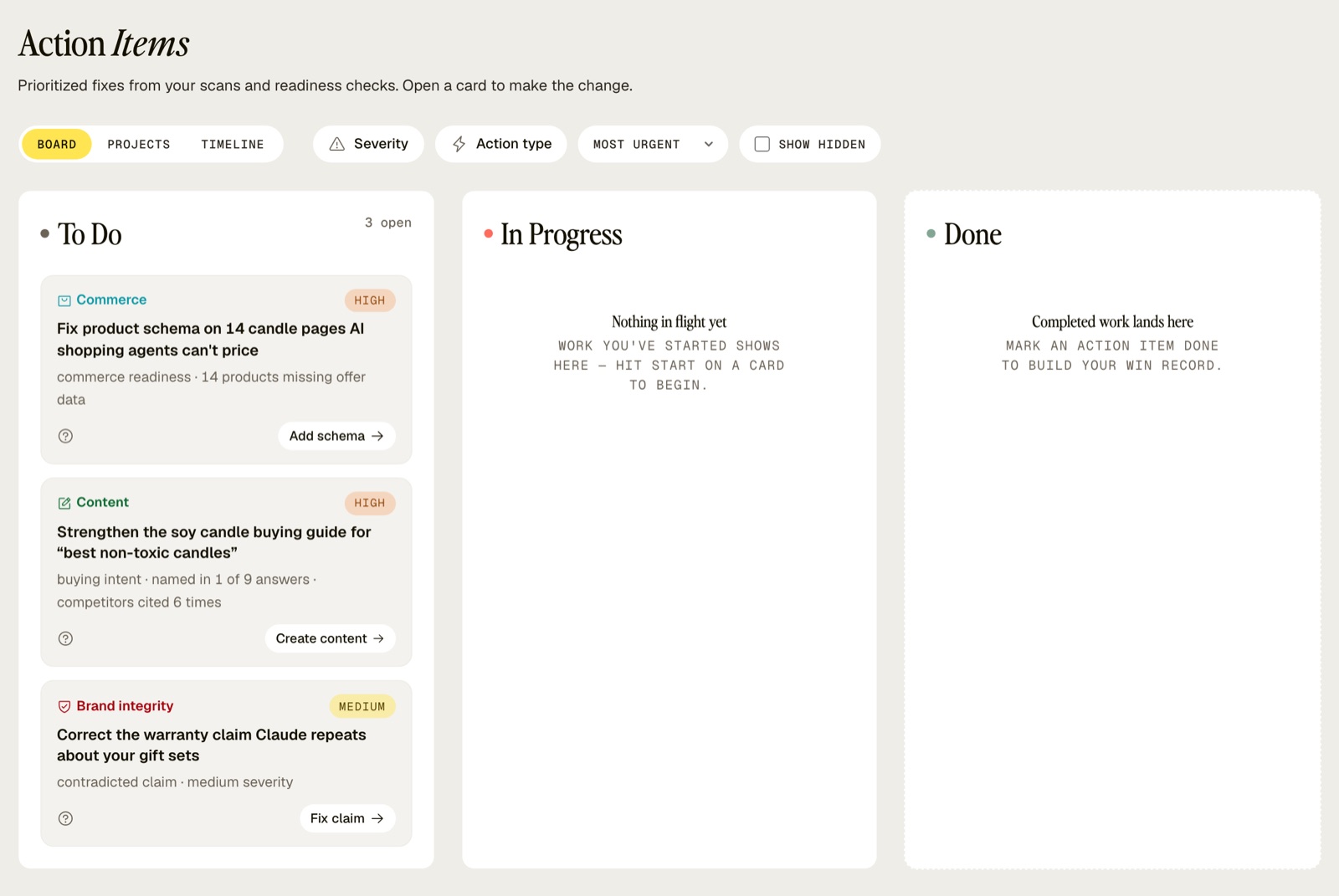
Stride turns each finding into an action item. Where the fix is content, it drafts the page or edit from the answers and sources in your own scans, and later scans show whether the prompt moved. The content drafting page shows how drafts are built.
Stride also reads GA4 and reports conversions and revenue for each AI source, which LLMrefs doesn't list.
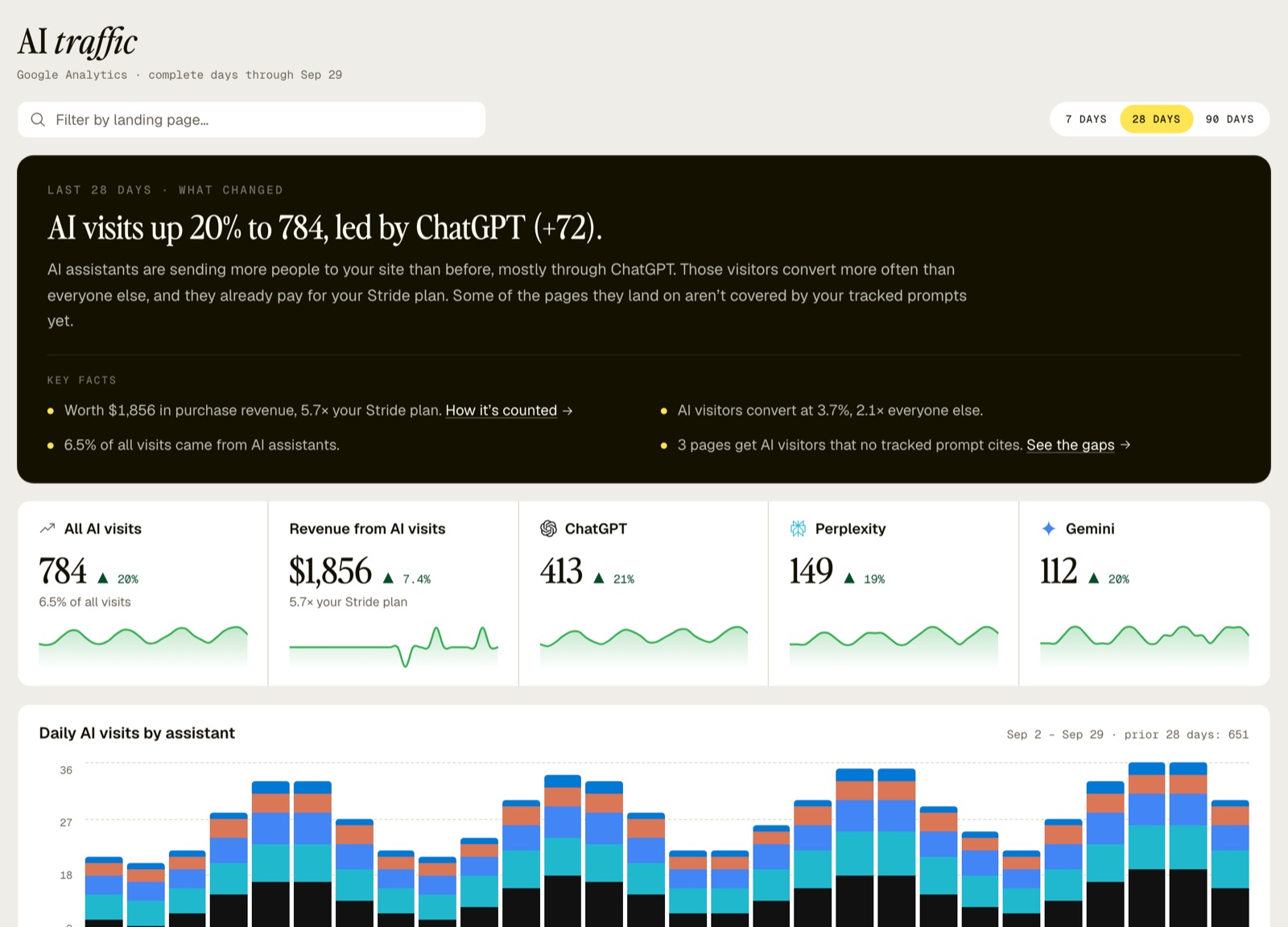
Stride's AI traffic view, shown with sample data.
Which is better for agencies?
LLMrefs is the cheaper way to report on many clients. One subscription covers unlimited projects and team members, with client dashboards and CSV exports. Its pricing page doesn't list white-label branding or client logins.
Stride Agency is a $499 monthly platform fee plus a discounted Starter, Grow or Scale plan per client, on one invoice. Seats are unlimited, clients get their own logins, branding carries across dashboards and reports, and a client's site and history can move into their own account if they take the work in-house. It costs more, and each client gets drafted fixes. The agency page covers the model.
When is LLMrefs the better choice?
- You want the most prompts and engines for the lowest monthly price.
- Your reporting is built on SEO keywords, not hand-written prompts.
- You track many brands or markets and want unlimited projects and seats.
- You need AI Mode, Copilot, Grok, Meta AI or DeepSeek covered.
- Weekly data is frequent enough for your reports.
When is Stride the better choice?
- You want findings turned into drafted content, not another report to act on.
- You need GA4 conversions and revenue for each AI source.
- You want scans three times a week or daily after you publish a fix.
- You want Brand Integrity, on Grow and up, to flag false or unsupported claims AI makes about you.
- You run an agency and want white-label branding and client logins.
Two quick scenarios
A freelance SEO consultant with eight retainer clients. They already report on keywords and want AI visibility in the same deck each month. LLMrefs fits: import keyword lists, one project per client, unlimited seats, all ten engines for $79.
A marketing manager at a regional services company. They've seen competitors named in ChatGPT and need pages that change that, plus proof for the owner. Stride Grow fits: three scans a week, 25 drafts a month aimed at the gaps, and GA4 showing which AI visitors became leads.
For more measurement-first tools, see Stride vs Otterly and Stride vs Peec AI.
Frequently asked questions
Is LLMrefs or Stride cheaper?
LLMrefs, by a lot. Its single plan is $79 a month, marked limited time, and covers 500 prompts on every AI engine it tracks, with unlimited team members and projects. Stride Starter is $99 a month for 25 prompts weekly on ChatGPT, two seats and three content drafts a week.
How often does LLMrefs refresh its data?
Weekly. Its pricing card lists weekly AI visibility reports, and its FAQ says every keyword is updated in the dashboard at least once a week. Stride scans weekly on Starter, three times a week on Grow, and daily for the top 100 prompts on Scale.
Which tracks more AI engines, LLMrefs or Stride?
LLMrefs. Its FAQ lists ChatGPT, Google AI Overviews, AI Mode, Gemini, Perplexity, Claude, Grok, Copilot, Meta AI and DeepSeek, all included in the one plan. Stride tracks up to four, ChatGPT, Gemini, Claude (beta) and Perplexity, plus Google AI Overviews, depending on plan.
Does LLMrefs show revenue from AI traffic?
Not on its pricing page. As of October 2026, LLMrefs lists citations, share of voice, prompt volume estimates, CSV export and an API, but no GA4 connection. Stride reads GA4 on every plan and reports sessions, conversions and revenue for each AI source.
Can I try both before paying?
Yes. LLMrefs offers a free account with no card and a 7-day free trial of its paid plan. Stride has a free audit that needs no account and a 7-day free trial on Starter, Grow and Scale, which requires a card.
Related comparisons
- Head to headStride vs Rankscale: Credits or Plans? (2026)
- Head to headStride vs Trakkr: Which Should You Pick? (2026)
- Head to headStride vs Otterly: Monitor or Act? (2026)
- Alternatives6 Peec AI Alternatives for Action and Agencies (2026)
- Tool roundupsAI Citation Tracking: What It Is and 7 Tools
- Tool roundupsAI Visibility Tools Under $100 a Month (2026)
How Stride does this: Create content
Product names are trademarks of their respective owners and are used here only to identify them. Stride is not affiliated with or endorsed by any company named on this page.