
Summary
Gauge is the better buy for a funded B2B or developer-tools company that wants daily data at volume: $599 a month runs 600 prompts every day on six platforms, includes 18 publish-ready articles, and publishes straight to Webflow, Framer, Sanity or GitHub. Stride fits smaller teams and online stores that want to start at $99, see conversions and revenue per AI source in GA4, and catch false claims AI makes about them. If your buyers are developers and Copilot or coding agents matter, pick Gauge; if budget is tight or you sell products, look at Stride.
Stride publishes this comparison and is one of the tools in it. Facts about Gauge come from its own public pricing and product pages, checked on October 13, 2026, and are linked where they appear. Where another tool is the better choice, we say so.
How do Stride and Gauge compare at a glance?
| Stride | Gauge | |
|---|---|---|
| Entry plan | Starter, $99/mo | Growth, $599/mo |
| Prompts and frequency | 25 weekly (Starter), 50 three times a week (Grow), 300 with the top 100 daily (Scale) | 600 prompts daily on Growth (108,000 answers a month) |
| AI engines | ChatGPT on Starter; up to ChatGPT, Gemini, Claude (beta), Perplexity, plus Google AI Overviews on Scale | ChatGPT, AI Overviews, AI Mode, Gemini, Perplexity, Copilot; Claude and Grok on Enterprise or with your own API key |
| Seats | 2, 3 or 5 by plan; unlimited on Agency | 5 on Growth |
| Drafts content | 3 a week (Starter), 25 or 100 a month (Grow, Scale) | 18 publish-ready articles a month (Growth) |
| Publishes to your CMS | No, you publish | Webflow, Framer, Sanity, GitHub |
| AI referral traffic | GA4 sessions, conversions and revenue per AI source | GA4 AI referral traffic; PostHog for product analytics |
| AI bot visits from server logs | Crawler logs, beta (Scale and Agency) | Cloudflare, Vercel or manual logs, incl. coding agents |
| Checks AI's facts about you | Brand Integrity (Grow and up) | Sentiment analysis; fact checking not listed on its pricing page |
| Agent-commerce readiness | ACP, UCP, x402 and other protocol checks on every plan | Not listed |
| MCP | None | MCP access on Growth |
| Free option | Free audit, no account; 7-day trial, card required | 1-week free trial on Growth |
Facts last verified October 13, 2026. Prices and plan limits change often; each vendor's pricing page is linked so you can check today's numbers.
Gauge's figures come from its pricing page and documentation. Stride's come from our pricing page.
What does a team like mine actually pay?
Stride costs less to get in the door. Starter is $99 a month, Grow is $349 or $279 billed annually, and Scale is $1,297 or $1,037 billed annually. Gauge has one self-serve plan, Growth at $599 a month, and Enterprise is custom.
Gauge makes a fair argument on its pricing page: Growth collects 108,000 answers a month, which it puts at about half a cent per answer. Stride collects far fewer answers at every tier. Grow runs 50 prompts three times a week on three engines; Scale runs the top 100 of 300 prompts daily and the full set weekly. If your job is statistical depth on a large prompt set, Gauge buys more of it.
If you don't need 600 daily prompts, though, $599 is a lot of measurement to pay for. A team tracking 50 buyer questions gets a working read from Stride Grow for a little over half the price, with three seats, 25 drafts a month and Brand Integrity.
Which tracks more AI engines?
Gauge. Growth covers ChatGPT, Google AI Overviews, Google AI Mode, Gemini, Perplexity and Microsoft Copilot. Enterprise adds Claude and Grok, and Gauge's pricing FAQ says any plan can turn them on by connecting your own Anthropic or xAI API key, with the provider billing you for those runs. Its engine docs say it measures the default logged-out ChatGPT experience with web search on.
Stride tracks ChatGPT on Starter, adds Gemini and Claude (beta) on Grow along with Google AI Overviews on the first 15 prompts you add, and adds Perplexity and full AI Overviews on Scale. Stride doesn't track Copilot, Google AI Mode, Grok, Meta AI or DeepSeek. B2B buyers who work inside Microsoft 365 are a good reason to choose Gauge.
Which one helps me fix what it finds?
Both turn findings into work, and Gauge goes one step further toward publishing.
Gauge's Action Center makes recommendations, and its content engine writes articles from your visibility gaps. Its CMS integrations pull your existing pages from Webflow, Framer, Sanity or GitHub, let you or the agent edit them, and publish back. On GitHub it opens a pull request for you to review. The Ask Gauge agent and Gauge MCP let you query all of it in plain language.
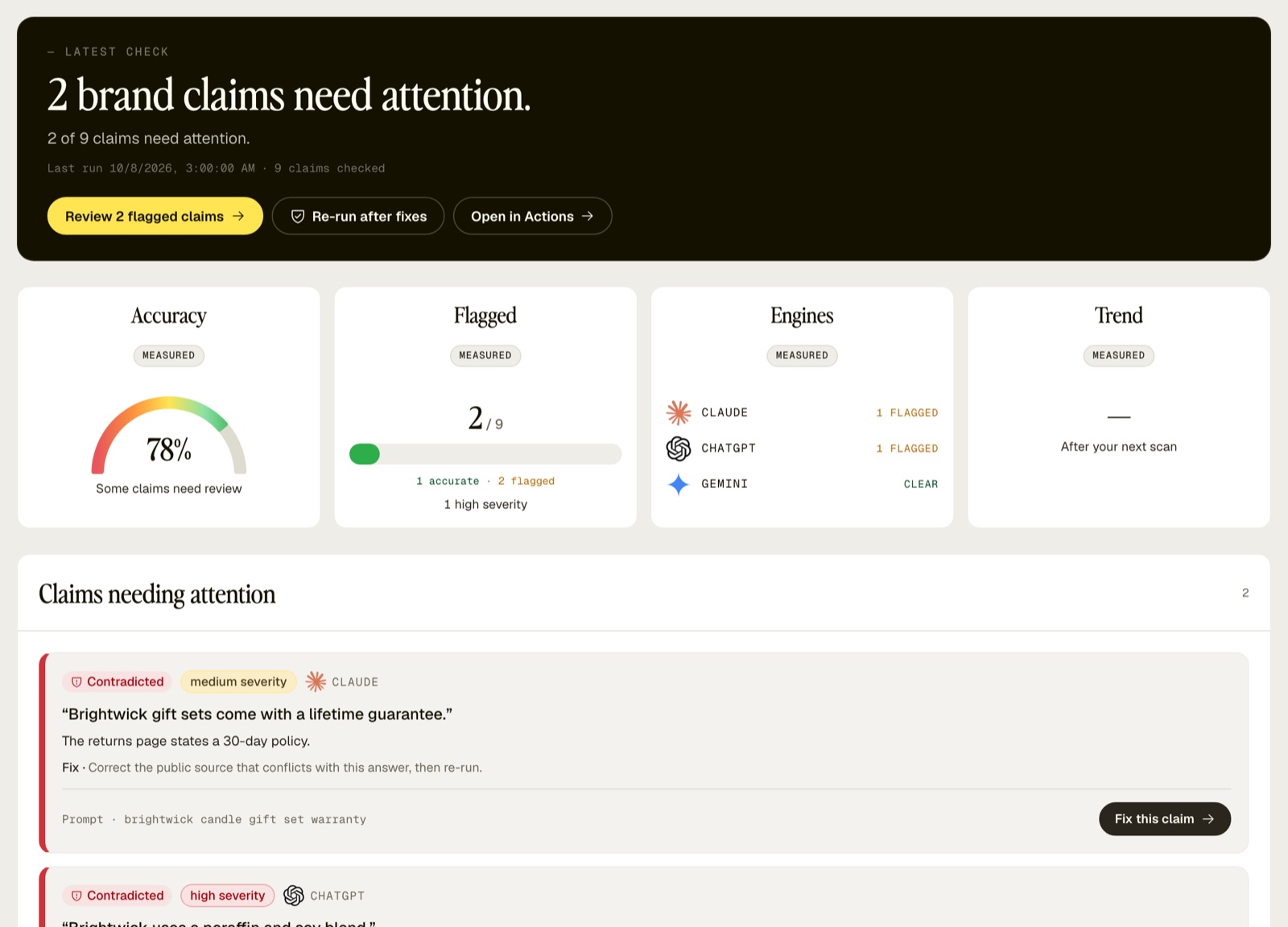
Stride turns every scan finding into an action item: a content gap, missing schema, a page AI shopping agents can't read, or a false claim about you. Where the fix is content, Stride drafts the page or the edit from the answers and sources in your own scans, and later scans show whether the prompt moved. You publish it yourself; Stride has no CMS publishing.
Teams with a Webflow or headless site and a content lead will get more out of Gauge's publishing loop. Teams without one get the diagnosis and the draft from Stride, and keep control of what ships.
Which shows what AI visits are worth?
Both read GA4, and they report different things.
Gauge's Google integration brings in Search Console, GA4 and Google Ads, including AI referral traffic from assistants like ChatGPT and Perplexity and where those visitors land. Its AI Traffic page reads your server logs to show AI bots and coding agents such as Claude Code and Cursor hitting your pages, which is useful if developers read your docs. PostHog connects so the agent can query your product analytics.
Stride's AI traffic view reads GA4 and reports sessions, conversions and revenue for each AI source on every plan, so you can tell the CFO what ChatGPT visitors bought. Crawler logs are in beta on Scale and Agency.
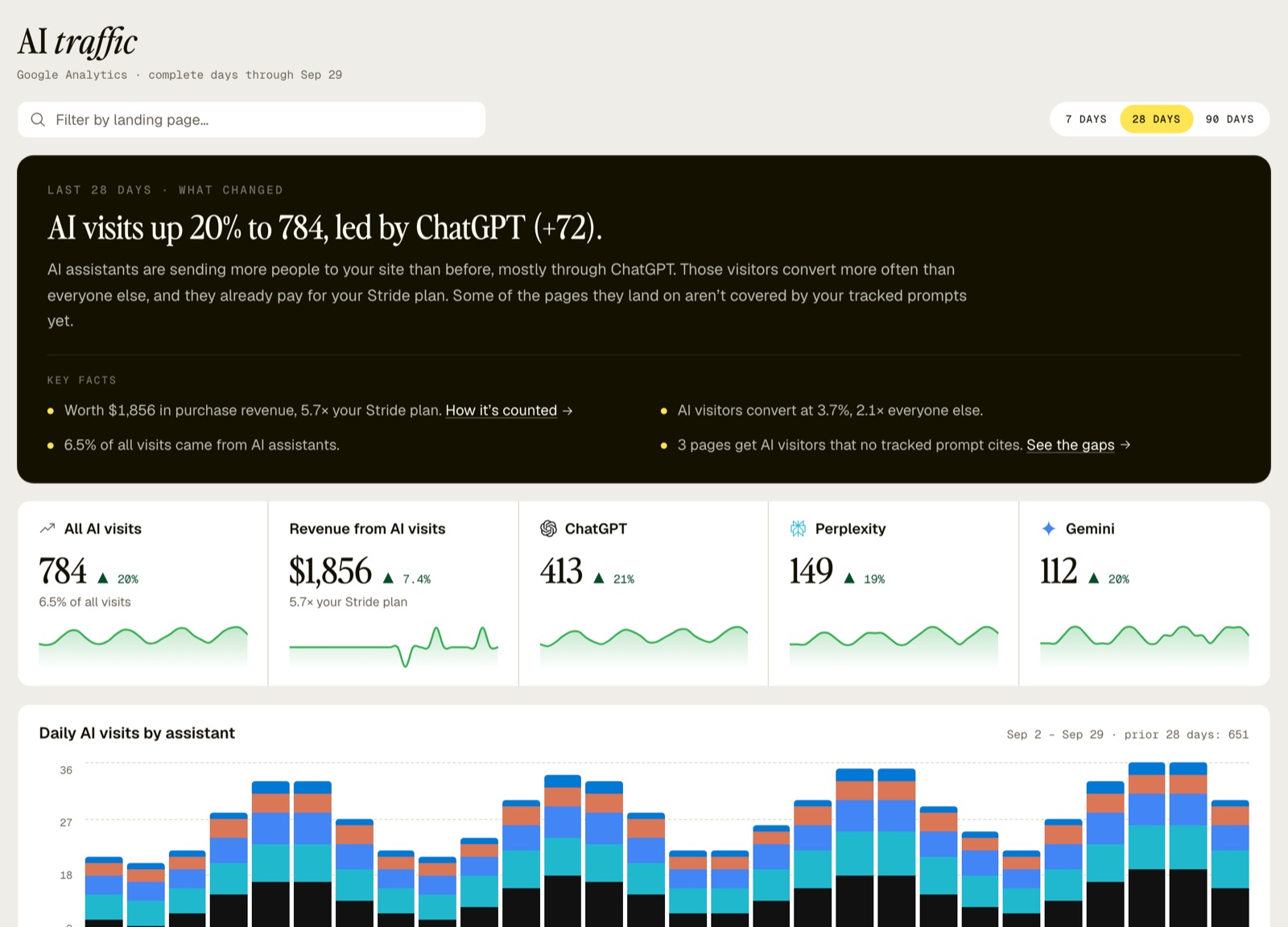
Stride's AI traffic view, shown with sample data.
Which is better for agencies?
Gauge has an agency mode with self-serve signup: a monthly agency base fee plus a per-client amount for each active client, with one parent account above full client workspaces. Its pricing page doesn't publish those amounts.
Stride Agency is a $499 monthly platform fee plus a discounted Starter, Grow or Scale plan per client, on one invoice. Team seats are unlimited, clients get their own logins, white-label branding carries across the dashboard and reports, and account transfer moves a client's site and history into their own account if they leave. Because Stride's client plans start at Starter, smaller retainers are easier to price.
When is Gauge the better choice?
- You want daily data at volume: 600 prompts on six platforms, 108,000 answers a month.
- Your buyers use Copilot or Google AI Mode, or you want Claude and Grok with your own API keys.
- You sell to developers and need to see coding agents like Claude Code and Cursor reading your docs.
- You publish on Webflow, Framer, Sanity or GitHub and want articles shipped from the tool.
- You want MCP access and an agent that queries GA4, Search Console and PostHog together.
When is Stride the better choice?
- Your budget starts closer to $100 than $600 a month.
- You need conversions and revenue per AI source from GA4, not only referral visits.
- You want AI's false claims about your brand flagged and routed into fixes, with Brand Integrity on Grow and up.
- You sell online and want your store checked against agent-commerce protocols such as ACP, UCP and x402.
- You run an agency that wants a published per-client plan for each client, unlimited seats and a clean handoff when a client leaves.
Two quick scenarios
The head of growth at a developer-tools startup. Their buyers ask ChatGPT and Copilot which SDK to use, and coding agents read their docs daily. They publish on a headless CMS from GitHub. Gauge fits: daily data on the right engines, coding-agent traffic from server logs, and drafts that land as pull requests.
A three-person team at a supplements brand. They have $350 a month for AI search and need to know whether AI is getting their ingredient claims right. Stride fits: Grow tracks 50 questions on three engines, Brand Integrity flags wrong claims, and GA4 shows what AI visitors bought.
For other options, see how Stride compares with Profound.
Frequently asked questions
Is Gauge or Stride cheaper?
Stride costs less to start. Stride Starter is $99 a month and Grow is $349, or $279 billed annually. Gauge's self-serve plan, Growth, is $599 a month. Gauge collects far more answers for that price, 600 prompts every day on six platforms, so per answer it is the cheaper of the two.
Which tracks more AI engines, Gauge or Stride?
Gauge. Growth includes ChatGPT, Google AI Overviews, Google AI Mode, Gemini, Perplexity and Microsoft Copilot, and you can add Claude and Grok by connecting your own Anthropic or xAI API key. Stride tracks up to four AI engines, ChatGPT, Gemini, Claude (beta) and Perplexity, plus Google AI Overviews, and does not track AI Mode, Copilot or Grok.
Can Gauge or Stride publish content to my site?
Gauge can. Its content engine includes 18 publish-ready articles a month on Growth and publishes to Webflow, Framer, Sanity or GitHub. Stride drafts pages and edits from your scan evidence, 3 a week on Starter, 25 a month on Grow and 100 a month on Scale, and you publish them yourself.
Do both show AI referral traffic?
Yes. Gauge connects GA4 for AI referral traffic and reads server logs for AI bot and coding agent visits. Stride connects GA4 and reports sessions, conversions and revenue for each AI source, and on Scale and Agency it reads AI crawler visits from Cloudflare or Vercel logs (beta).
Can I try both before paying?
Yes. Gauge Growth has a 1-week free trial. Stride has a free audit that needs no account and a 7-day free trial on Starter, Grow and Scale, which requires a card.
Related comparisons
- Head to headStride vs Profound: Enterprise or Self-Serve? (2026)
- Head to headStride vs Peec AI: Which Fits Your Team? (2026)
- AlternativesAI Visibility Tools for SEO Teams: 6 Compared (2026)
- Tool roundupsBest AI Visibility Monitoring Tools in 2026
- Tool roundupsAI Traffic Analytics Tools That Show Revenue (2026)
- Tool roundupsGEO Tools That Write Content: 10 Compared (2026)
How Stride does this: Brand Integrity
Product names are trademarks of their respective owners and are used here only to identify them. Stride is not affiliated with or endorsed by any company named on this page.