
Summary
AirOps is the better fit for a content team that publishes at volume and wants one system to research, write, review and publish, with AI search data feeding the workflows. Stride fits a small team or online store that wants a fixed monthly price, a short list of evidence-backed fixes with drafts, and GA4 revenue per AI source, without building workflows first. If you have content operations people, AirOps gives them more to work with; if you are the content team, Stride asks less of you.
Stride publishes this comparison and is one of the tools in it. Facts about AirOps come from its own public pricing and product pages, checked on October 13, 2026, and are linked where they appear. Where another tool is the better choice, we say so.
How do Stride and AirOps compare at a glance?
| Stride | AirOps | |
|---|---|---|
| Plans | Starter $99/mo, Grow $349/mo ($279 annual), Scale $1,297/mo ($1,037 annual), Agency | Solo, Pro, Enterprise; prices not published on its pricing page |
| How you pay | Flat monthly plan with set limits | Based on task volume; Solo extra tasks $0.025 each |
| AI engines | ChatGPT on Starter; up to ChatGPT, Gemini, Claude (beta), Perplexity, plus Google AI Overviews on Scale | ChatGPT only on Solo; 7+ answer engines on Pro |
| Content production | 3 drafts a week (Starter), 25 or 100 a month (Grow, Scale) | 35,000 tasks (Solo), 100,000 tasks (Pro), custom (Enterprise) |
| Workflows and review | Action items with drafts and verification | Playbooks, workflows, grids, brand kits, human review inbox |
| Publishes to your CMS | No, you publish | Webflow, Sanity, Contentful; imports from WordPress and Webflow |
| Seats | 2, 3 or 5 by plan; unlimited on Agency | 1 on Solo; unlimited on Pro and Enterprise |
| AI traffic | GA4 sessions, conversions and revenue per AI source | GA4 traffic, engagement and selected conversions per page |
| Agent-commerce readiness | ACP, UCP, x402 and other protocol checks | Not listed |
| API, MCP | None | AirOps MCP and API |
| Free option | Free audit, no account; 7-day trial, card required | Solo and Pro start free; 14-day trial, no payment details until it ends |
Facts last verified October 13, 2026. Prices and plan limits change often; each vendor's pricing page is linked so you can check today's numbers.
AirOps's figures come from its pricing page and documentation. Stride's come from our pricing page.
What does each tool actually do?
AirOps calls its platform a growth system for the AI-first buyer. In practice, it is a content operations platform.
You define brand kits and knowledge bases, then run playbooks and workflows that research, write, review, publish and refresh content. Agents can pause for a human to approve or edit, and every run builds on what earlier runs learned. Its Insights side tracks visibility, citations, sentiment and competitors, and feeds that data into the workflows.
Stride is narrower and more fixed. It asks AI engines the questions your buyers ask, records who gets named and which sources AI cites, and checks your site for what AI crawlers and shopping agents need. Each finding becomes an action item, and where the fix is content, Stride drafts it from the answers and sources in your own scans. You don't build a workflow; the work arrives as a prioritized list.
Neither is a smaller version of the other. AirOps is a system you configure to run your content program. Stride is a tool that tells you what to fix next and drafts it.
What does a team like mine actually pay?
Stride's prices are on its pricing page: Starter $99 a month, Grow $349 or $279 billed annually, Scale $1,297 or $1,037 billed annually. Each plan sets the prompts, engines, seats and drafts you get.
AirOps doesn't publish prices on its pricing page today. It lists Solo, Pro and Enterprise, says pricing is based on your task volume and needs, and offers to build a package with you.
Tasks are its unit: generating content or extracting data uses them, and the number depends on the step type and data processed. Solo includes 35,000 tasks and Pro 100,000. On Solo, tasks past your allotment cost $0.025 each.
So with Stride you know the bill before you sign up. With AirOps you size it against your content volume, which suits teams with a plan for how much they will produce.
Which tracks more AI engines?
AirOps, on Pro. Its Insights settings docs list ChatGPT, Gemini, Perplexity, Claude, Google AI Mode and Google AI Overviews, and its pricing page says Pro covers 7+ answer engines. Solo covers ChatGPT only.
Two details from the docs matter: a Claude answer costs four times the usual tasks, and Claude is on by default only for Enterprise, so other plans ask the account team. By default AirOps collects one answer per prompt per platform per day, and Enterprise can request more.
Stride tracks ChatGPT on Starter. Grow adds Gemini and Claude (beta), plus Google AI Overviews on the first 15 prompts you add. Scale adds Perplexity and full AI Overviews. Stride doesn't track Google AI Mode, Copilot, Grok, Meta AI or DeepSeek.
Which one helps me fix what it finds?
Both, at very different scales.
AirOps gives you the machinery: workflow steps that pull AEO prompt and page data, playbook triggers that start work when a competitor moves, content scores for readability, claim support and AEO before anything ships, and publishing to Webflow, Sanity or Contentful. It also covers channels off your site, such as Reddit and YouTube citations and ChatGPT ads reporting. A content operations lead can build a lot with it.
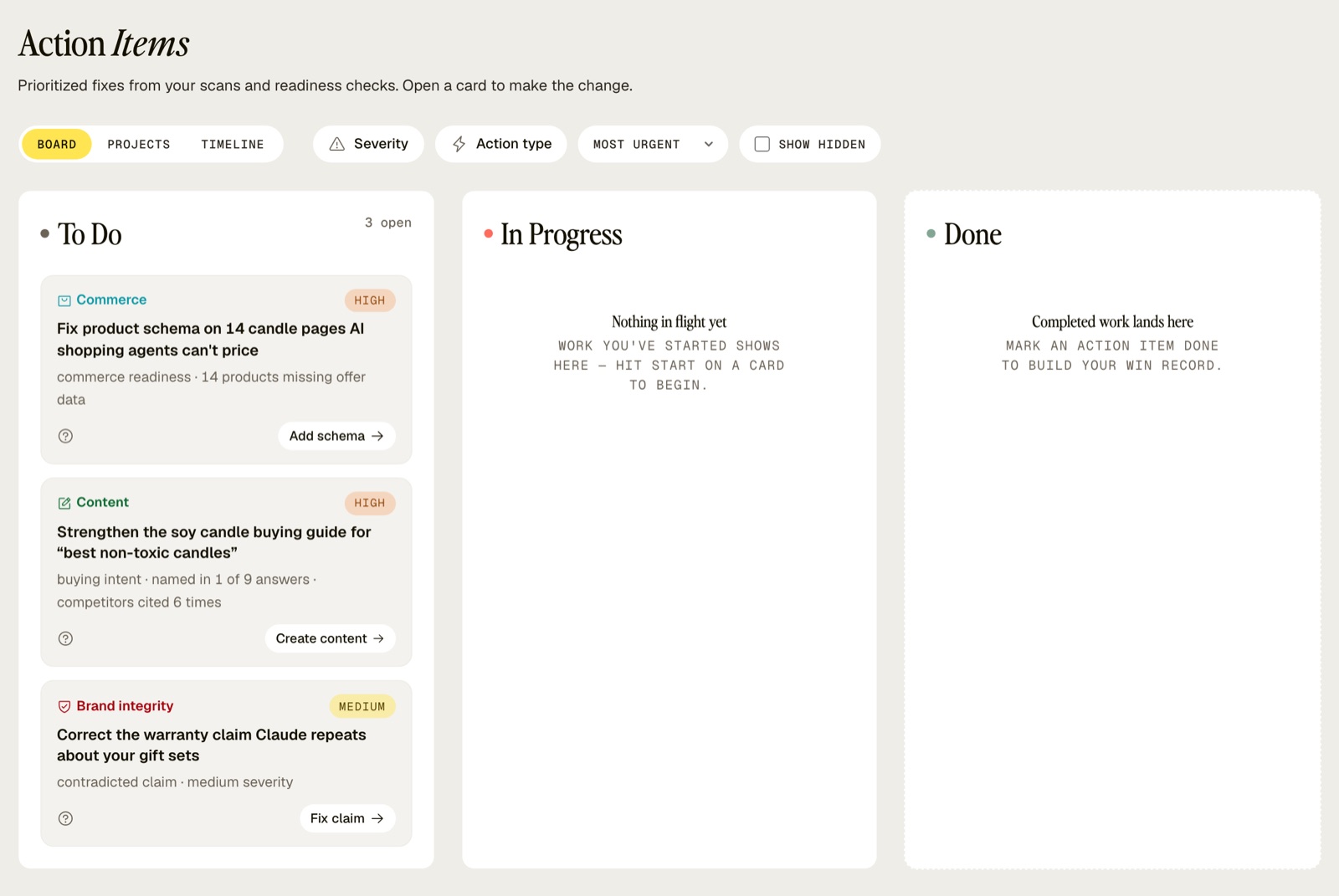
Stride hands you the next fix. Every scan finding, readiness gap, competitor loss or false claim AI makes about you becomes an action item. Content fixes come with a draft grounded in your scan evidence; technical fixes come with instructions and templates you can copy.
Later scans check whether the prompt moved. Stride doesn't publish for you and doesn't run custom workflows.
If nobody on your team will build and maintain playbooks, Stride's fixed loop is the faster route to a change on your site.
Which is better for an online store?
Stride, for checking whether AI shopping agents can buy from you. AI Readiness crawls any site and checks it against agent-commerce protocols such as ACP, UCP and x402, and each gap becomes an action item. GA4 then shows whether AI visitors bought, with revenue per AI source.
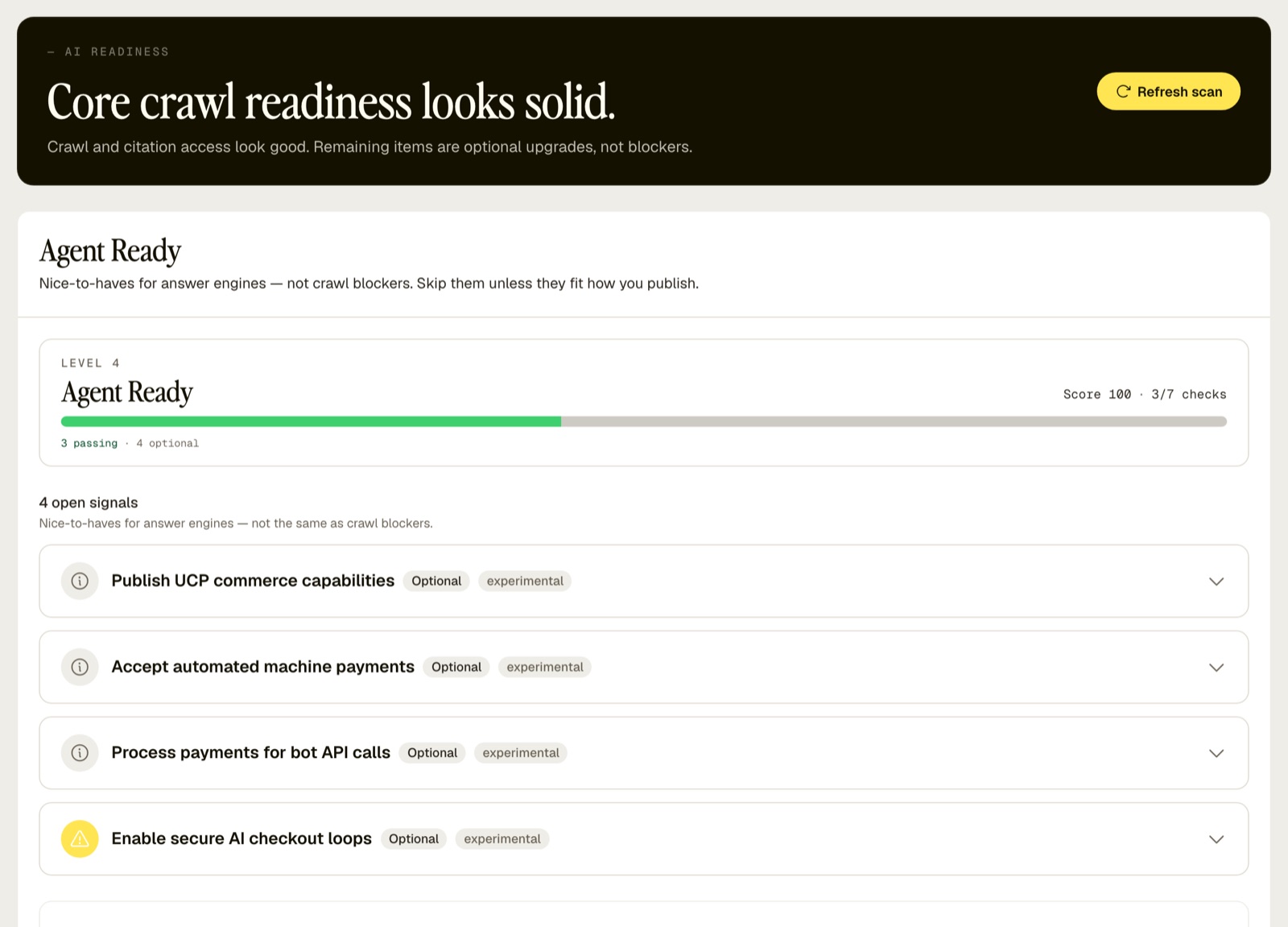
Stride's AI Readiness agent-commerce checks, shown with sample data.
AirOps connects GA4 to its Pages view, with traffic, engagement and the conversions you select, so you can rank pages by business impact. Its pricing page doesn't list agent-commerce checks. Stride's Shopify catalog sync and commerce readiness launch with its Shopify App Store listing, so today Stride doesn't grade your catalog product by product.
When is AirOps the better choice?
- You have a content team and want one system to research, write, review, publish and refresh at volume.
- You want playbooks that trigger on changes, with human approval steps and version history.
- You publish on Webflow, Sanity or Contentful and want the tool to ship pages.
- You need an API and MCP, Google AI Mode tracking, or unlimited seats on Pro.
- You want a strategy team on hand; AirOps sells expert services alongside the platform.
When is Stride the better choice?
- You want a published monthly price with set limits, starting at $99.
- You want findings turned into a prioritized list of action items, with drafts, and no workflows to build.
- You sell online and want your store checked against agent-commerce protocols.
- You need GA4 revenue per AI source to show what AI visits are worth.
- You want AI's false claims about your brand flagged, with Brand Integrity on Grow and up.
Two quick scenarios
A content operations lead at a B2B software company with six writers. They publish 40 pieces a month on Webflow and want AI search data steering every brief. AirOps fits: playbooks, brand kits and human review sized to that output, with publishing built in.
The founder of a two-person outdoor gear store. Nobody writes full time, and they need to know what to change this week. Stride fits: a weekly scan on Starter, a short list of fixes with drafts, and readiness checks that show whether shopping agents can read the store.
For other options, see how Stride compares with Promptwatch.
Frequently asked questions
How much does AirOps cost compared with Stride?
AirOps doesn't publish prices on its pricing page. Its plans are Solo, Pro and Enterprise, and it says pricing is based on your task volume and needs. Stride publishes its prices, Starter $99 a month, Grow $349 or $279 billed annually, and Scale $1,297 or $1,037 billed annually.
Which tracks more AI engines, AirOps or Stride?
AirOps, on Pro. Its docs list ChatGPT, Gemini, Perplexity, Claude, Google AI Mode and Google AI Overviews, and its pricing page says Pro covers 7+ answer engines. Solo covers ChatGPT only. Stride tracks up to four AI engines, ChatGPT, Gemini, Claude (beta) and Perplexity, plus Google AI Overviews, and does not track AI Mode.
Is AirOps or Stride better for producing content at scale?
AirOps. It is built around content workflows, playbooks, brand kits, human review and CMS publishing to Webflow, Sanity and Contentful, metered in tasks. Stride drafts content inside action items from your scan evidence, 3 drafts a week on Starter, 25 a month on Grow and 100 a month on Scale, and you publish them yourself.
Do AirOps and Stride both connect to GA4?
Yes. AirOps brings GA4 traffic, engagement and selected conversions into its Pages view. Stride's AI traffic view reads GA4 and reports sessions, conversions and revenue for each AI source.
Can I try both before paying?
Yes. AirOps offers a 14-day free trial and says you don't need payment details until it ends, and Solo and Pro both start free. Stride has a free audit that needs no account and a 7-day free trial on Starter, Grow and Scale, which requires a card.
Related comparisons
- Head to headStride vs Promptwatch: Which Should You Pick? (2026)
- Head to headStride vs Profound: Enterprise or Self-Serve? (2026)
- Head to headStride vs Goodie: Which Fits Your Budget? (2026)
- Tool roundupsThe Best GEO Tools in 2026: 10 Compared
- Alternatives6 AirOps Alternatives With Published Prices (2026)
- Tool roundupsGEO Tools That Write Content: 10 Compared (2026)
How Stride does this: Action items
Product names are trademarks of their respective owners and are used here only to identify them. Stride is not affiliated with or endorsed by any company named on this page.