
Summary
Rankscale tracks 17+ AI engines on every plan, which is hard to beat for the money. If you are leaving because of credit math, LLMrefs is the closest swap at one flat price, and Trakkr and Geoptie are the picks for agencies that want white-label reports for less. Stride fits teams that would trade engine breadth for drafted fixes and AI revenue in GA4.
Stride publishes this comparison and is one of the tools in it. Facts about Rankscale come from its own public pricing and product pages, checked on October 13, 2026, and are linked where they appear. Where another tool is the better choice, we say so.
Why do people look for Rankscale alternatives?
Rankscale is a strong measurement tool. Its pricing page lists 17+ engines on all plans, including ChatGPT, Gemini, Perplexity, Claude, DeepSeek, Mistral, Grok and Copilot, with no per-engine fee. Pro is $99 a month for 1,200 credits, and every plan from Pro up adds shopping and ad analytics and unlimited seats.
The trade-off is the credit model. Each query to an AI engine uses a fraction of a credit, typically 0.25, so what your plan covers depends on how many engines and how often you schedule each term. Teams that like a fixed prompt count find that harder to budget.
Two other reasons come up. White-labeled dashboard links start on Growth at $385 a month. And the pricing page lists recommendations (Rankscale Scout) and page audits but no article drafting, so the fix work happens elsewhere.
How we evaluated
We looked for tools a Rankscale customer could move to without a sales call. Each one had to show a price on its own pricing page on October 13, 2026. We ranked them by fit for a small team or agency that chose Rankscale for engine breadth at a low price: engines on the entry plan, price per tracked prompt, white-label cost, and what the tool does with its findings.
Prices are monthly in US dollars unless noted. Stride's facts come from our pricing page.
Which Rankscale alternatives are worth a look?
| Tool | Entry price (Oct 2026) | Tracking at entry | Engines at entry | White-label | Trial |
|---|---|---|---|---|---|
| Rankscale | Pro $99/mo (Essentials yearly only) | 1,200 credits, up to 4,800 answers | 17+ | Growth, $385/mo | 7 days on Pro |
| LLMrefs | $79/mo (limited time) | 500 prompts, weekly reports | 10 | Not listed | 7 days |
| Trakkr | $100/mo | 50 prompts per brand, daily | 8 | Scale, $500/mo | 14 days, card required |
| Geoptie | $490/yr (about $41/mo) | 15 prompts, daily | Any 4 of 7 | Professional, $990/yr | Not stated |
| Peec AI | $95/mo | 50 prompts, daily | 3 you choose | Separate agency plans | Free trial |
| Stride | $99/mo | 25 prompts, weekly | ChatGPT | Agency plan, or $99/mo add-on | 7 days, card required |
| Otterly | $29/mo | 15 prompts, daily | 4 | Not listed | Free trial |
Facts last verified October 13, 2026. Prices and plan limits change often; each vendor's pricing page is linked so you can check today's numbers.
1. LLMrefs
Best for: teams that want a long engine list at one flat price, with no credits to manage.
LLMrefs is the nearest match to what draws people to Rankscale. One plan, $79 a month and marked "limited time", tracks 500 prompts on ChatGPT, Google AI Overviews, AI Mode, Gemini, Perplexity, Claude, Grok, Copilot, Meta and DeepSeek. You import keywords and it generates the fan-out prompts for you.
Strengths: unlimited seats and projects on one subscription, geo-targeting in 50+ countries, monthly prompt volume estimates, and CSV plus API access.
Limits: reports refresh weekly, not daily. The pricing page lists no white-label, sentiment or GA4 reporting.
Price: $79 a month on LLMrefs' pricing page, as of October 2026.
2. Trakkr
Best for: agencies that want every model included and white-label client portals for less than Rankscale Growth.
Trakkr's Growth plan is $100 a month for one brand, 50 prompts tracked daily across eight models: ChatGPT, Claude, Gemini, Perplexity, Google AI Overviews, Grok, DeepSeek and Meta AI. It includes 25 articles a month and three seats. Scale is $500 for ten brands, unlimited seats, white-label client portals and a REST API.
Strengths: eight models and article drafting on the entry plan, MCP access, and a ChatGPT Shopping add-on at $49 per brand a month.
Limits: 50 prompts per brand is a fraction of what Rankscale credits can cover. The trial needs a card and starts on Growth.
Price: from $100 a month on Trakkr's pricing page, as of October 2026.
3. Geoptie
Best for: agencies that need white-label reports, an API and many brands on a small budget.
Geoptie lets every plan track any four of seven engines per brand: ChatGPT, Claude, Perplexity, Gemini, Copilot, Google AI Mode and Google AI Overviews. Starter is $490 a year for 15 prompts and two brands. Professional is $990 a year for 100 prompts across ten brands, with white-label reports, a REST API and an MCP server.
Strengths: the cheapest white-label in this group, unlimited team members on every plan, and daily tracking in 123 markets.
Limits: four engines per brand, not 17. Prices shown are annual; the pricing page doesn't state a trial.
Price: from $490 a year on Geoptie's pricing page, as of October 2026.
4. Peec AI
Best for: SEO and analytics teams that want deeper data on fewer engines.
Peec trades Rankscale's breadth for depth. Starter is $95 a month for 50 prompts tracked daily on three models you choose, with unlimited users. Pro is $245 for 150 prompts and Advanced is $495 for 350. Enterprise opens up to 13 models, an API and SSO.
Strengths: product-level tracking from a Shopify, CSV or Google Merchant Center catalog, fact-checked prompts against facts you set, and a Google Analytics integration.
Limits: three models on standard plans, so you pick your engines carefully. Agencies buy separate credit-based plans.
Price: from $95 a month on Peec's pricing page, as of October 2026. Our Peec AI alternatives page covers where it falls short.
5. Stride
Best for: small teams and online stores that want each finding turned into a drafted fix.
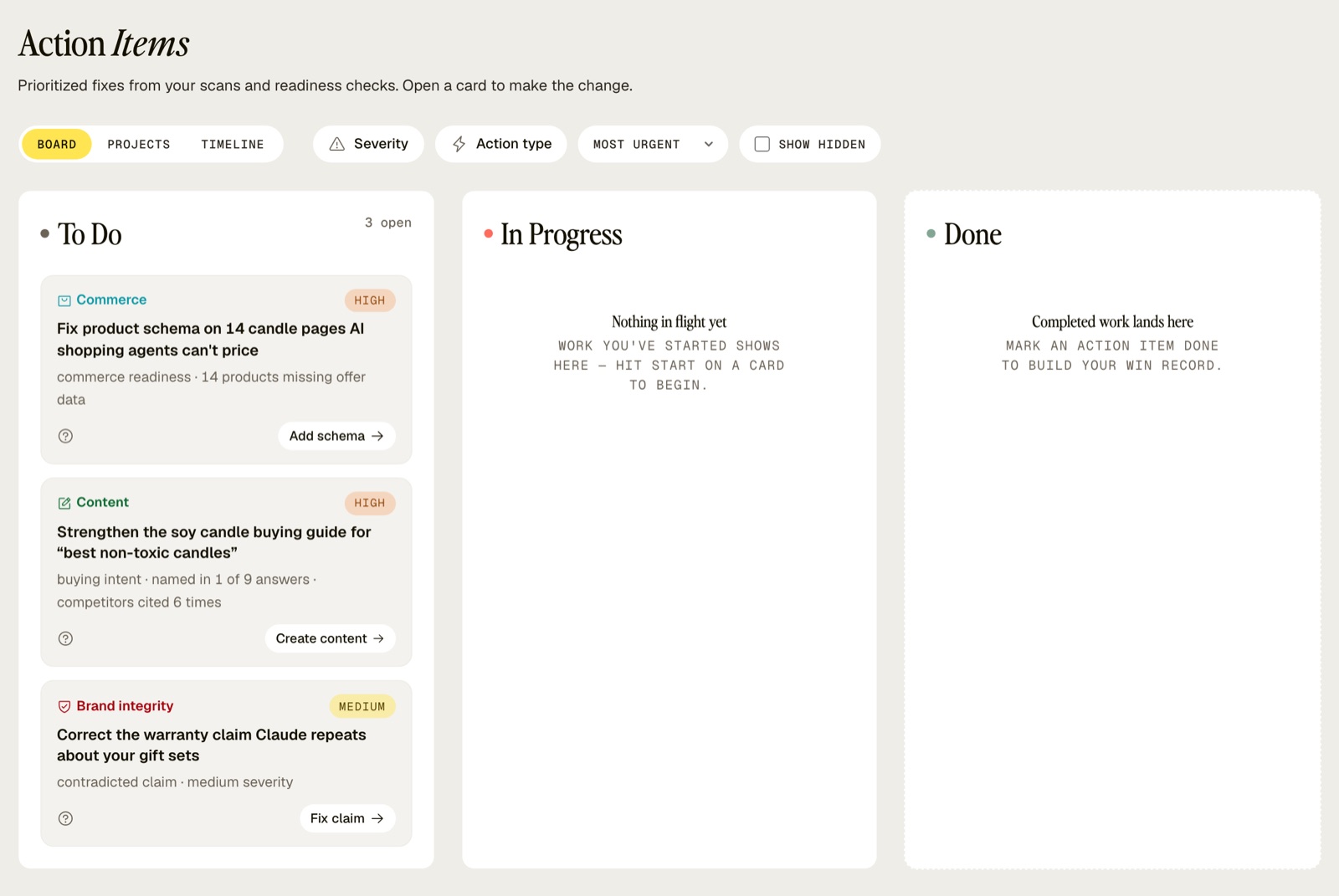
Stride is the opposite bet from Rankscale: fewer engines, more help with the work. Every scan finding lands as an action item, and content gaps come with a draft grounded in your own scan evidence. The AI traffic view reads GA4 and shows conversions and revenue for each AI source.
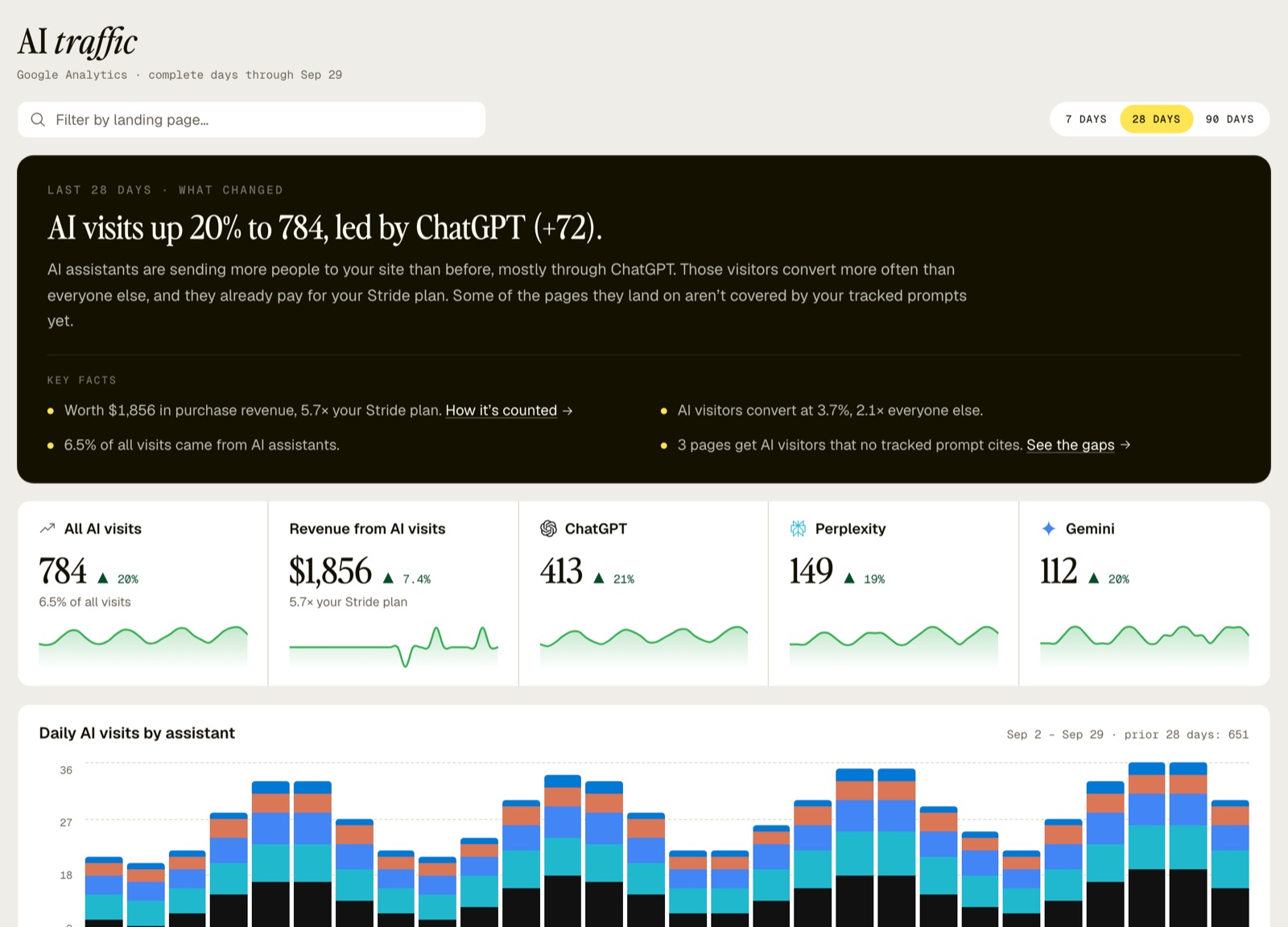
Stride's AI traffic view with revenue per AI source, shown with sample data.
Strengths: drafts on every plan (3 a week on Starter, 25 or 100 a month on Grow and Scale), agent-commerce protocol checks for ACP, UCP and x402, and Brand Integrity on Grow, which flags false claims AI makes about you.
Limits: Starter tracks ChatGPT only, 25 prompts weekly. The most Stride covers is ChatGPT, Gemini, Claude (beta) and Perplexity plus Google AI Overviews, with no Copilot, Grok or DeepSeek. There is no API or MCP.
Price: Starter $99, Grow $349 ($279 annual), Scale $1,297 ($1,037 annual). Agency is a $499 platform fee plus a discounted plan per client, with white-label included. Our Stride vs Rankscale page goes further.
6. Otterly
Best for: solo marketers who want to start tracking for the least money.
Otterly's Lite plan is $29 a month for 15 prompts on ChatGPT, Google AI Overviews, Perplexity and Copilot. Standard is $189 for 100 prompts, and every plan includes unlimited team members and daily tracking. Gemini, AI Mode and Claude are paid add-ons.
Strengths: the lowest entry price here and four engines from day one, Copilot among them.
Limits: 15 prompts is a sample, and adding Claude costs extra on every tier. It sits last because it covers the least of what Rankscale users came for: engine breadth.
Price: from $29 a month on Otterly's pricing page, as of October 2026.
How to switch without losing your baseline
- Export before you cancel. Rankscale lists CSV and Sheets export. Pull your search terms, competitors and the last few weeks of results.
- Rebuild the same prompt set. Load the exact terms into the new tool. Changing prompts and tools at once breaks every trend line.
- Match engines. Compare only the engines both tools track. A score across 17 engines won't line up with one across four.
- Run both for two to four weeks. AI answers vary run to run, so watch the direction of travel, not one scan.
- Reset the baseline on purpose. Record the week the new numbers settle as your starting point, and tell stakeholders why the figures moved.
Frequently asked questions
What is the closest alternative to Rankscale?
LLMrefs. Like Rankscale, it covers a long engine list on its base plan. It charges $79 a month (marked limited time) for 500 prompts across ten engines, with unlimited seats and projects and weekly report refreshes, and no credits to budget.
Which Rankscale alternative has the cheapest white-label reporting?
Geoptie. Its Professional plan is $990 a year, about $83 a month, and adds white-label reports, a REST API and an MCP server for 10 brands. Rankscale's white-label dashboards start on its $385 Growth plan.
How does Rankscale pricing work?
Rankscale sells monthly credits. As of October 2026, Pro is $99 for 1,200 credits, Pro+ is $229 for 3,000, Growth is $385 for 5,500 and Enterprise is $780 for 12,000. One AI engine query typically uses 0.25 credits, and unused credits roll over, up to twice your allocation on Pro and Pro+ and three times on Growth and Enterprise.
Where does Stride fit as a Rankscale alternative?
Stride fits a team that wants fixes drafted from its findings and AI visits tied to GA4 revenue, from $99 a month. It tracks far fewer engines than Rankscale, at most ChatGPT, Gemini, Claude (beta) and Perplexity plus Google AI Overviews, and has no API or MCP.
How do I switch from Rankscale without losing my trend lines?
Export your search terms and recent results to CSV or Sheets before you cancel, load the same terms into the new tool, and run both for two to four weeks. Compare only the engines both tools track, then record a new baseline on purpose.
Related comparisons
- Head to headStride vs Rankscale: Credits or Plans? (2026)
- Alternatives6 Otterly Alternatives for More Engines (2026)
- Alternatives6 Peec AI Alternatives for Action and Agencies (2026)
- Tool roundupsThe Best GEO Tools in 2026: 10 Compared
- Tool roundupsAI Traffic Analytics Tools That Show Revenue (2026)
- Tool roundupsAI Visibility Tools Under $100 a Month (2026)
How Stride does this: Action items
Product names are trademarks of their respective owners and are used here only to identify them. Stride is not affiliated with or endorsed by any company named on this page.