
Summary
Similarweb AI Search Intelligence is the better buy if you want to see the whole market: it estimates AI-referred traffic for your site and your competitors' sites, which tools reading only your own analytics can't show, from $99 a month billed annually. Stride fits teams that care more about their own numbers and the next fix: it reads your GA4 to tie each AI source to conversions and revenue, then turns scan findings into drafted content. Analysts and market researchers should start with Similarweb; small marketing teams and online stores that need work done should look at Stride.
Stride publishes this comparison and is one of the tools in it. Facts about Similarweb come from its own public pricing and product pages, checked on October 13, 2026, and are linked where they appear. Where another tool is the better choice, we say so.
How do Stride and Similarweb compare at a glance?
| Stride | Similarweb AI Search Intelligence | |
|---|---|---|
| Entry plan | Starter, $99/mo | AEO Intelligence, $99/mo billed annually or $129 billed monthly |
| Prompts at entry | 25, scanned weekly | 150 tracked prompts |
| AI engines tracked for visibility | ChatGPT on Starter; up to ChatGPT, Gemini, Claude (beta), Perplexity plus Google AI Overviews on Scale | Not stated on its pricing page |
| AI traffic, your site | GA4 sessions, conversions and revenue per AI source | AI Traffic module; ChatGPT, Perplexity, Gemini and AI Mode named |
| AI traffic, competitors' sites | No | Yes |
| Users at entry | 2 seats (3 on Grow, 5 on Scale) | 1 user |
| Data history at entry | No history cap in its plans | 3 months (6 on the $333 and $542 bundles) |
| Drafts content from findings | Yes, every plan | Not listed on its pricing page |
| Checks AI's facts about you | Brand Integrity (Grow and up) | Not listed; sentiment analysis included |
| SEO and market data | Search Console connection; no keyword or backlink data | Bundles from $333/mo add SEO, traffic and competitive data |
| API | None | Custom business packages or standalone, through sales |
| Free option | Free audit, no account; 7-day trial, card required | Free trial; length not stated |
Facts last verified October 13, 2026. Prices and plan limits change often; each vendor's pricing page is linked so you can check today's numbers.
Similarweb's figures come from its AI search pricing page and its AI Search Intelligence page. Stride's come from our pricing page.
Where does each tool's AI traffic data come from?
This is the core difference, and both answers are useful.
Similarweb sells web traffic intelligence. Its data page says it blends four sources: sites that connect their own analytics, a contributor network of devices running Similarweb tools, publicly available data, and data partners. From that it models traffic for almost any site.
Its AI Search Intelligence FAQ says the AI Traffic module measures traffic "to your and your competitors' sites" from the major AI assistants. It can even list the competitor pages that get AI visits.
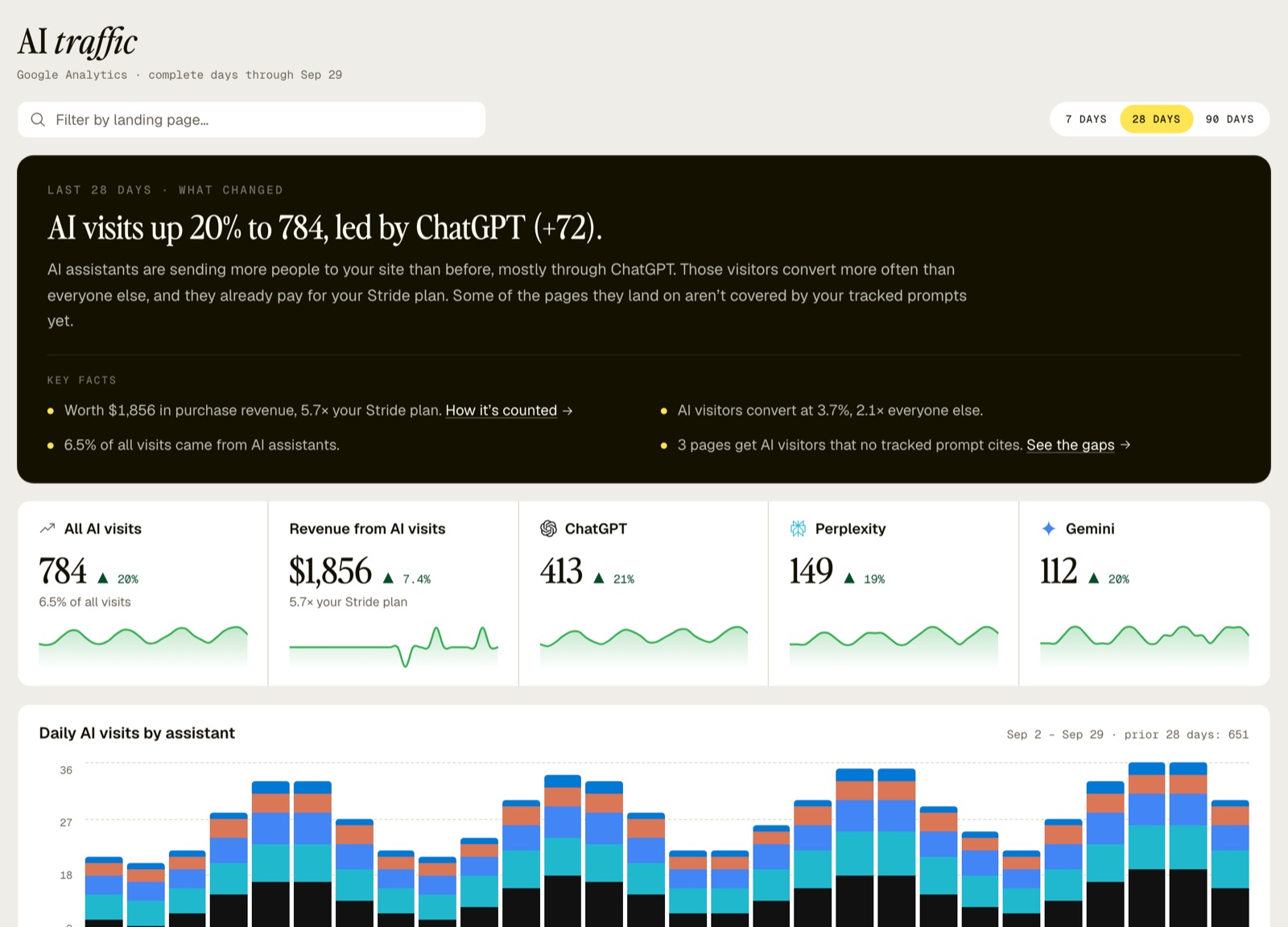
Stride reads your own GA4 property. You see sessions, conversions and revenue for each AI source, measured on your site rather than estimated. The trade is scope. Stride knows your numbers well and nobody else's.
So the question is which one you need to answer. "Is ChatGPT sending our rival more buyers than us?" is a Similarweb question. "What did ChatGPT visitors spend with us last month?" is a Stride question.
Which shows more about my competitors?
Similarweb, by a distance. Beyond AI traffic, its $333 bundle (or $399 billed monthly) adds website performance, traffic and engagement, audience demographics, marketing channels and competitor alerts. The $542 bundle adds ad intelligence. If your job is market research, Stride doesn't compete with that.
Stride's competitor view is narrower and lives inside AI answers. It tracks which competitors the engines name on your prompts, where they pull ahead, and whether the gap is closing. That tells you who AI recommends instead of you, not how much traffic they get for it.
What does each tool do after it measures?
Similarweb's AI plans give you visibility, prompt analysis with real user questions, citation analysis down to the exact link, and sentiment. Its AI SEO Agent builds an SEO strategy from Similarweb data. Its pricing page doesn't list drafting page content.
Stride spends its effort on the step after the report. Every scan finding becomes an action item, and for content gaps Stride drafts the page or the edit, grounded in the answers and sources from your own scans. Starter includes three drafts a week, Grow 25 a month, Scale 100 a month.
When you publish, later scans show whether the prompt moved, and GA4 shows whether the visits paid.
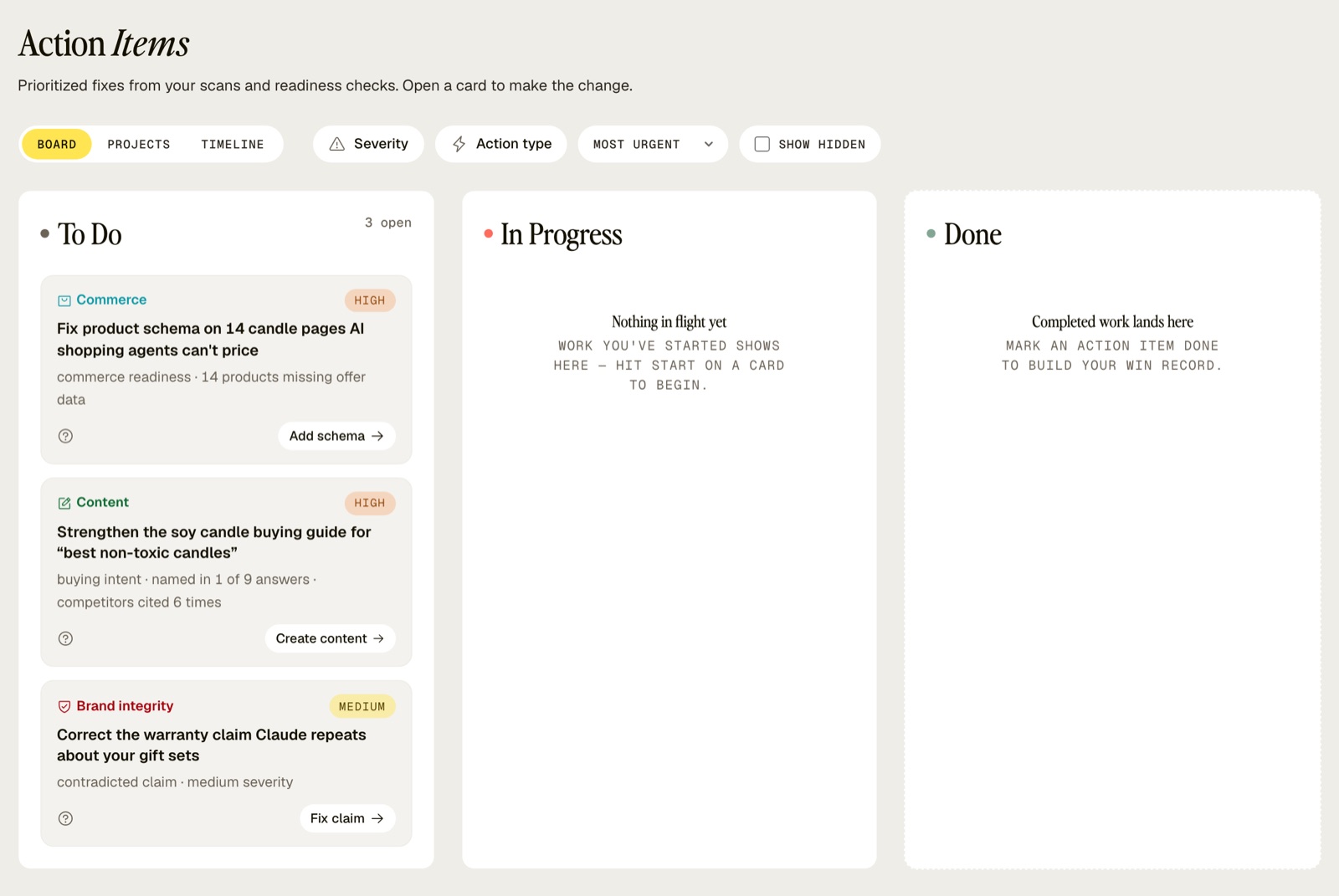
Stride's Action Items board, shown with sample data.
Which tracks more AI engines?
Hard to call from public pages. Similarweb's AI Search Intelligence page names ChatGPT, Perplexity, Gemini and AI Mode for traffic, and it sells an AI Overviews tracker. Its pricing page doesn't say which engines the 150 tracked prompts run on, so ask in your trial.
Stride's Starter plan scans ChatGPT only. Grow adds Gemini and Claude (still in beta), plus Google AI Overviews on the first 15 prompts you add. Scale adds Perplexity and full AI Overviews. Stride doesn't track Copilot, Google AI Mode, Grok, Meta AI or DeepSeek, though Copilot visits still show up in its GA4 traffic view.
What does a team like mine actually pay?
For one analyst who wants AI visibility plus traffic estimates, Similarweb AEO Intelligence at $99 a month billed annually is hard to beat: 150 prompts, sentiment, citations and AI traffic for you and rivals. Note the one user and three months of history.
For a small team that wants the work done, Stride Grow is $349 a month, or $279 billed annually: 50 prompts scanned three times a week on ChatGPT, Gemini and Claude (beta), three seats, Brand Integrity and 25 drafts a month. That's more money for less measurement, with production included. Price it against what a drafted, evidence-backed page costs you today.
When is Similarweb the better choice?
- You need competitors' AI traffic, not only your own. Stride can't show it, and prompt trackers that rely on your own analytics can't either.
- You want 150 prompts and AI traffic for $99 a month and can commit to a year.
- You already use Similarweb for market and channel research and want AI search in the same place.
- You don't have GA4 access to a site, for example when researching a market before entering it.
- You need an API and can buy through sales.
When is Stride the better choice?
- You want measured revenue, not estimates. Stride's AI traffic view reads your GA4 conversions and revenue for each AI source.
- You want findings turned into drafted content and action items, not another report to act on.
- You need to know whether AI says false things about you. Brand Integrity on Grow and up flags false or unsupported claims AI makes about you and routes each fix into an action item.
- You sell online and want your store checked against agent-commerce protocols such as ACP, UCP and x402.
- More than one person on the team needs a login at entry.
Two quick scenarios
A category manager at a consumer brand. They report monthly on whether AI assistants send more visits to the brand or its three biggest rivals, and nobody owns content production. Similarweb fits: competitor AI traffic is the number leadership asks for, and only a traffic-intelligence tool has it.
A three-person marketing team at a furniture store. They want to know which AI visitors buy, and they need someone to write the buying guides AI keeps citing from competitors. Stride fits: GA4 shows revenue per AI source, and each gap arrives as an action item with a draft.
For a wider view of measurement tools, see our AI visibility monitoring roundup, or how Stride compares with SEO suites in Stride vs Semrush.
Frequently asked questions
Is Similarweb or Stride cheaper?
Similarweb at entry. Its AEO Intelligence plan is $99 a month billed annually, or $129 billed monthly, for 150 tracked prompts, one user and AI traffic data. Stride Starter is $99 a month for 25 prompts tracked weekly on ChatGPT, two seats and three content drafts a week.
Can Similarweb show my competitors' AI traffic?
Yes, and that is its standout feature. Similarweb's AI Traffic module estimates visits from the major AI assistants to your site and to competitors' sites, and lists competitor landing pages that get AI traffic. Stride cannot see competitors' traffic. It reads your own GA4.
Where does each tool get its AI traffic numbers?
Similarweb builds its traffic data from several sources it describes on its own data page, including a contributor network, public data, partners and sites that connect their analytics. Stride reads your own GA4 property, so its numbers are your measured sessions, conversions and revenue from each AI source.
Does Similarweb or Stride write content for me?
Stride drafts content on every plan, from action items grounded in your own scan results. Similarweb's AI search pages list visibility, sentiment, citation and traffic analysis, plus an AI SEO agent that builds a strategy, but no page drafting.
Can I try both before paying?
Yes. Similarweb offers a free trial on its AI search plans; its pricing page does not state the length. Stride has a free audit that needs no account and a 7-day free trial on Starter, Grow and Scale, which requires a card.
Related comparisons
- Head to headStride vs Semrush: Specialist or Suite? (2026)
- Head to headStride vs Ahrefs Brand Radar: Which to Pick? (2026)
- Head to headStride vs Peec AI: Which Fits Your Team? (2026)
- Tool roundupsBest AI Visibility Monitoring Tools in 2026
- Tool roundupsAI Traffic Analytics Tools That Show Revenue (2026)
- Tool roundupsAI Visibility Tools Under $100 a Month (2026)
How Stride does this: AI traffic
Product names are trademarks of their respective owners and are used here only to identify them. Stride is not affiliated with or endorsed by any company named on this page.