
Summary
Nightwatch is the better buy for an SEO team that wants classic rank tracking and AI tracking in one bill: €99 a month tracks 500 keywords daily on Google, Bing, YouTube and three more search surfaces, plus 50 AI prompts on six AI platforms, with a content tool, site audit and MCP server included. Stride is narrower and goes further on the AI side, turning each finding into an action item with a drafted fix, reporting revenue per AI source from GA4, and checking whether shopping agents can read your store. SEO teams who live in rankings will usually prefer Nightwatch; marketing teams whose question is what AI says and what it earns should look at Stride.
Stride publishes this comparison and is one of the tools in it. Facts about Nightwatch come from its own public pricing and product pages, checked on October 13, 2026, and are linked where they appear. Where another tool is the better choice, we say so.
How do Stride and Nightwatch compare at a glance?
| Stride | Nightwatch | |
|---|---|---|
| Entry plan | Starter, $99/mo | Starter, €99/mo (€79 billed yearly) |
| Mid tier | Grow, $349/mo ($279 annually) | Professional, €199/mo (€159 billed yearly) |
| Higher tier | Scale, $1,297/mo ($1,037 annually) | Agency, €499/mo (€399 billed yearly) |
| AI prompts | 25, 50 or 300 by plan | 50, 150 or 500 by plan |
| AI scan frequency | Weekly on Starter, 3 times a week on Grow, top 100 daily on Scale | Daily, within 1,500, 4,500 or 15,000 AI answers a month |
| AI engines | ChatGPT on Starter; Gemini, Claude (beta) and AI Overviews on Grow; Perplexity on Scale | ChatGPT, Claude, Gemini, Perplexity, AI Mode, AI Overviews on every plan |
| Classic rank tracking | No | 500, 2,500 or 7,500 keywords daily on Google, YouTube, Bing, Yahoo, DuckDuckGo, Google Maps |
| Content | Drafts from scan findings: 3 a week on Starter, 25 or 100 a month on Grow and Scale | Content Studio: research, draft and score SEO content, every plan |
| Analytics | GA4 sessions, conversions and revenue per AI source | Google Analytics integration; Looker Studio from Professional |
| Seats | 2, 3 or 5 by plan; unlimited on Agency | Unlimited listed from Professional; the page also says every plan |
| API and MCP | None | MCP server every plan; API from Professional |
| White-label | Agency plan; $99/mo report add-on on other plans | Professional and up |
| Free option | Free audit, no account; 7-day trial, card required | 14-day trial, no card |
Facts last verified October 13, 2026. Prices and plan limits change often; each vendor's pricing page is linked so you can check today's numbers.
Nightwatch's figures come from its pricing page and AI tracking page. Stride's come from our pricing page. Nightwatch bills in euros; Stride bills in US dollars.
Is this a rank tracker or an AI visibility tool?
Nightwatch is a rank tracker with AI tracking included on every plan. Its pitch is that AI engines cite what ranks on Google, so it connects your AI citations to your keyword positions. Every plan includes daily rank tracking across 107,000+ locations, keyword research, a site audit, a search simulator and three years of SERP history. AI tracking rides on top at no extra charge.
Stride doesn't track classic rankings at all. It asks AI engines the questions your buyers ask, records who gets named and cited, and works on closing the gaps. It connects Google Search Console to find Google demand you aren't tracking as prompts, but it won't tell you that you slipped from position 4 to 7 for a keyword.
If your team already reports keyword rankings weekly, Nightwatch puts both views in one tool and one bill. If you're starting from AI answers, Stride is built around them.
Which tracks more AI engines?
Nightwatch. Every plan, Starter included, covers ChatGPT, Claude, Gemini, Perplexity, Google AI Mode and Google AI Overviews.
Stride's Starter tracks ChatGPT only. Grow adds Gemini, Claude (beta) and Google AI Overviews on the first 15 prompts you add, and Scale adds Perplexity and full AI Overviews. Stride doesn't track AI Mode, Copilot, Grok, Meta AI or DeepSeek.
One number to check on Nightwatch: the monthly AI answer allowance. Starter includes 50 prompts and 1,500 AI answers a month, and its plan details say prompts are tracked daily. By our arithmetic, fifty prompts on six platforms every day would use far more than 1,500 answers, so the allowance, not the prompt count, is what sets how much AI data you get. The Nightwatch help center is the place to confirm how it's spent.
What does each tool do after it measures?
Nightwatch gives you tools to act. Content Studio researches, drafts and scores SEO content against page one, Citation Intelligence maps which URLs AI answers cite, and an SEO Agent runs tasks on a monthly credit allowance. The emphasis is on ranking content, on the theory that rankings feed AI citations.
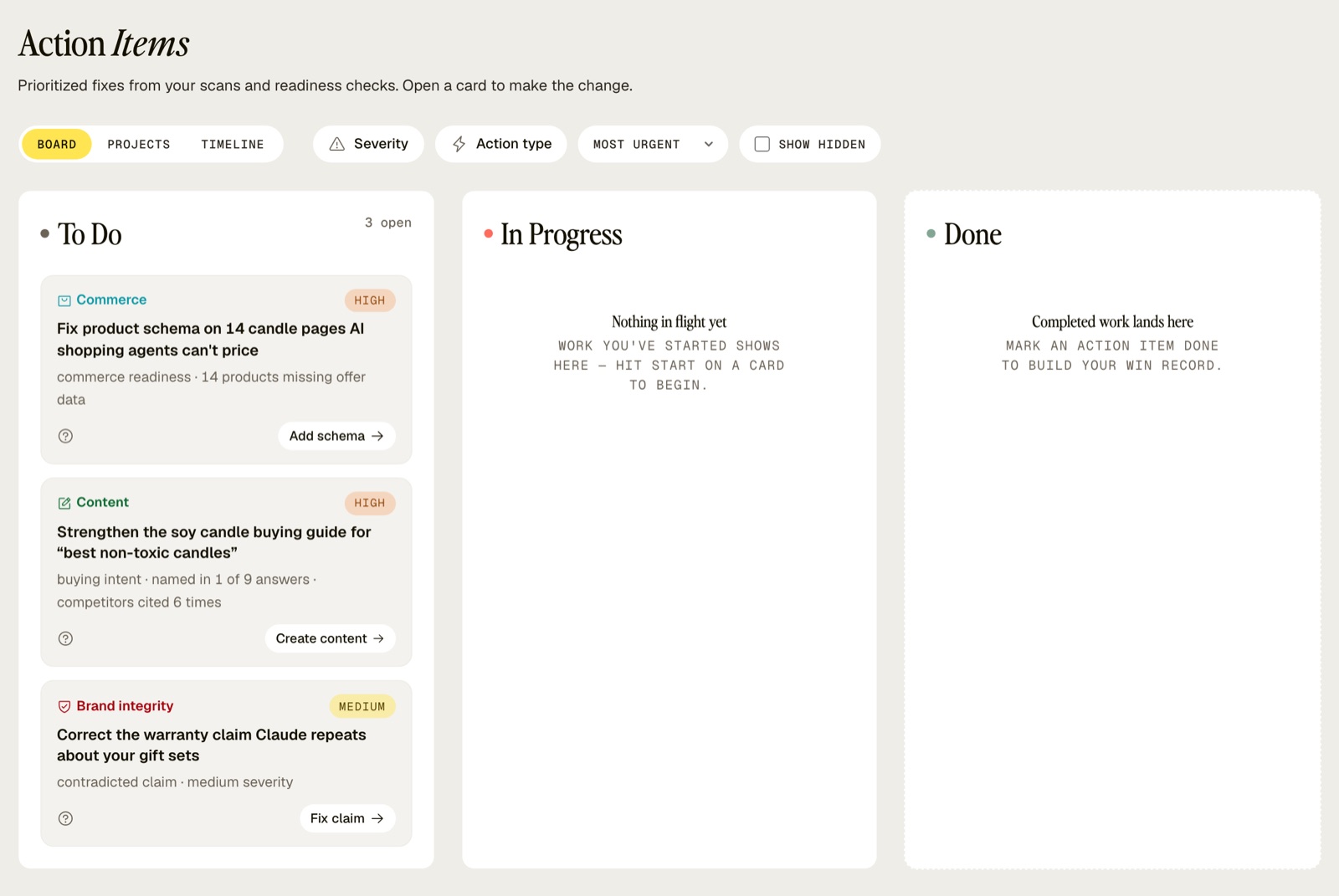
Stride builds the work list from AI answers directly. Every scan finding becomes an action item on one board: a missing comparison page, a schema gap, a claim AI gets wrong.
Where the fix is content, Stride drafts it from the answers and sources in your own scans. When you publish, later scans show whether the prompt moved. The action items feature shows how it works.
Can either show what AI visitors are worth?
Stride's AI traffic view connects Google Analytics 4 on every plan and reports sessions, conversions and revenue for each AI source. Nightwatch lists a Google Analytics integration on every plan and Looker Studio from Professional; its pricing page doesn't describe revenue reporting per AI source.
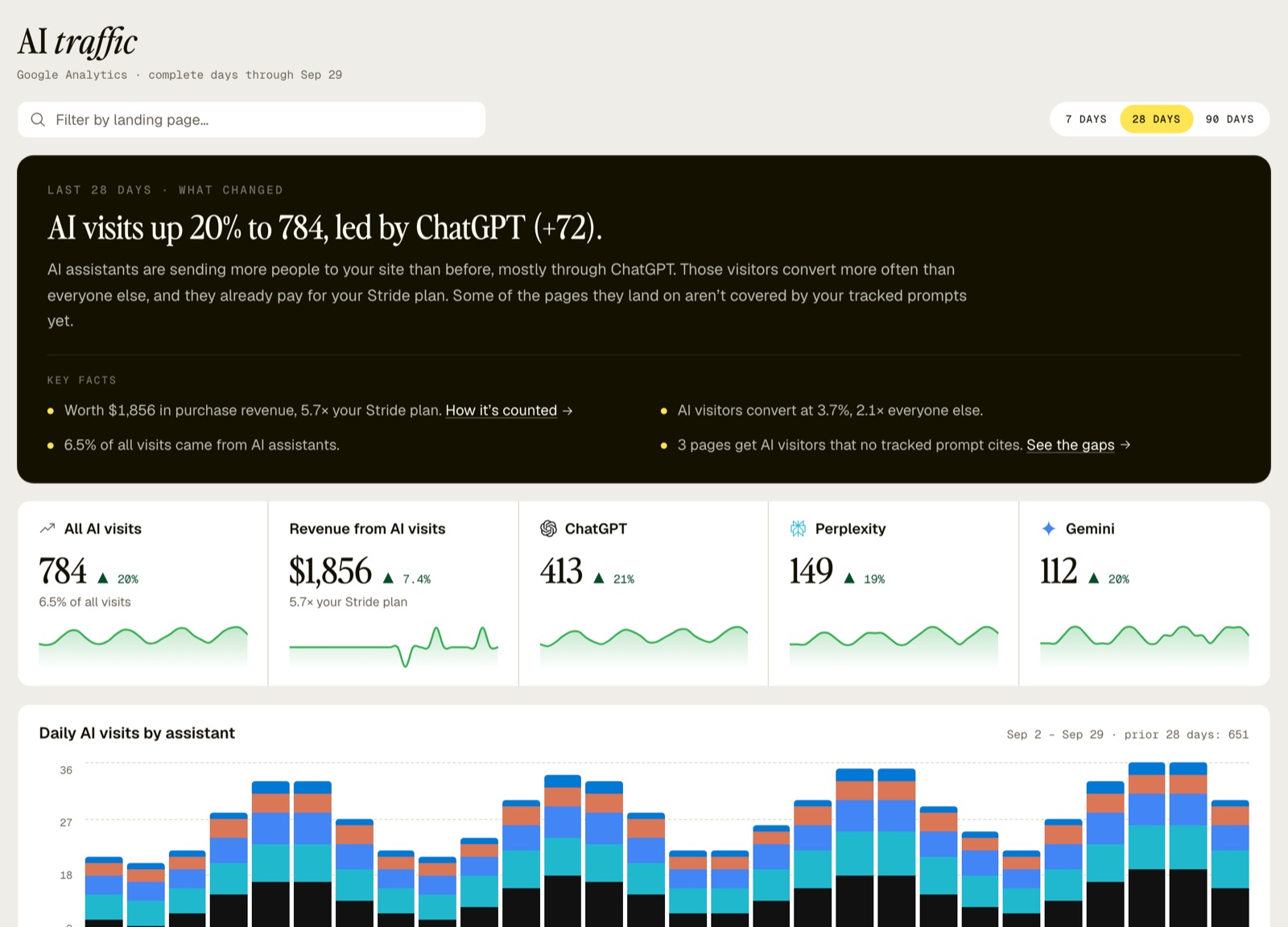
Stride's AI traffic view, shown with sample data.
Which is better for agencies?
Nightwatch's Agency plan is built for volume. It covers 100 websites, 7,500 keywords and 500 AI prompts for €499 a month, with white-label reports, Looker Studio and an account manager. Its pricing page also links to a partner program.
Stride Agency is a $499 monthly platform fee plus a discounted Starter, Grow or Scale plan per client, on one invoice. Team seats are unlimited, clients get their own logins, branding carries across the dashboard and reports, and a client's site and history can move into their own account if they leave. Agencies that already sell rank tracking will find more reuse in Nightwatch; agencies building a separate GEO retainer may prefer Stride's per-client model.
When is Nightwatch the better choice?
- You want classic rank tracking and AI tracking in one tool and one bill.
- You need six AI platforms, including Google AI Mode, from the entry plan.
- You track rankings in many locations, or on YouTube, Bing and Google Maps.
- You want an MCP server, site audits and keyword research included.
- You want a 14-day trial with no card.
When is Stride the better choice?
- Your question is what AI says about you, not where you rank on Google.
- You want each fix drafted from AI scan evidence and tracked to a result.
- You need revenue per AI source from GA4.
- You sell online and want your store checked against agent-commerce protocols such as ACP, UCP and x402.
- You want to know when AI states something false about your brand, which Brand Integrity flags on Grow and up.
Stride's limits: no keyword rank tracking, no API or MCP, no AI Mode, and Starter scans weekly on one engine.
Two quick scenarios
An in-house SEO lead at a travel site. They report rankings for 2,000 keywords across ten markets and leadership now asks about ChatGPT too. Nightwatch fits: Professional covers the keywords, adds 150 AI prompts on six platforms and keeps one reporting stack.
A founder of a direct-to-consumer coffee brand. Rankings aren't the worry; ChatGPT recommending three competitors is. Stride fits: scans show who AI names instead, action items arrive with drafts, and GA4 shows what AI visitors spend.
Frequently asked questions
How much does Nightwatch cost compared with Stride?
As of October 2026, Nightwatch prices in euros. Starter is €99 a month, or €79 a month billed yearly, Professional €199 or €159, and Agency €499 or €399, with AI tracking included on every plan. Stride starts at $99 a month, with Grow at $349 ($279 billed annually) and Scale at $1,297 ($1,037 billed annually).
Which AI engines does Nightwatch track?
Every Nightwatch plan tracks ChatGPT, Claude, Gemini, Perplexity, Google AI Mode and Google AI Overviews. Stride tracks up to four AI engines, ChatGPT, Gemini, Claude (beta) and Perplexity, plus Google AI Overviews, depending on plan, and does not track AI Mode.
Does Stride track Google keyword rankings like Nightwatch?
No. Stride tracks AI answers, not classic search rankings. Nightwatch tracks keyword positions daily on Google, YouTube, Bing, Yahoo, DuckDuckGo and Google Maps alongside its AI tracking. Stride connects Google Search Console to surface Google demand you are not yet tracking as prompts.
Can Nightwatch or Stride show revenue from AI search?
Stride reports sessions, conversions and revenue for each AI source from Google Analytics 4 on every plan. Nightwatch lists a Google Analytics integration on every plan; its pricing page does not describe revenue reporting per AI source.
Can I try both before paying?
Yes. Nightwatch offers a 14-day trial on every plan with no card required to start. Stride has a free audit that needs no account and a 7-day free trial on Starter, Grow and Scale, which requires a card.
Related comparisons
- Head to headStride vs SE Ranking: Which Fits Your Team? (2026)
- Head to headStride vs Semrush: Specialist or Suite? (2026)
- Head to headStride vs Ahrefs Brand Radar: Which to Pick? (2026)
- Head to headStride vs Enterprise SEO Suites: Which Fits? (2026)
- AlternativesAI Visibility Tools for SEO Teams: 6 Compared (2026)
- Tool roundupsGEO Tools for Agencies: White-Label Options Compared
How Stride does this: Action items
Product names are trademarks of their respective owners and are used here only to identify them. Stride is not affiliated with or endorsed by any company named on this page.